
Key Findings
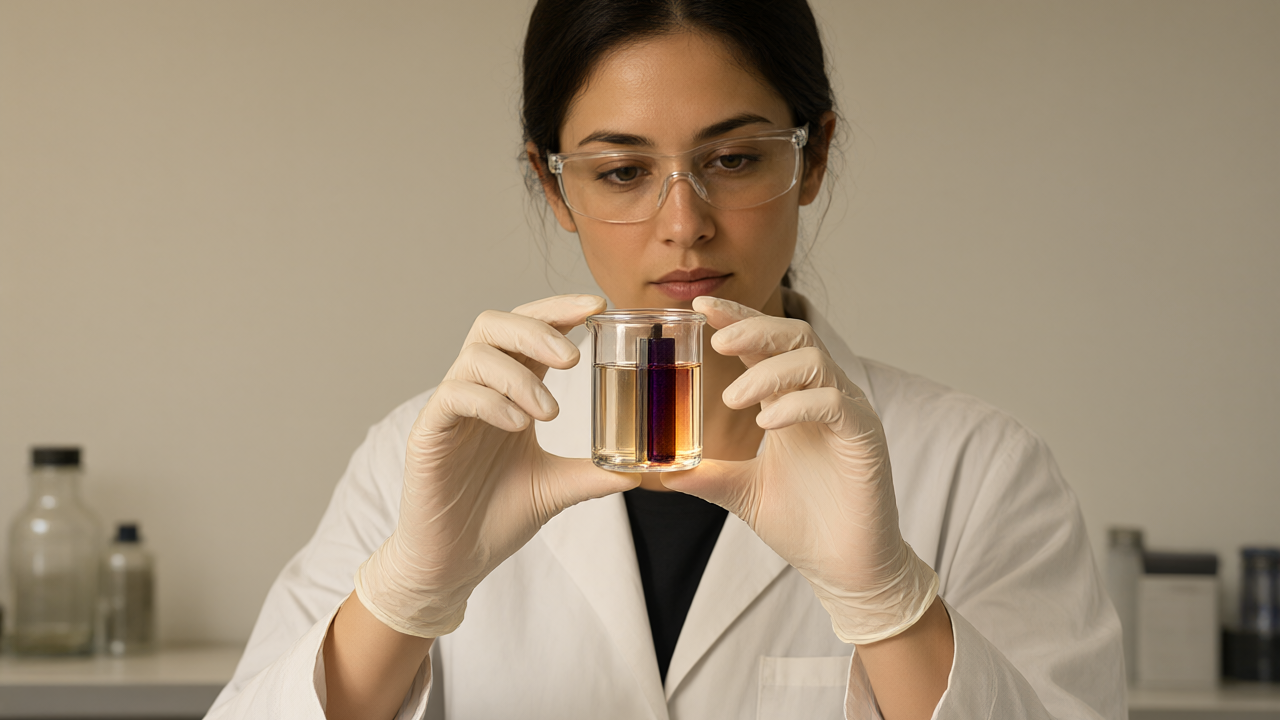
A research team led by University College London (UCL) has developed a design methodology to enable the reversible 4-electron oxidation-reduction reaction of iodine in aqueous electrolytes without using chloride or bromide salts. Published in Nature on November 11, 2026, the study demonstrates that this approach allows for a theoretical capacity of 422 mAh g⁻¹, double the 211 mAh g⁻¹ provided by conventional 2-electron reactions. In experimental Zn-I₂ batteries, the system maintained 96% capacity after 1,000 cycles at a current density of 1 A g⁻¹ and 94% after 2,000 cycles at 2 A g⁻¹.
Technical Details
The “KA–PA–Nuc” framework utilizes three components to stabilize the highly reactive iodine cation (I⁺) and prevent hydrolysis:
- Polar Anions (PA): Such as acetate ions (CH₃COO⁻), which concentrate at the electrode interface to create a local environment with fewer water molecules.
- Kosmotropic Anions (KA): Such as sulfate ions (SO₄²⁻), which weaken hydrogen bonds between water and nucleophiles, facilitating the stabilization of I⁺.
- Nucleophiles (Nuc): Including urea, acetamide, nicotinamide, or pyridine, which form a linear Nuc-I⁺-Nuc structure via halogen bonding.
The team verified this mechanism using in situ ATR-IR, NMR spectroscopy, and molecular dynamics simulations. They also demonstrated the framework’s versatility by applying it to Al-I₂ batteries using an Al-Zn alloy anode.
Background and Context
Traditional 4-electron iodine batteries required high concentrations of halide salts to form interhalogen complexes (e.g., ICl₂), which caused high costs and material corrosion. While previous studies in 2021 and 2024 explored 4-electron reactions using chlorides or specific organic combinations, the UCL approach focuses on a systematic framework to control the electrode interface and molecular stability.
Significance and Outlook
The research includes a prototype 1.1 Ah pouch cell with a 10×15 cm electrode, though the specific mechanical constraint pressure used during testing was not quantified. Future challenges include suppressing irreversible iodine loss at high loading levels and validating performance under actual operational conditions for large-scale energy storage.
Source: https://xenospectrum.com/ucl-halogen-free-four-electron-aqueous-iodine-battery/
Get our weekly technology intelligence — free
Receive an infographic that lets you judge at a glance whether each field’s analysis report is worth reading.
Subscribe Free — Weekly Tech Intelligence
By subscribing, you’ll receive Troy-Technical’s weekly technology intelligence newsletter.
- Your email and selected fields are used only to deliver the newsletter.
- We never share your information with third parties.
- You can unsubscribe anytime via the link in each email.
See our Privacy Policy for details.
Takes about a minute · Unsubscribe anytime