Key Findings
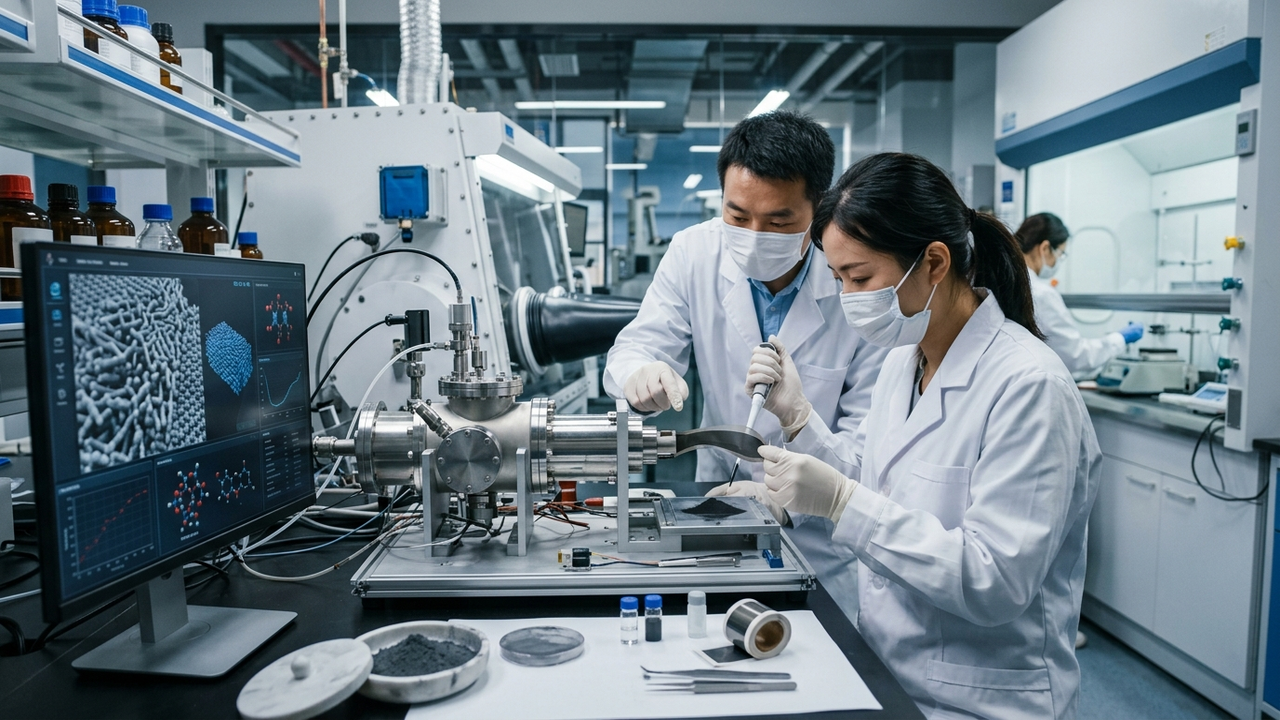
A Chinese research team has developed a novel sulfur-affinic ZrB2/MXene composite material, which they successfully applied as a sulfur host in lithium-sulfur (Li-S) battery cathodes to dramatically enhance performance. The S/ZrB2/MXene electrode achieved an exceptionally high initial discharge specific capacity of 1395.9 mA·h/g at a rate of 0.1 C. Remarkably, it retained 512.3 mA·h/g after 500 cycles, exhibiting an outstandingly low capacity decay rate of just 0.072% per cycle.
Technical / Clinical Details
The developed ZrB2/MXene composite material is engineered to effectively suppress the polysulfide shuttle effect, a major challenge in Li-S batteries. MXene, with its high electrical conductivity and large surface area, enhances sulfur utilization and facilitates charge transfer. Simultaneously, ZrB2 (zirconium diboride) contributes to robust chemical adsorption of sulfur and its reaction intermediates, preventing soluble polysulfides from dissolving into the electrolyte. This dual action stabilizes the active material in the electrode, leading to long-term cycle stability and improved Coulombic efficiency. The unique structure and synergistic effects of this composite are key to achieving both high energy density and extended lifespan.
Background & Context
Lithium-sulfur batteries hold immense promise for applications in electric vehicles and large-scale stationary energy storage systems, owing to their theoretically very high energy density of 2500 Wh/kg. However, commercialization has been hampered by significant challenges, including the low electrical conductivity of sulfur, volume changes during charge/discharge cycles, and most critically, rapid capacity degradation due to the polysulfide shuttle effect. Developing high-performance sulfur host materials that can mitigate these issues has been a decisive factor for breakthroughs in Li-S battery technology. This research represents a crucial advancement towards overcoming these challenges, accelerating the practical implementation of Li-S batteries.
Strategic Significance & Outlook
The success of the ZrB2/MXene composite marks a significant step towards the practical commercialization of lithium-sulfur batteries. Future efforts will focus on further improving the scalability and cost-efficiency of the material synthesis process, as well as validating performance in practical battery cell configurations. If commercialized, this technology could revolutionize clean energy technologies by significantly extending the range of electric vehicles and enhancing the efficiency of renewable energy storage. Researchers and investors are keenly anticipating the transformative impact this type of breakthrough could have on the Li-S battery market.
Source: https://www.gncl.cn/EN/10.3969/j.issn.1001-9731.2026.08.012
Get our weekly technology intelligence — free
Receive an infographic that lets you judge at a glance whether each field’s analysis report is worth reading.
Subscribe Free — Weekly Tech Intelligence
By subscribing, you’ll receive Troy-Technical’s weekly technology intelligence newsletter.
- Your email and selected fields are used only to deliver the newsletter.
- We never share your information with third parties.
- You can unsubscribe anytime via the link in each email.
See our Privacy Policy for details.
Takes about a minute · Unsubscribe anytime



Comments