
Background and Industry Context
China’s commercial space sector has witnessed explosive growth in recent years, propelled by substantial government backing and a surge in private investment. The success of LandSpace’s Zhuque-3 marks a pivotal moment, signaling a significant transition from predominantly state-led to increasingly commercially driven space endeavors within the nation. Analogous to how SpaceX’s innovations reshaped the global space transport landscape, LandSpace’s validation of reusable rocket technology is instrumental for China to cement its standing as a formidable contender in the international space arena. The broader ecosystem is vibrant, with other Chinese commercial space firms like CAS Space and Galactic Energy also achieving orbital launch successes and actively pursuing initial public offerings (IPOs), underscoring a rapidly expanding and competitive market.
Key Achievement
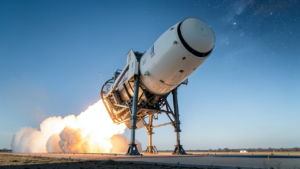
On August 19, 2026, LandSpace Technology Co., Ltd., a leading Chinese commercial space firm, announced the successful land-based recovery of the first stage of its methane-fueled reusable rocket, the Zhuque-3 (Vermilion Bird-3), immediately following its maiden launch. This landmark achievement represents China’s inaugural successful first-stage rocket recovery employing landing legs, placing LandSpace in an elite global cohort alongside SpaceX and Blue Origin as only the third entity to demonstrate mastery of methane-fueled reusable rocket landing technology. This critical breakthrough not only signifies a major leap for China’s commercial space sector but also promises dramatic reductions in space transportation costs and significantly enhanced access to space globally.
Technical Details and Innovation
The Zhuque-3 is engineered as a state-of-the-art reusable launch vehicle, propelled by a liquid methane and liquid oxygen propulsion system. It employs Vertical Takeoff and Vertical Landing (VTVL) technology, akin to the systems demonstrated by SpaceX’s Starship and Blue Origin’s New Glenn. Methane, or ‘methalox,’ fuel is particularly advantageous for reusable rockets due to its high thrust efficiency, superior cooling properties, and the minimal carbon residue it leaves behind, which significantly streamlines engine refurbishment for reuse. LandSpace’s successful landing underscores its mastery of sophisticated guidance and control systems crucial for precise first-stage descent and controlled soft landings, alongside a robust and reliable landing leg system. This technological prowess is central to the objective of drastically reducing manufacturing and operational costs through the recovery and reuse of expensive rocket components, thereby making space access substantially more affordable.
Future Implications and Global Competition
The successful first-stage landing of the Zhuque-3 is set to dramatically bolster China’s space transportation capabilities, with the potential to significantly drive down the cost of satellite launches and future resupply missions to orbiting space stations. This achievement is expected to accelerate the deployment of large low-Earth orbit (LEO) satellite constellations and advance the commercialization of ambitious lunar and Mars exploration initiatives. LandSpace is now poised to incrementally increase the frequency and reliability of its reusable rocket flights, thereby intensifying global competition with established players such as SpaceX and Blue Origin. Ultimately, this technological leap holds the promise of ‘democratizing’ access to space, ushering in a new era where a broader spectrum of nations and commercial entities can actively participate in space utilization and exploration.
Source: https://www.stdaily.com/web/English/2026-09/05/content_575075.html
Get our weekly technology intelligence — free
Receive an infographic that lets you judge at a glance whether each field’s analysis report is worth reading.
Subscribe Free — Weekly Tech Intelligence
By subscribing, you’ll receive Troy-Technical’s weekly technology intelligence newsletter.
- Your email and selected fields are used only to deliver the newsletter.
- We never share your information with third parties.
- You can unsubscribe anytime via the link in each email.
See our Privacy Policy for details.
Takes about a minute · Unsubscribe anytime








Comments