
Key Findings: NASA Invests in In-Orbit Robotic Welding to Advance Large Structure Assembly in Space
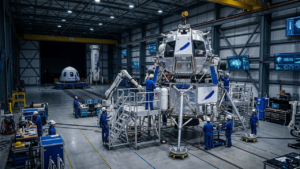
NASA has invested in AnalySwift LLC, a startup pioneering in-orbit robotic welding technology for thermoplastic composites. This breakthrough capability will enable the autonomous assembly of large truss structures, such as communications antennas, expansive solar arrays, high-resolution telescope mirrors, and efficient heat radiators, directly in the vacuum of space. By overcoming the size constraints of launch fairings, this technology is set to significantly enhance the construction of vast space infrastructure, critical for sustaining a human presence beyond Earth.
Technical Details: Robotic Welding of Thermoplastic Composites and its Advantages
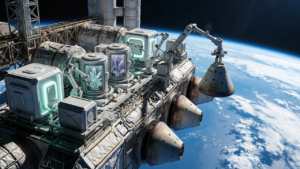
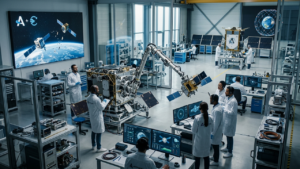
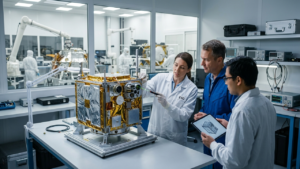
The robotic welding technology developed by AnalySwift LLC leverages the unique properties of thermoplastic composites. These materials soften when heated and solidify upon cooling, making them ideal for welding components together in space. This process creates stronger, more reliable joints compared to traditional adhesives or mechanical fasteners, while also reducing the overall mass of the structure. Autonomous robotic welding enables precise assembly operations without human intervention, thereby mitigating the risks and costs associated with astronaut extravehicular activities (EVAs). The introduction of this technology is expected to revolutionize the size and complexity of components that can be launched and assembled in a single mission, accelerating the construction of large-scale structures in space, such as modules for lunar-orbiting gateways or Mars transit vehicles.
Background & Industry Context: The Imperative for In-Space Infrastructure and Sustainability
As human exploration extends from low-Earth orbit (LEO) to the Moon and Mars, the demand for large-scale in-space infrastructure is growing. Traditionally, spacecraft and structures have been limited by the size and weight constraints of launch vehicle payload fairings, often requiring complex deployment mechanisms and numerous components. Autonomous in-orbit manufacturing and assembly capabilities are key to overcoming these limitations and efficiently constructing larger, more capable space systems. NASA’s investment aligns with its long-term vision under the Artemis program to establish a sustainable presence on the Moon and build necessary infrastructure for future crewed missions to Mars. Furthermore, enhancing the reusability of spacecraft components will boost the overall sustainability of space development.
Future Outlook: New Frontiers in Space Exploration and Commercial Opportunities
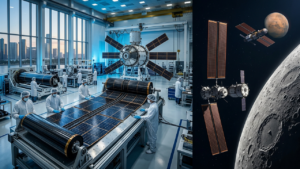
The maturation of in-orbit robotic welding technology will unlock new frontiers in space exploration. It is expected to have diverse applications, including the construction of ultra-large antennas for communication satellite constellations, the assembly of mirror arrays for next-generation space telescopes, and the deployment of massive solar arrays for space-based solar power satellites. This technology will accelerate ‘in-space manufacturing,’ fostering a new industry that utilizes space as a ‘factory,’ and creating immeasurable opportunities for space-related commercial activities. The investment in AnalySwift LLC is not merely about technological development; it is a strategic step towards a future where humanity’s activities in space are fundamentally transformed, enabling more ambitious exploration and habitation.
Source: https://www.assemblymag.com/articles/100389-nasa-invests-in-robotic-in-space-welding-technology
Get our weekly technology intelligence — free
Receive an infographic that lets you judge at a glance whether each field’s analysis report is worth reading.
Subscribe Free — Weekly Tech Intelligence
By subscribing, you’ll receive Troy-Technical’s weekly technology intelligence newsletter.
- Your email and selected fields are used only to deliver the newsletter.
- We never share your information with third parties.
- You can unsubscribe anytime via the link in each email.
See our Privacy Policy for details.
Takes about a minute · Unsubscribe anytime


Comments