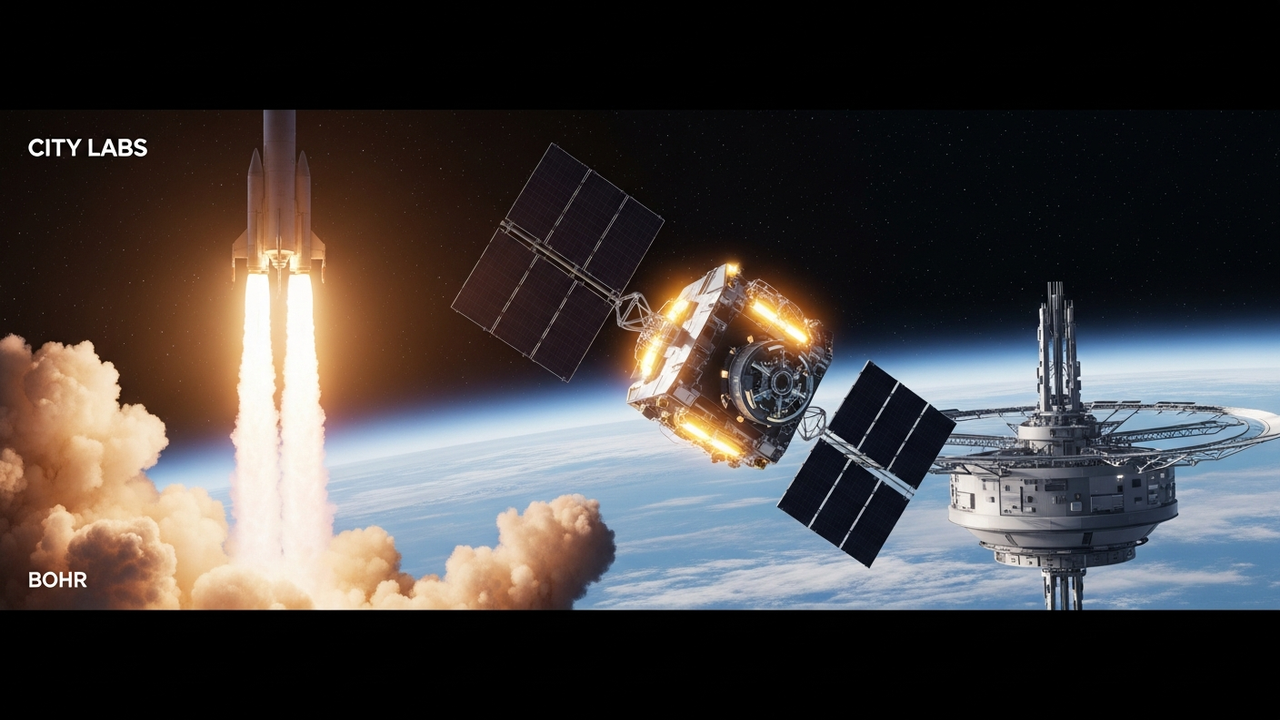
Key Findings
City Labs, a Florida-based startup, has successfully launched its first commercial satellite, the ‘BOHR satellite,’ powered by the company’s proprietary tritium-based ‘nuclear battery.’ This groundbreaking achievement signals the dawn of a new era for long-duration, stable power supply in extreme environments where solar power is unavailable, pushing the boundaries of autonomous space operations.
Technical Details
The core of the BOHR satellite’s nuclear battery is its betavoltaic technology. This innovative approach harnesses the low-energy beta particles (electrons) emitted during the radioactive decay of tritium, an isotope of hydrogen, by directly converting them into electrical energy through semiconductor materials. This process is inherently stable, less susceptible to external radiation interference, and operates independently of solar illumination. This makes it an ideal power source for challenging environments such as the Moon’s permanently shadowed regions and deep-space exploration missions, where solar energy is highly constrained. City Labs’ battery is remarkably compact, requires no recharging like chemical batteries, and offers an exceptionally long operational lifespan of several decades, governed by tritium’s half-life of approximately 12.3 years. This dramatically enhances the reliability and autonomy of long-duration space missions.
Background & Industry Context
Power supply has consistently been one of the greatest challenges in space exploration. Traditional combinations of solar panels and chemical batteries proved insufficient for environments like the Moon’s permanently shadowed regions, characterized by extreme cold and complete lack of sunlight, or for extended deep-space missions. Historically, radioisotope thermoelectric generators (RTGs) using plutonium-238 have been employed for deep-space probes, but they face challenges in manufacturing costs, supply chain, and radioactive material management. Tritium nuclear batteries, while lower in power output than RTGs, are significantly smaller, safer, and offer potential application across a wider range of platforms, including small satellites, lunar rovers, and sensor networks. City Labs’ recent success represents a major commercialization milestone in this critical field.
Strategic Significance & Outlook
The in-orbit performance validation of the BOHR satellite will serve as a crucial testbed for the maturity of tritium nuclear battery technology. Based on data gathered from this mission, City Labs will likely further optimize its battery design and performance, targeting adoption in future lunar landers, exploration rovers, and as auxiliary power for space stations. If established, this technology is expected to accelerate the realization of diverse space missions, including resource exploration in lunar polar regions, astrophysical research, and extending the lifespan of Earth observation satellites, contributing to the overall advancement of the space industry. Crucially, small, long-lasting autonomous power sources will be indispensable components for building next-generation space infrastructure.
Source: https://thenextweb.com/news/city-labs-bohr-first-commercial-nuclear-power-space
Get our weekly technology intelligence — free
Receive an infographic that lets you judge at a glance whether each field’s analysis report is worth reading.
Subscribe Free — Weekly Tech Intelligence
By subscribing, you’ll receive Troy-Technical’s weekly technology intelligence newsletter.
- Your email and selected fields are used only to deliver the newsletter.
- We never share your information with third parties.
- You can unsubscribe anytime via the link in each email.
See our Privacy Policy for details.
Takes about a minute · Unsubscribe anytime







Comments