Key Findings
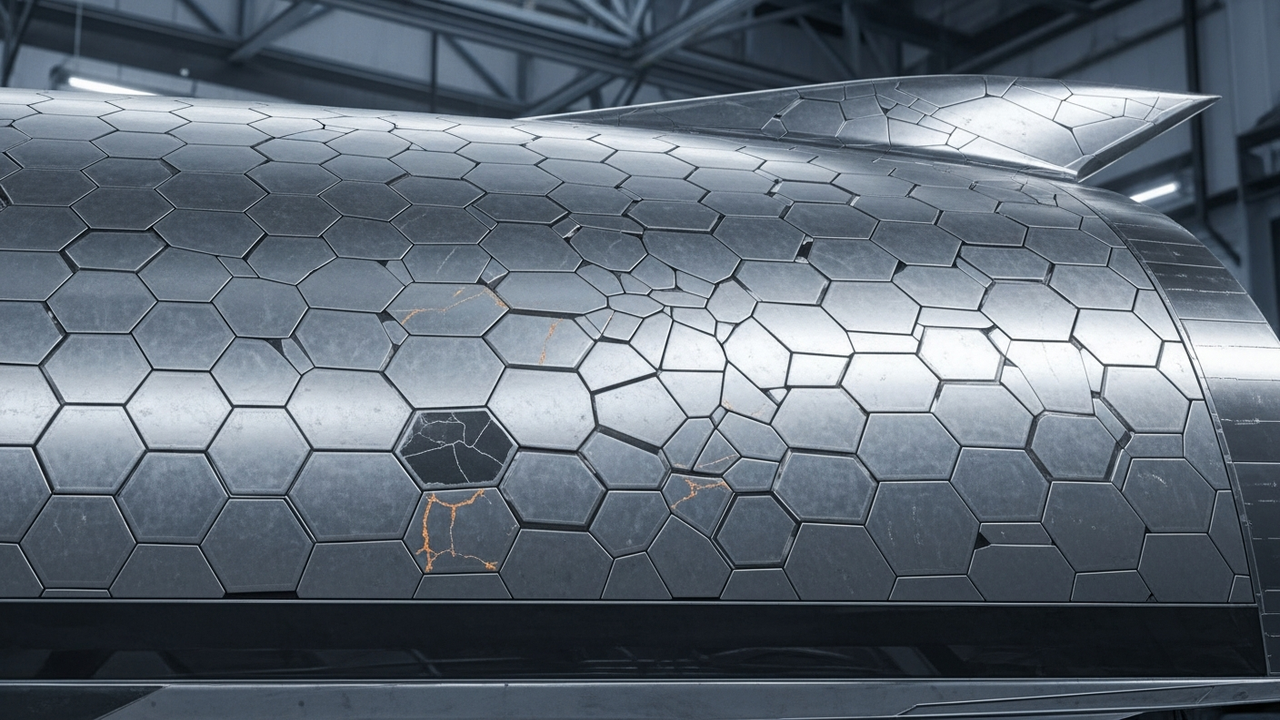
The Thermal Protection System (TPS) of the SpaceX Starship, which incorporates approximately 18,000 hexagonal tiles, has been highlighted as an innovative engineering solution. This design is crucial for efficiently dispersing the extreme thermal stresses and mechanical loads encountered during atmospheric re-entry, thereby maintaining the vehicle’s structural integrity and substantially reducing the risk of cracking. This design choice is fundamental to maximizing the reusability and operational efficiency of the Starship.
Technical Details
The Starship’s TPS is covered with specialized ceramic composite tiles designed to shield the vehicle from the high-temperature plasma generated during re-entry. The hexagonal shape of these tiles offers several significant engineering advantages. First, hexagons are an optimal geometric shape for covering not only flat surfaces but also complex curved surfaces, such as those of the Starship, with minimal gaps and high efficiency. This minimizes thermal intrusion pathways and maximizes tile packing density. Second, the hexagonal arrangement allows for uniform distribution of mechanical loads and thermal stresses among the tiles. This is critically important for preventing stress concentrations caused by rapid temperature changes and aerodynamic pressures during re-entry, thereby mitigating the risk of tile damage or detachment. Third, hexagons facilitate stable structural formation between adjacent tiles while allowing individual tiles to move independently, making them more accommodating to stress from thermal expansion and contraction. Finally, the modular nature of hexagonal tiles means that if damaged, they can be quickly replaced individually, significantly reducing maintenance time and costs associated with Starship’s reusability objectives.
Background & Industry Context
Reusable space transport systems are key to drastically reducing the cost of accessing space and enabling sustainable space exploration and development. SpaceX’s Starship aims to be the largest fully reusable rocket ever built, and its success hinges on its thermal protection system. The Space Shuttle, a predecessor in reusability, incurred immense time and cost for its thermal shield tile maintenance, which proved a significant barrier to its operational reusability. The Starship’s hexagonal tile design represents a novel approach to this historical challenge, streamlining the manufacturing, installation, inspection, and replacement processes, potentially shaping the future of space transportation.
Strategic Significance & Outlook
The performance of the Starship’s TPS will be continuously evaluated through upcoming orbital test flights. If the hexagonal tile design performs as expected, it could establish a new standard for reusable spacecraft design. The success of this technology would be a pivotal step towards realizing SpaceX’s ambitious vision of routine space travel, human settlement on the Moon and Mars, and the construction of large-scale orbital infrastructure. Furthermore, the insights gained from this material engineering and structural design could find applications in other aerospace domains and sectors requiring extreme environment durability.
Source: https://www.youtube.com/watch?v=iU8MfTQ3QvM
Get our weekly technology intelligence — free
Receive an infographic that lets you judge at a glance whether each field’s analysis report is worth reading.
Subscribe Free — Weekly Tech Intelligence
By subscribing, you’ll receive Troy-Technical’s weekly technology intelligence newsletter.
- Your email and selected fields are used only to deliver the newsletter.
- We never share your information with third parties.
- You can unsubscribe anytime via the link in each email.
See our Privacy Policy for details.
Takes about a minute · Unsubscribe anytime








Comments