Background
Lead-halide perovskite solar cells have demonstrated remarkable efficiencies, but concerns regarding lead toxicity and stability issues in humid environments hinder their widespread adoption. Tin-based perovskites offer a promising lead-free alternative but have historically struggled with lower efficiencies and poor environmental stability due to the easy oxidation of Sn2+ to Sn4+.
Key Findings
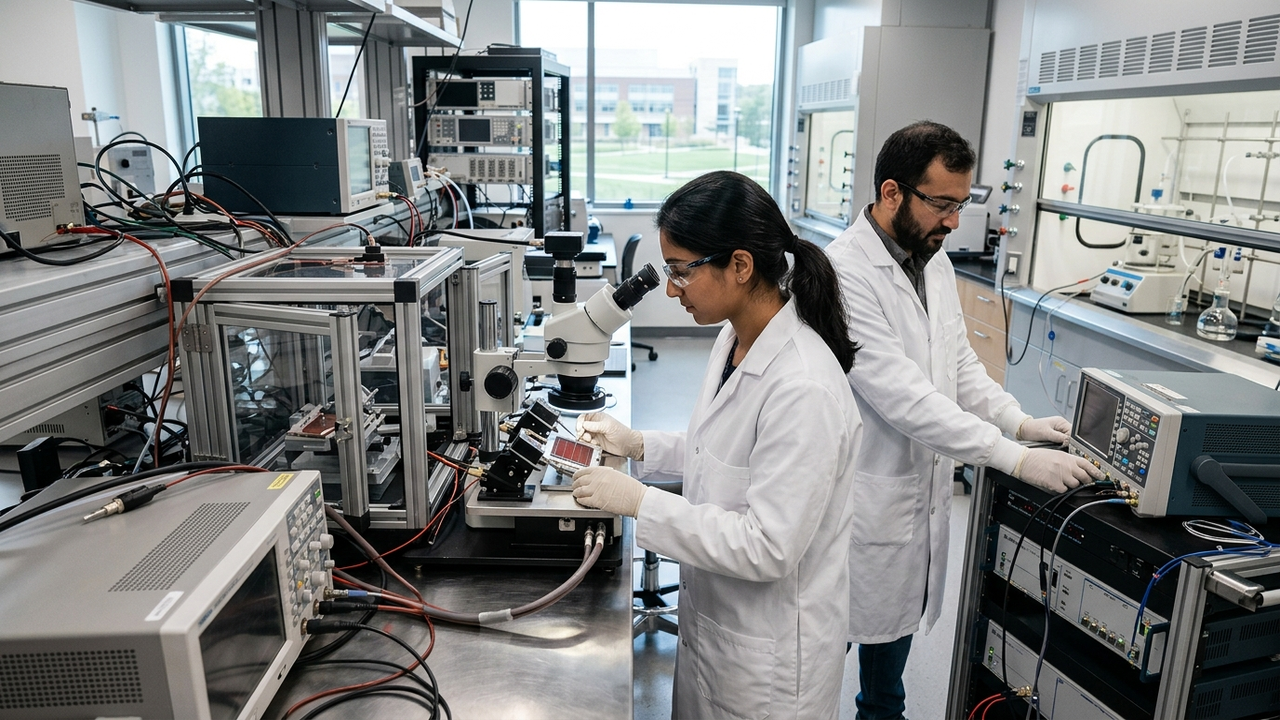
A collaborative team from the University of Wisconsin–Madison has successfully developed a novel tin-based perovskite solar cell that addresses these critical stability challenges. Their design incorporates inherent protection mechanisms against oxygen and moisture, which are typically detrimental to perovskite performance. These lead-free cells achieved a power-conversion efficiency of 16.2%, a significant milestone that ranks among the highest reported for tin perovskite solar cells. Crucially, this enhanced durability was achieved without any compromise on the device’s photovoltaic performance. The research, published in the prestigious journal Nature Materials, details the material engineering strategies employed to achieve this robust performance.
Significance & Outlook
This breakthrough provides a vital new design strategy for creating robust and non-toxic solar materials. By demonstrating high efficiency coupled with intrinsic environmental protection, these tin-based perovskites pave the way for more sustainable and commercially viable next-generation solar technologies. The ability to withstand environmental degradation opens up possibilities for broader applications and accelerates the shift towards safer, high-performance photovoltaic devices, potentially reducing reliance on lead-containing materials in solar energy production.
Get our weekly technology intelligence — free
Receive an infographic that lets you judge at a glance whether each field’s analysis report is worth reading.
Subscribe Free — Weekly Tech Intelligence
By subscribing, you’ll receive Troy-Technical’s weekly technology intelligence newsletter.
- Your email and selected fields are used only to deliver the newsletter.
- We never share your information with third parties.
- You can unsubscribe anytime via the link in each email.
See our Privacy Policy for details.
Takes about a minute · Unsubscribe anytime




Comments