
Key Findings
An international research team, spearheaded by the Daegu Gyeongbuk Institute of Science and Technology (DGIST), has developed an innovative ‘graphene nanowall (GNW) nanomesh’ that dramatically enhances the sensitivity of wearable gas sensors. This hierarchical nanomesh achieved up to a sixfold increase in sensitivity compared to conventional planar graphene gas sensors, recording a 2.4 ppm detection limit for nitrogen dioxide (NO2). Furthermore, its response speed was more than twice as fast.
Technical / Clinical Details
The developed GNW nanomesh features a unique structure known as a 3D-on-3D architecture. In this design, graphene nanowalls are three-dimensionally oriented, forming a nanoscale mesh structure that vastly increases the surface area available for interaction with gas molecules. This architecture facilitates efficient diffusion and adsorption of gas molecules within the nanostructure, enhancing both detection sensitivity and response speed. Specifically, for NO2 detection, the nanomesh demonstrated a sensitivity of 0.261%·ppm⁻¹, a sixfold improvement over the planar GNW’s 0.044%·ppm⁻¹. The response time was also more than doubled, enabling rapid, near real-time detection. This technology is founded on a new design principle that precisely controls the movement of gas molecules within the nanostructure, fundamentally strengthening the sensor’s core performance.
Background & Context
Gas sensors play an indispensable role in environmental monitoring, industrial safety, and health monitoring (e.g., breath analysis diagnostics). However, their integration into wearable devices demands miniaturization, low power consumption, high sensitivity, and rapid response. While conventional graphene-based gas sensors held significant promise, further improvements in sensitivity and speed remained challenges. This breakthrough by the DGIST team presents a novel direction in graphene nanostructure design, effectively overcoming these limitations.
Strategic Significance & Outlook
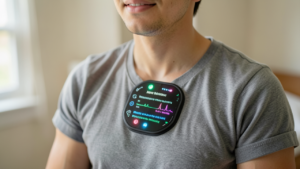
The substantial enhancement in sensitivity and response speed achieved with the GNW nanomesh is poised to revolutionize gas sensing performance in wearable electronic devices. This will enable more advanced applications such as early detection of trace hazardous substances in the air, gas leak detection in industrial environments, and real-time monitoring of disease biomarkers in breath for medical purposes. For instance, continuous monitoring of specific gas components in the breath of asthma patients could provide early warnings of attacks, facilitating personalized healthcare applications. This new 3D-on-3D architecture holds the potential to be a foundational technology for the development of future high-performance wearable sensors and IoT devices.
Get our weekly technology intelligence — free
Receive an infographic that lets you judge at a glance whether each field’s analysis report is worth reading.
Subscribe Free — Weekly Tech Intelligence
By subscribing, you’ll receive Troy-Technical’s weekly technology intelligence newsletter.
- Your email and selected fields are used only to deliver the newsletter.
- We never share your information with third parties.
- You can unsubscribe anytime via the link in each email.
See our Privacy Policy for details.
Takes about a minute · Unsubscribe anytime








Comments