Key Findings
NASA’s Parker Solar Probe has set unprecedented records for speed and solar proximity, plunging into the Sun’s corona at an astonishing 692,000 km/h. This audacious mission is enabled by its highly innovative Thermal Protection System (TPS), a carbon composite shield weighing a mere 73 kilograms. This eleven-centimeter-thick shield is capable of enduring temperatures approaching 1400 degrees Celsius on its outer surface, while remarkably maintaining the internal scientific instruments at a stable 30°C, showcasing a monumental leap in extreme environment spacecraft survivability.
Technical Details
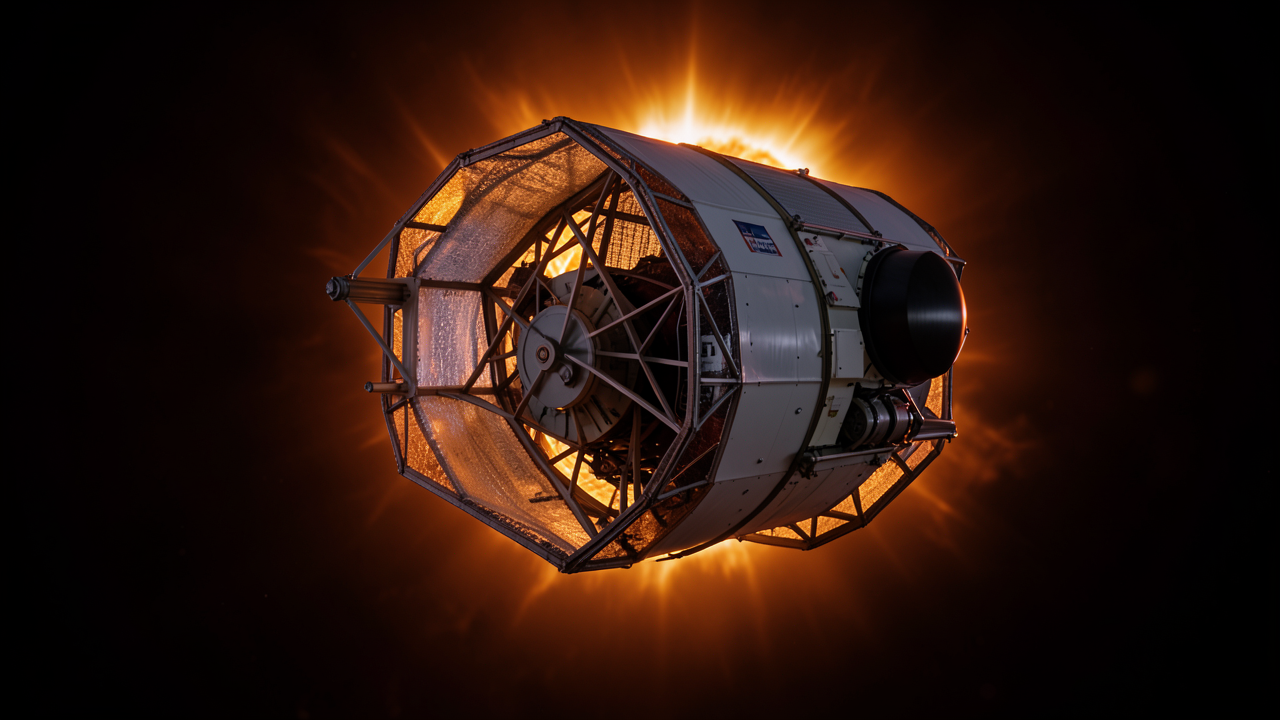
The Parker Solar Probe’s TPS, often referred to as the heat shield, is a marvel of materials science and engineering. Constructed from a carbon-carbon composite sandwich structure with a lightweight foam core, the 11-centimeter thick shield is designed to absorb the immense solar energy and re-radiate it into space. Its effectiveness stems from a combination of design principles: Firstly, its precise geometrical design ensures that direct sunlight is largely blocked from reaching the spacecraft body. Secondly, the vacuum of space between the shield and the spacecraft acts as an extremely efficient thermal insulator. Thirdly, the probe incorporates passive and active thermal management systems, including an elaborate fluid cooling system, to distribute and reject residual heat, ensuring that the sensitive instruments operate within their optimal temperature range of around 30°C. The white ceramic coating on the sun-facing side further enhances emissivity, aiding in heat rejection.
Background & Context
Understanding the Sun’s corona—the outermost layer of its atmosphere—and the origins of the solar wind has been a grand challenge in heliophysics. These phenomena profoundly influence space weather, which can impact Earth’s technology and astronauts. To unravel these mysteries, direct measurements within the corona are essential, requiring a spacecraft to survive conditions of extreme heat and radiation that were previously thought impossible. The Parker Solar Probe’s mission represents a paradigm shift, allowing in-situ data collection closer to the Sun than any previous mission, thereby pushing the boundaries of material science and thermal engineering for space applications.
Strategic Significance & Outlook
The Parker Solar Probe mission is expected to deliver revolutionary insights into solar physics, addressing fundamental questions about our star’s dynamics and evolution. The advanced TPS technology developed for this mission has profound implications for future deep-space exploration, particularly for missions to inner planets like Mercury and Venus, or potentially even exoplanetary systems with close-orbiting stars. The ability to manage extreme thermal loads in such challenging environments will offer unprecedented design flexibility for spacecraft and enable humanity to venture into regions of the cosmos that were once considered unreachable, opening new avenues for scientific discovery and technological innovation.
Get our weekly technology intelligence — free
Receive an infographic that lets you judge at a glance whether each field’s analysis report is worth reading.
Subscribe Free — Weekly Tech Intelligence
By subscribing, you’ll receive Troy-Technical’s weekly technology intelligence newsletter.
- Your email and selected fields are used only to deliver the newsletter.
- We never share your information with third parties.
- You can unsubscribe anytime via the link in each email.
See our Privacy Policy for details.
Takes about a minute · Unsubscribe anytime








Comments