Key Findings
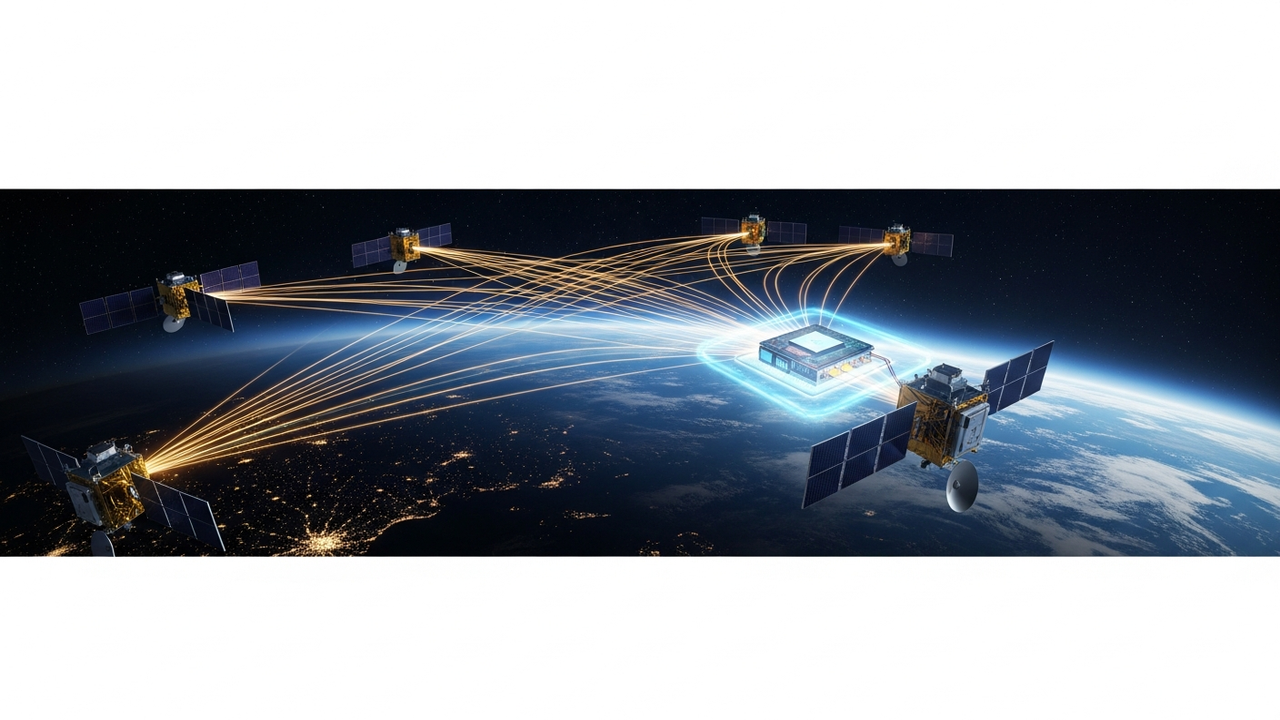
An innovative in-orbit edge computing architecture, specifically designed for small satellite constellations, has been unveiled, demonstrating its capability to enable real-time data processing in orbit while reducing data downlink to Earth by up to 80%. This distributed computing model is a groundbreaking technology that significantly enhances mission efficiency and responsiveness by dramatically improving immediate analysis of Earth observation data and rapid information delivery for disaster response. It effectively addresses data processing bottlenecks and maximizes the value derived from space-borne data.
Technical Details
This new architecture features high-performance processors and AI accelerators integrated into each small satellite, allowing for pre-processing, filtering, and advanced analysis of acquired data directly in orbit before transmission to Earth. Conventional systems typically required all raw data to be downlinked, posing challenges due to communication bandwidth constraints and latency. With this edge computing model, for instance, Earth observation satellites can extract and compress only objects of interest (e.g., changes in disaster areas, vessels, cloud-free regions) from vast amounts of image data before transmission. This can reduce downlink data volume by an average of 60% to 80%, alleviating the load on ground stations and simultaneously shortening information delivery times from hours to minutes for end-users. The architecture also includes capabilities for updating and executing machine learning models in orbit, enhancing mission flexibility and adaptability.
Background & Context
The explosive growth of small satellite constellations and the proliferation of high-resolution sensors have led to an unprecedented increase in the volume of data generated from space. However, the capacity of terrestrial communication infrastructure is finite, and the ability to efficiently downlink large volumes of raw data to Earth and process it in real-time has become a bottleneck for the entire space industry. In-orbit edge computing has gained significant attention as a strategic solution to this challenge. By processing data closer to its source, it reduces communication latency, improves bandwidth utilization efficiency, and supports faster decision-making.
Strategic Significance & Outlook
This in-orbit edge computing architecture is poised to revolutionize a wide range of small satellite missions, including Earth observation, weather forecasting, IoT communication, and space situational awareness. Its application is particularly anticipated in disaster monitoring and defense, where real-time information is critical. Future efforts will focus on enhancing ‘distributed autonomous computing’ capabilities, where multiple satellites collaboratively process tasks, further improving radiation hardness, and establishing standardization and security measures for commercial service provision. This technology will be foundational for creating new value from space data and accelerating the growth of the space economy.
Get our weekly technology intelligence — free
Receive an infographic that lets you judge at a glance whether each field’s analysis report is worth reading.
Subscribe Free — Weekly Tech Intelligence
By subscribing, you’ll receive Troy-Technical’s weekly technology intelligence newsletter.
- Your email and selected fields are used only to deliver the newsletter.
- We never share your information with third parties.
- You can unsubscribe anytime via the link in each email.
See our Privacy Policy for details.
Takes about a minute · Unsubscribe anytime









Comments