Key Findings
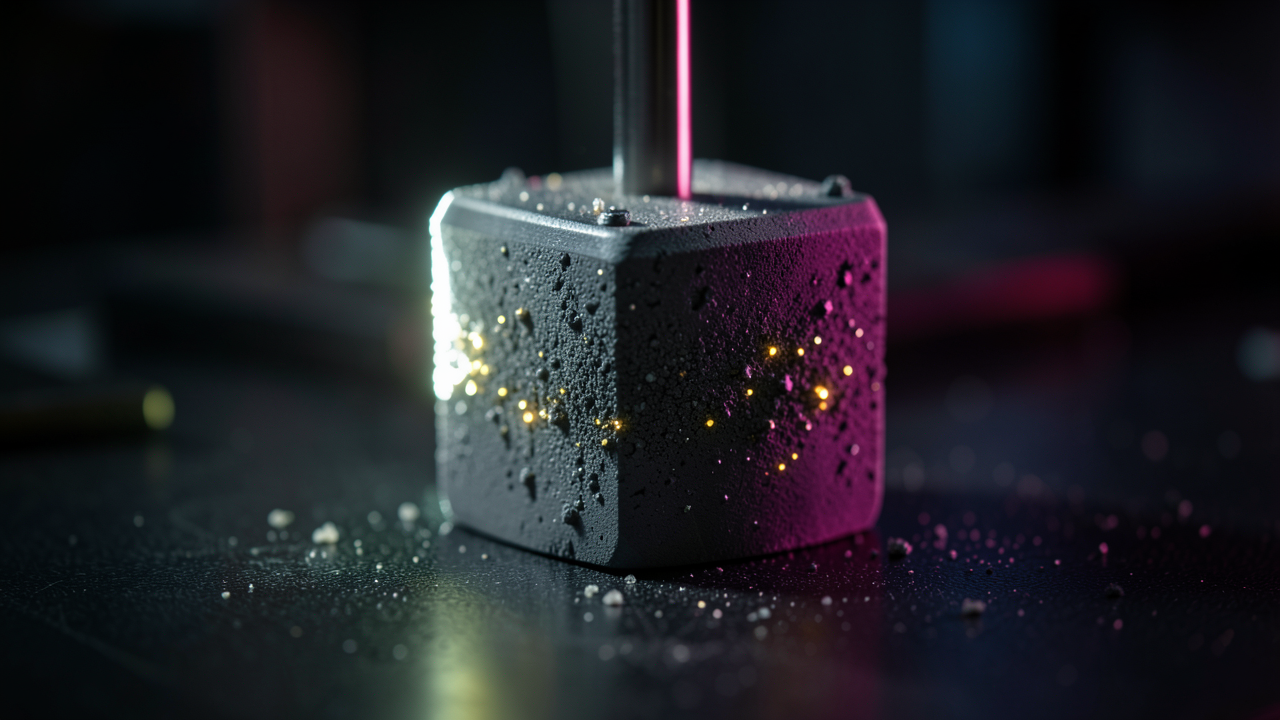
A research group at Osaka Metropolitan University has successfully fabricated fine particles of multi-element high-entropy alloys (HEAs) through an innovative underwater laser irradiation method. Furthermore, the study identified the cause of non-uniform elemental distribution within these nanoparticles, a challenge in previous research, and demonstrated precise control over the elemental ratios of HEAs by optimizing the laser process. This technology is poised to maximize the potential of HEAs, which offer significant freedom in compositional design, thereby strengthening the foundation for next-generation material development.
Technical Details
The research team positioned multiple target metals in water and irradiated them with a high-power pulsed laser. Laser ablation caused the metals to vaporize into a plasma, followed by rapid quenching and condensation in the water to form nanoscale alloy particles. In this process, the team precisely controlled parameters such as laser energy density, pulse width, and the solution environment to manage the solid solubility and homogeneity of each element within the alloy particles. They specifically discovered that the cooling rate after laser irradiation significantly influences elemental distribution within the particles. By optimizing this parameter, they achieved HEA nanoparticles with uniform elemental distribution.
Background and Industry Context
High entropy alloys have garnered considerable attention for their exceptional combination of properties, including high strength, superior toughness, excellent heat resistance, and corrosion resistance, making them highly promising for aerospace, energy, and medical applications. However, efficient fabrication of HEAs with desired compositions and uniform mixing of diverse elements has remained a significant challenge. Conventional melt-solidification methods often lead to segregation due to differences in element densities and melting points, making nanoscale compositional control particularly difficult. The underwater laser irradiation method, with its rapid quenching effect, suppresses segregation and enables nanoparticle formation, making it a promising technique for HEA fabrication.
Strategic Significance and Outlook
The achievement by Osaka Metropolitan University significantly enhances the flexibility of HEA compositional design, enabling the fabrication of HEAs with specific functionalities that were previously difficult to realize. In the future, this technology is expected to lead to the development of higher-performance structural materials, more efficient catalysts, durable coating materials, and functional materials with superior magnetic or thermoelectric properties. Its combination with 3D printing also opens up possibilities for manufacturing complex HEA components. Ongoing research will further advance this laser irradiation method, exploring its scalability for mass production and applicability to different multi-element alloy systems, thereby expanding the frontiers of new materials science.
Source: https://sj.jst.go.jp/news/202609/n0910-02p.html
Get our weekly technology intelligence — free
Receive an infographic that lets you judge at a glance whether each field’s analysis report is worth reading.
Subscribe Free — Weekly Tech Intelligence
By subscribing, you’ll receive Troy-Technical’s weekly technology intelligence newsletter.
- Your email and selected fields are used only to deliver the newsletter.
- We never share your information with third parties.
- You can unsubscribe anytime via the link in each email.
See our Privacy Policy for details.
Takes about a minute · Unsubscribe anytime





Comments