Key Findings
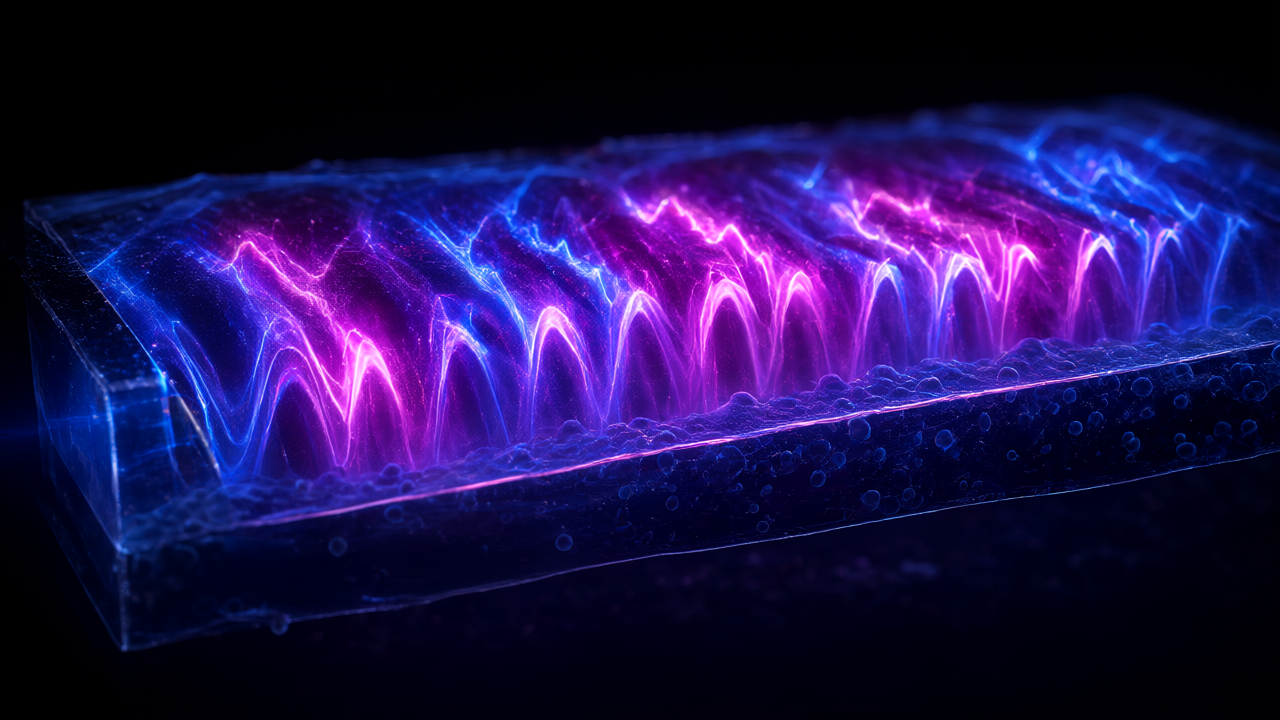
Scientists have successfully constructed the world’s first ‘all-optical photonic time crystal’ by periodically modulating a material’s optical properties every trillionth of a second (femtosecond). This pioneering experiment achieved a groundbreaking reduction of over 50% in energy losses within light-electron oscillation systems, thereby unlocking new possibilities for the development of next-generation terahertz lasers.
Technical / Clinical Details
Unlike conventional photonic crystals, which have spatially periodic structures, a photonic time crystal is a medium whose optical properties change periodically in time. In this study, ultrafast laser pulses were used to repeatedly modulate the optical properties, such as refractive index and dielectric constant, of a specific material on a femtosecond scale. This process artificially created a state of broken temporal symmetry, allowing the observation of ‘time crystal’-like behavior where photons are repeatedly scattered in time during their interaction with electrons. Crucially, the system demonstrated an ability to suppress losses (damping) in the coherent oscillations of light and electrons (e.g., polaritons) by utilizing the principles of non-Hermitian physics. Specifically, it was demonstrated that energy dissipation, which is unavoidable in conventional systems, could be reduced by over 50%. This loss reduction is critically important for high-efficiency optical devices and the exploration of new physical phenomena.
Background & Context
The concept of time crystals, first proposed by Nobel laureate Frank Wilczek in 2012, has been an active area of research at the forefront of condensed matter physics. While ordinary crystals are composed of spatially periodic atomic arrangements, time crystals refer to a more exotic state of matter where the ground state of a quantum system exhibits periodic motion in time. Until now, time crystals have primarily been realized in quantum simulations and atomic systems, with an all-optical realization considered challenging. This achievement deepens our understanding of light control and interaction, and paves the way for applying new physical principles to reduce electromagnetic wave losses. In particular, terahertz wave technology holds potential applications in security scanning, high-speed communication, and medical imaging, but the development of high-power and efficient terahertz sources has been a significant hurdle.
Strategic Significance & Outlook
The construction of this all-optical photonic time crystal and the associated reduction of over 50% in light-electron oscillation losses have direct implications for breakthroughs in terahertz technology. Systems with significantly reduced losses will enable the development of higher-power and more efficient terahertz lasers, thereby accelerating the practical application of new imaging technologies, high-speed wireless communication, and spectroscopic analysis devices utilizing terahertz waves. Furthermore, this research offers new perspectives for fundamental research areas such as non-equilibrium quantum optics and non-Hermitian physics, potentially leading to the control of photons using temporal symmetry breaking and the development of new types of quantum devices. In the future, it is expected to form the foundation for highly energy-efficient light-based computing systems and entirely new types of sensor technologies.
Source: https://www.ecoticias.com/en/all-optical-photonic-time-crystal-terahertz/37029/
Get our weekly technology intelligence — free
Receive an infographic that lets you judge at a glance whether each field’s analysis report is worth reading.
Subscribe Free — Weekly Tech Intelligence
By subscribing, you’ll receive Troy-Technical’s weekly technology intelligence newsletter.
- Your email and selected fields are used only to deliver the newsletter.
- We never share your information with third parties.
- You can unsubscribe anytime via the link in each email.
See our Privacy Policy for details.
Takes about a minute · Unsubscribe anytime






Comments