Key Findings
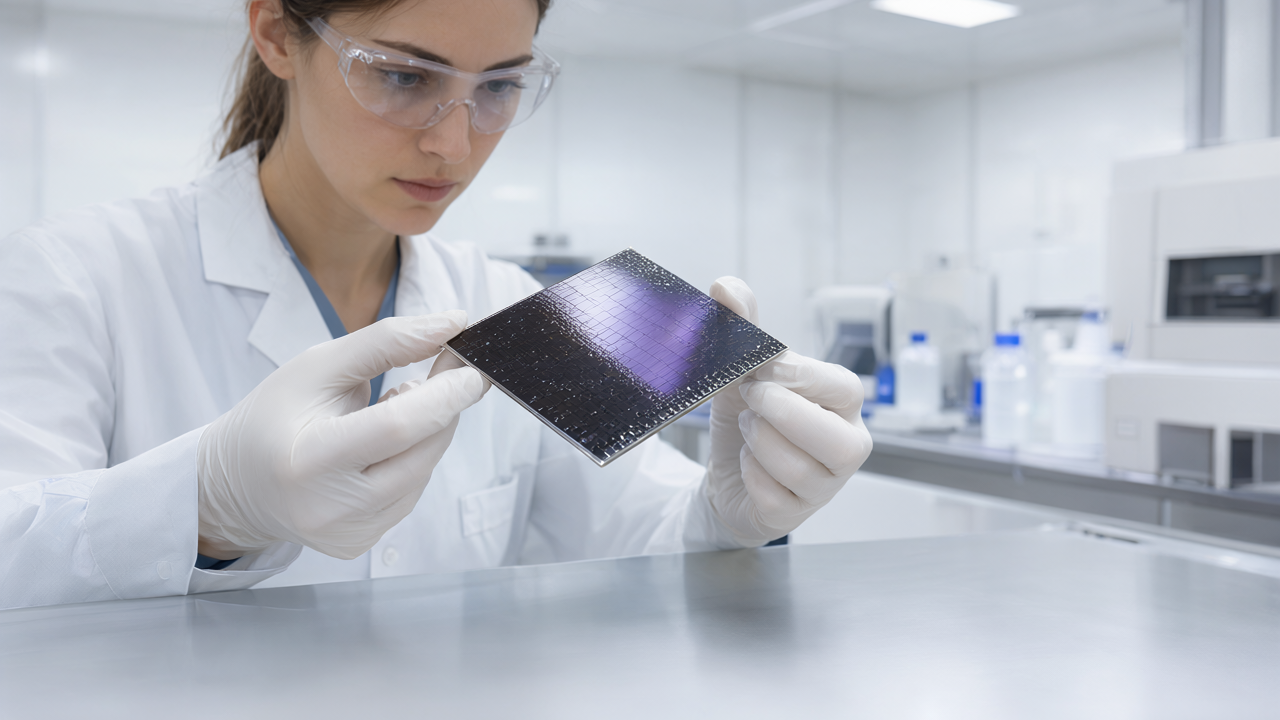
A research team from Nanjing University in China has achieved a groundbreaking certified stabilized tandem efficiency of 30.77% for a perovskite-silicon tandem solar cell. This impressive performance, recorded over an active area of 1.164 cm² with an open-circuit voltage of 1.915 V, was made possible by a newly developed “healing treatment” that significantly improves the quality of perovskite films on industrial textured silicon. Furthermore, an encapsulated device demonstrated unprecedented long-term stability, maintaining its initial performance for 3,400 hours under continuous one-sun illumination in ambient air, setting a new benchmark for this class of solar cells.
Technical / Clinical Details
The innovation lies in applying a methylammonium thiocyanate solution as a healing treatment to the perovskite films deposited on industrial textured silicon. This treatment effectively mitigates defects and enhances the film morphology, boosting the efficiency of the single-junction perovskite top cell to 21.1%. The optimized top cell, when integrated into a tandem architecture with a silicon bottom cell, yielded a certified efficiency of 30.77% with specific parameters: Voc of 1.915 V, Jsc of 20.13 mA/cm², and FF of 79.85%. The remarkable stability of 3,400 hours under continuous operation signifies a major breakthrough in addressing one of the most persistent challenges for perovskite technology: its long-term durability. This stability is attributed to the improved film quality and suppressed ion migration within the perovskite layer.
Background & Context
Perovskite-silicon tandem solar cells are considered the most promising next-generation photovoltaic technology, capable of surpassing the Shockley-Queisser limit (approximately 33.7%) of single-junction silicon cells. However, two significant barriers to commercialization have been the difficulty of fabricating high-quality perovskite films on industrially relevant textured silicon substrates and achieving long-term operational stability. Nanjing University’s research provides a practical and effective solution to both challenges. By utilizing existing textured silicon wafers, their method offers compatibility with current silicon manufacturing infrastructure, which is crucial for cost-effective scale-up and market penetration.
Strategic Significance & Outlook
The achievement of 30.77% efficiency coupled with exceptional stability of 3,400 hours firmly establishes perovskite-silicon tandem solar cells as a viable and compelling technology for future energy grids. This is not merely a laboratory record but a demonstration of the technology’s readiness for practical application, addressing critical concerns for investors and developers. The ability to integrate this technology with existing textured silicon substrates significantly de-risks the commercialization pathway and reduces the need for entirely new manufacturing lines. Future efforts will focus on scaling up the active area while maintaining efficiency and stability, as well as conducting extensive outdoor field testing. Should these efforts succeed, this technology has the potential to substantially lower the cost of solar electricity and accelerate the global transition to clean energy.
Get our weekly technology intelligence — free
Receive an infographic that lets you judge at a glance whether each field’s analysis report is worth reading.
Subscribe Free — Weekly Tech Intelligence
By subscribing, you’ll receive Troy-Technical’s weekly technology intelligence newsletter.
- Your email and selected fields are used only to deliver the newsletter.
- We never share your information with third parties.
- You can unsubscribe anytime via the link in each email.
See our Privacy Policy for details.
Takes about a minute · Unsubscribe anytime