


Key Findings
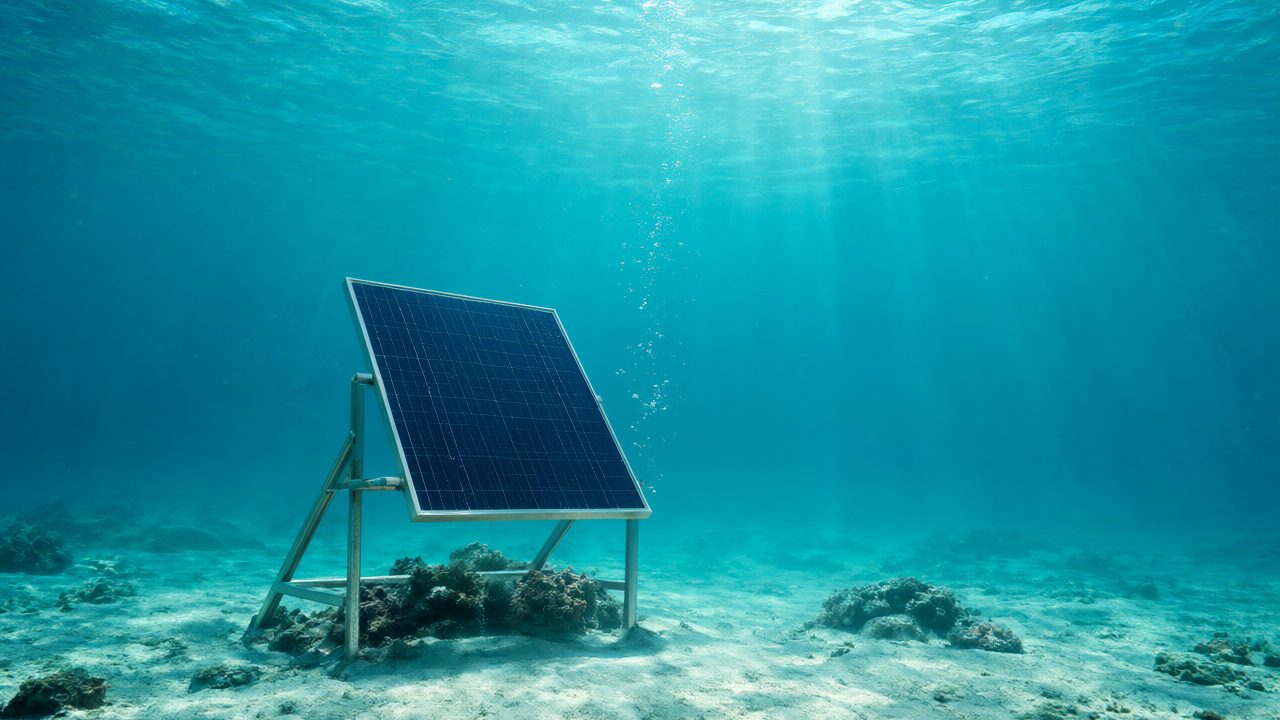
A joint research team from Yunnan University and Southwest Joint Graduate School in China has developed groundbreaking wide-bandgap perovskite solar cells capable of generating electricity in underwater environments. Beyond achieving a certified efficiency of 16.79% under standard AM1.5G illumination, these novel devices recorded an astonishing world-record power conversion efficiency of 34.71% under a simulated underwater light spectrum at a depth of 10 meters. Furthermore, they demonstrated exceptional stability, showing no significant degradation after 1,160 hours of continuous maximum power point tracking, with an estimated T80 lifetime of approximately 5.49 years. Crucial field tests in the South China Sea successfully charged a lithium-ion battery, significantly expanding the potential for marine IoT applications.
Technical & Experimental Details
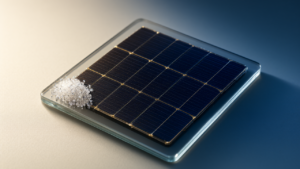
The underwater perovskite solar cells developed by the research team are engineered to maximize performance in the unique aquatic light conditions through polymer optimization. Underwater, the red light component of the solar spectrum is rapidly absorbed, making blue-green light dominant. Wide-bandgap perovskite materials are highly efficient at absorbing this specific light, thus enabling high power generation capabilities underwater. Regarding stability, the devices maintaining high efficiency after 1,160 hours of continuous operation represent a major advancement in addressing the long-term reliability challenges inherent to perovskite solar cells. An estimated T80 lifetime of approximately 5.49 years suggests potential commercial viability. Field tests conducted near Weizhou Island in the South China Sea involved a 115 cm² perovskite module operating at a 10m depth for two hours, successfully generating 324 mWh of power to charge a lithium-ion battery. This practical demonstration validates theoretical performance in a real-world environment, paving the way for autonomous underwater devices in marine monitoring, sensor networks, and resource exploration.
Background & Industry Context
Despite vast and diverse data collection needs, the immense and challenging marine environment has limited the deployment of many underwater IoT devices and sensors due to power supply difficulties. Traditional underwater power sources, such as batteries and subsea cables, face limitations in lifespan for batteries and high costs and complex installation for cables. Underwater solar cells offer a sustainable and clean solution to these challenges. Perovskite solar cells, in particular, hold great promise for underwater use due to their high light absorption efficiency and relatively low manufacturing costs. This research is poised to significantly impact marine IoT, underwater robotics, and oceanographic research by opening new avenues for application.
Strategic Significance & Outlook
The development of these underwater perovskite solar cells marks a significant step in shaping the future of autonomous power supply systems in marine environments. The record-breaking underwater conversion efficiency of 34.71% and the demonstrated long-term stability strongly indicate that perovskite technology is viable not only on land but also in harsh subsea conditions. Future challenges will include scaling up the modules, further enhancing stability, and reducing costs for mass production. Widespread adoption of this technology would enable humanity to explore and utilize the vast potential of oceans more deeply and sustainably, contributing to a more comprehensive understanding and management of our planet’s largest ecosystem.
Source: https://physicsworld.com/a/polymer-tuned-perovskite-creates-high-efficiency-underwater-solar-cells/
Get our weekly technology intelligence — free
Receive an infographic that lets you judge at a glance whether each field’s analysis report is worth reading.
Subscribe Free — Weekly Tech Intelligence
By subscribing, you’ll receive Troy-Technical’s weekly technology intelligence newsletter.
- Your email and selected fields are used only to deliver the newsletter.
- We never share your information with third parties.
- You can unsubscribe anytime via the link in each email.
See our Privacy Policy for details.
Takes about a minute · Unsubscribe anytime