
Key Findings
A research team led by Yiqiang Zhang and Shasha Zhang from Zhengzhou University, in collaboration with Yanlin Song from the Institute of Chemistry at the Chinese Academy of Sciences, has achieved a verified power conversion efficiency of 26.56% in formamidinium-based perovskite solar cells, compared to 23.68% in control devices. The treatment improved the open-circuit voltage from 1.162 volts to 1.195 volts and the fill factor from 78.72% to 84.58%. Additionally, the current-voltage hysteresis factor was reduced from 2.5% to 0.8%.
Technical Details
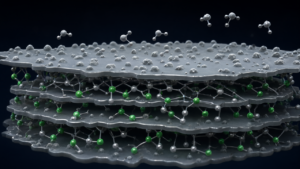
The strategy utilizes benzeneseleninic acid (C₆H₅SeO₂H) as a multifunctional interfacial regulator. Upon deposition, the seleninic acid moiety deprotonates and forms bidentate lead-oxygen-selenium chelate structures with under-coordinated divalent lead ions. This mechanism provides several technical advantages:
- Defect Passivation: Trap-state density decreased by approximately 23%, and charge carrier lifetime increased from 144 nanoseconds to 330 nanoseconds.
- Chemical Conversion: The process suppresses the chemical reduction of divalent lead and converts excess residual lead iodide phases.
- Environmental Shielding: Outward-oriented hydrophobic phenyl groups form a barrier against moisture and oxygen.
- Lattice Stabilization: Residual protonated groups interact with formamidinium cations via hydrogen bonding, suppressing ion migration.
Background & Context
While formamidinium-based perovskites have seen efficiency gains from 3.8% to over 27%, commercialization is hindered by interface defects. Conventional monodentate Lewis-base passivators often fail to simultaneously address defect passivation, residual-phase conversion, and environmental shielding.
Significance & Outlook
The modification significantly enhances durability without encapsulation. Unencapsulated treated cells retained 87.8% efficiency after 2000 hours at 25°C and 60% relative humidity, while controls dropped to 47.1% within 1000 hours. Thermal testing at 65°C showed 82.6% retention after 1600 hours versus 50.6% for controls. Published in Materials Futures, the study suggests a paradigm for combining chemical reconstruction with lattice stabilization. Future work will explore benzeneseleninic acid derivatives, selenium-containing polymer ligands, and buried interface applications.
Get our weekly technology intelligence — free
Receive an infographic that lets you judge at a glance whether each field’s analysis report is worth reading.
Subscribe Free — Weekly Tech Intelligence
By subscribing, you’ll receive Troy-Technical’s weekly technology intelligence newsletter.
- Your email and selected fields are used only to deliver the newsletter.
- We never share your information with third parties.
- You can unsubscribe anytime via the link in each email.
See our Privacy Policy for details.
Takes about a minute · Unsubscribe anytime