Key Findings
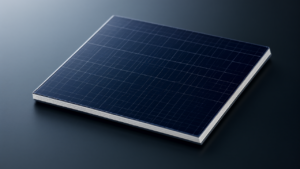
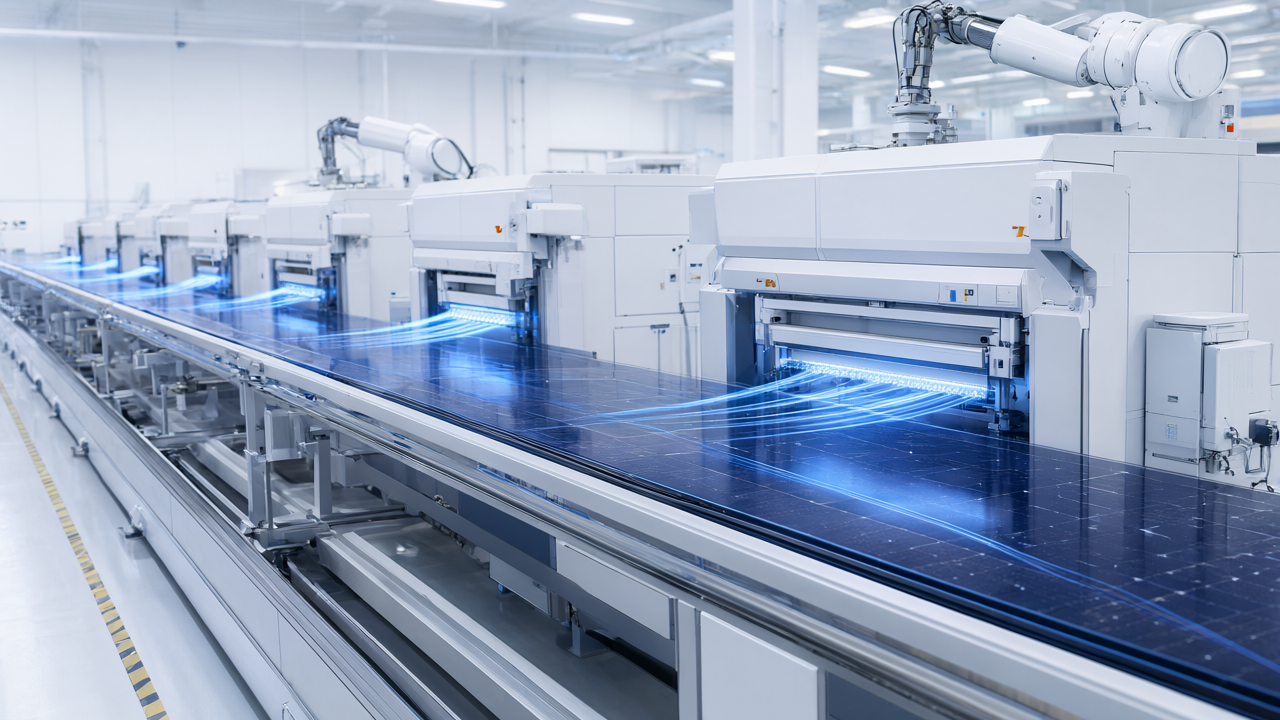
GCL-Perovskite has announced a significant breakthrough in solar technology, developing a perovskite-silicon four-terminal tandem solar cell module that achieves efficiencies over 30%. This advancement was enabled by an innovative AI-driven materials research and development approach. Critically, modules produced on the company’s pilot line have successfully secured IEC (International Electrotechnical Commission) reliability certification, demonstrating that this cutting-edge technology possesses the robustness and performance required for commercial mass production and sets a new benchmark in solar cell efficiency competition.
Technical and Clinical Details
- According to Fan Bin of GCL-Perovskite, the company has established a methodology that uses artificial intelligence to efficiently identify optimal material compositions from a virtually infinite number of perovskite material combinations. This AI-driven strategy substantially accelerates the material discovery process and shortens development cycles.
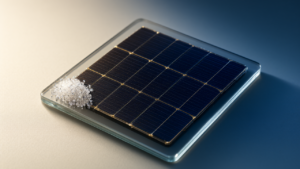
- The developed technology platform utilizes a four-terminal tandem architecture, which is compatible with existing crystalline silicon (c-Si) cells. This design allows for the efficient utilization of a broader spectrum of sunlight by integrating a perovskite layer on top of a c-Si base, thereby significantly boosting power generation efficiency while leveraging existing c-Si infrastructure.
- The achievement of over 30% efficiency and subsequent IEC reliability certification for modules from the pilot line is a crucial validation. It signifies that this technology is not merely a laboratory success but a practical product capable of enduring long-term operation under demanding environmental conditions. IEC certification serves as a testament to the product meeting international standards for quality, safety, and performance.
Background and Industry Context
The solar photovoltaic market is constantly driven by the need for new breakthroughs due to rapid technological advancements and intensifying cost competition. Perovskite solar cells have emerged as a promising next-generation technology with the potential to surpass the theoretical efficiency limits of conventional silicon solar cells, although material stability and durability have been key challenges. GCL-Perovskite’s achievement demonstrates how integrating AI can help overcome these hurdles, paving the way for high-efficiency and high-reliability solutions.
Strategic Significance and Outlook
The combination of AI-powered materials development and IEC certification for modules exceeding 30% efficiency is pivotal for GCL-Perovskite to establish a competitive edge in the solar market. As this technology progresses into full-scale mass production, it holds the potential to further reduce the cost of electricity generation and increase power output per unit area, thereby accelerating the global adoption of solar energy. This also highlights the profound impact AI can have on materials science research, with potential applications in other industrial sectors. GCL-Perovskite’s developments clearly illustrate the role of AI in the evolution of next-generation solar cell technology and the transformative industrial potential it brings.
Get our weekly technology intelligence — free
Receive an infographic that lets you judge at a glance whether each field’s analysis report is worth reading.
Subscribe Free — Weekly Tech Intelligence
By subscribing, you’ll receive Troy-Technical’s weekly technology intelligence newsletter.
- Your email and selected fields are used only to deliver the newsletter.
- We never share your information with third parties.
- You can unsubscribe anytime via the link in each email.
See our Privacy Policy for details.
Takes about a minute · Unsubscribe anytime