Key Findings
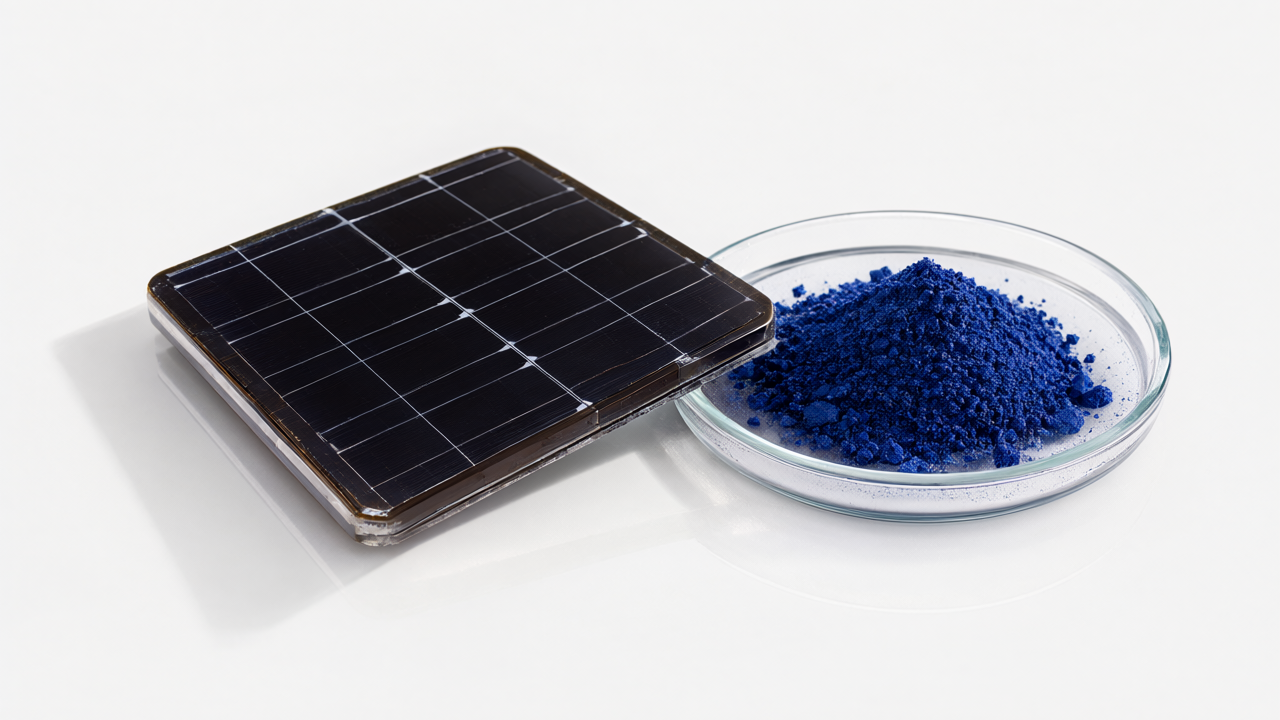
A team of Chinese researchers has pioneered a Prussian blue (PB)-based strategy to precisely control the crystallization and ion migration dynamics within perovskite solar cells. This innovative approach has resulted in a remarkable power conversion efficiency (PCE) of 26.9% in small-area devices. Critically, this strategy has demonstrated excellent scalability, achieving 23.4% efficiency in 6 cm × 6 cm minimodules and a certified 22.9% efficiency in large-area 30 cm × 30 cm perovskite submodules. This groundbreaking study, published in Science on September 24, 2026, offers a robust and practical solution for enhancing both the efficiency and stability of perovskite solar cells, accelerating their path towards commercialization.
Technical / Clinical Details
The research leverages the unique properties of Prussian blue and its derivatives, which act as effective ion-trapping agents and crystallization regulators within the perovskite film. By incorporating PB-based materials during the perovskite film formation, the team successfully reduced defects at grain boundaries and suppressed the migration of ions, particularly halide ions, which are a major cause of device degradation. The 26.9% PCE for small cells is highly competitive with current world records for perovskite solar cells. Furthermore, achieving 23.4% for 6 cm × 6 cm minimodules and a certified 22.9% for 30 cm × 30 cm submodules proves that the high performance can be successfully translated from laboratory-scale devices to industrially relevant large areas without significant efficiency losses. This scalability is a vital prerequisite for mass production.
Background & Context
Perovskite solar cells are widely regarded as a ‘dream solar cell’ due to their high theoretical efficiency and potential for low-cost manufacturing. However, their commercialization has been hindered by challenges in achieving long-term stability and scaling up laboratory-level efficiencies to large-area devices. Ion migration within the perovskite lattice is a primary culprit for instability and performance degradation. The Prussian blue strategy directly addresses these critical issues by simultaneously improving efficiency, enhancing stability, and enabling large-area fabrication. This represents a significant breakthrough, indicating a decisive shift of perovskite technology from the research phase to a viable commercial product stage.
Strategic Significance & Outlook
The development of this Prussian blue-based strategy marks a pivotal moment for the commercialization of perovskite solar cells. The achievement of 22.9% certified efficiency on a large 30 cm × 30 cm submodule demonstrates the technology’s readiness for substantial applications, such as large-scale solar farms or building-integrated photovoltaics. Future efforts will focus on further optimizing the material composition, simplifying manufacturing processes, and conducting extensive long-term outdoor reliability tests. If deployed at scale, this technology has the potential to dramatically reduce the cost of solar electricity, significantly contributing to global clean energy targets and diversifying the renewable energy portfolio.
Source: https://www.eurekalert.org/news-releases/1145992
Get our weekly technology intelligence — free
Receive an infographic that lets you judge at a glance whether each field’s analysis report is worth reading.
Subscribe Free — Weekly Tech Intelligence
By subscribing, you’ll receive Troy-Technical’s weekly technology intelligence newsletter.
- Your email and selected fields are used only to deliver the newsletter.
- We never share your information with third parties.
- You can unsubscribe anytime via the link in each email.
See our Privacy Policy for details.
Takes about a minute · Unsubscribe anytime