

Key Findings
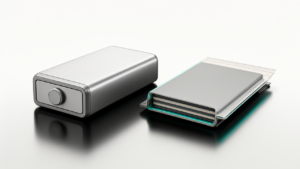
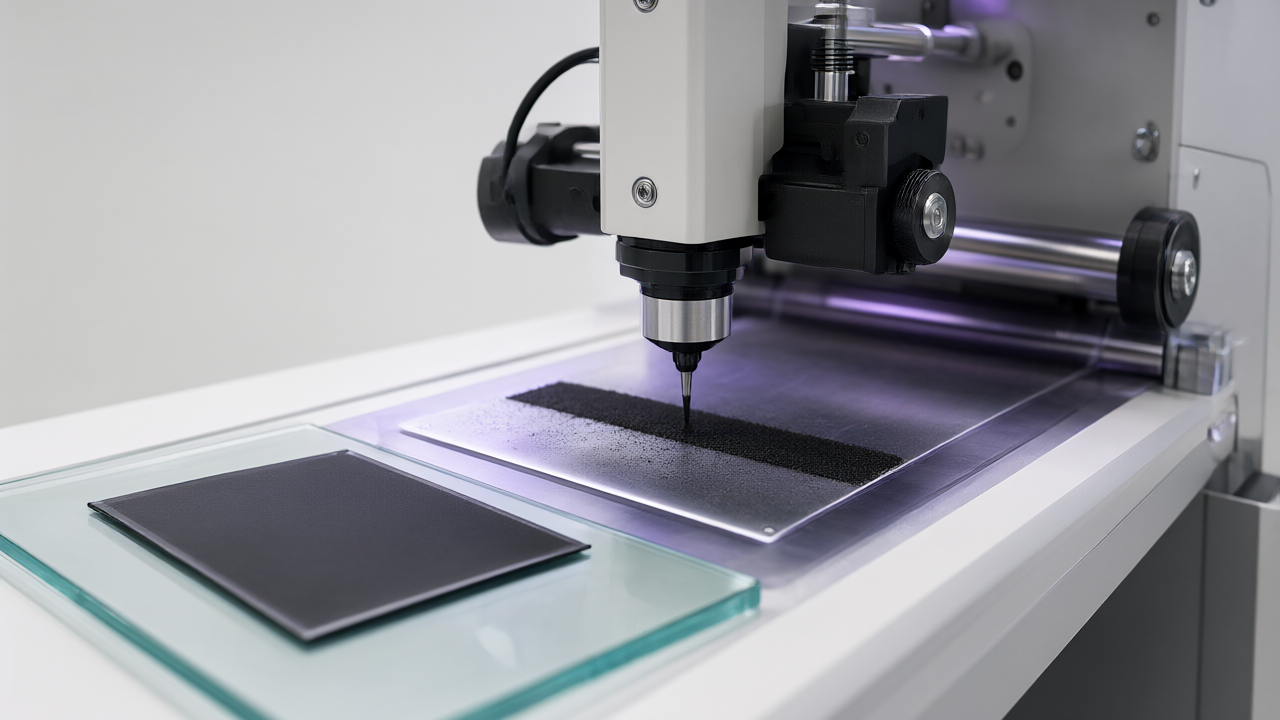
On October 12, 2026, Sakuu announced the production of a functional, metal-free battery test cell. The cell was manufactured at the company’s Silicon Valley research and development facility using the Kavian platform. This prototype utilizes 100% dry-printed anodes and cathodes, resulting in a lightweight and flexible form factor.
Technical Details
The cell’s architecture integrates carbon composite materials, a carbon fiber veil, and polymeric current collector technology. Unlike conventional lithium-ion cells that use parallel-connected configurations, Sakuu employs individually sealed, series-connected layers. Current is carried vertically through the stack across contact surfaces via a thin conductive polymer film.
To prevent the thin polymer films from wrinkling, Sakuu incorporated a carbon fiber veil. These fibers penetrate the current collector and are embedded directly into the dry-powder anode and cathode. According to Sakuu, this specific configuration provides several technical advantages:
- Improved contact between adjacent layers.
- Enhanced mechanical reinforcement.
- Increased electrical conductivity.
- Low contact resistance and mechanical integrity.
Safety and Manufacturing
The polymeric current collector architecture is designed for safety; in the event of a puncture, defect, or short circuit, energy dissipates slowly. Sakuu states this prevents the generation of sufficient heat to produce a fire. The production process leverages the company’s additive manufacturing platform, which is capable of dry-printing electrodes for both carbon fiber batteries and supercapacitors.
Significance and Outlook
The combination of flexible electrode and current collector layers enables the potential for structurally integrated battery designs. Sakuu identifies several target applications for this technology, including aerospace, transportation, wearables, data centers, and energy storage systems. The company is currently developing equipment to transition these capabilities to commercial-scale manufacturing, including the possibility of regionalized production for batteries and supercapacitors.
Source: https://battery-tech.net/battery-markets-news/sakuu-dry-metal-free-cell/
Get our weekly technology intelligence — free
Receive an infographic that lets you judge at a glance whether each field’s analysis report is worth reading.
Subscribe Free — Weekly Tech Intelligence
By subscribing, you’ll receive Troy-Technical’s weekly technology intelligence newsletter.
- Your email and selected fields are used only to deliver the newsletter.
- We never share your information with third parties.
- You can unsubscribe anytime via the link in each email.
See our Privacy Policy for details.
Takes about a minute · Unsubscribe anytime