


Key Findings
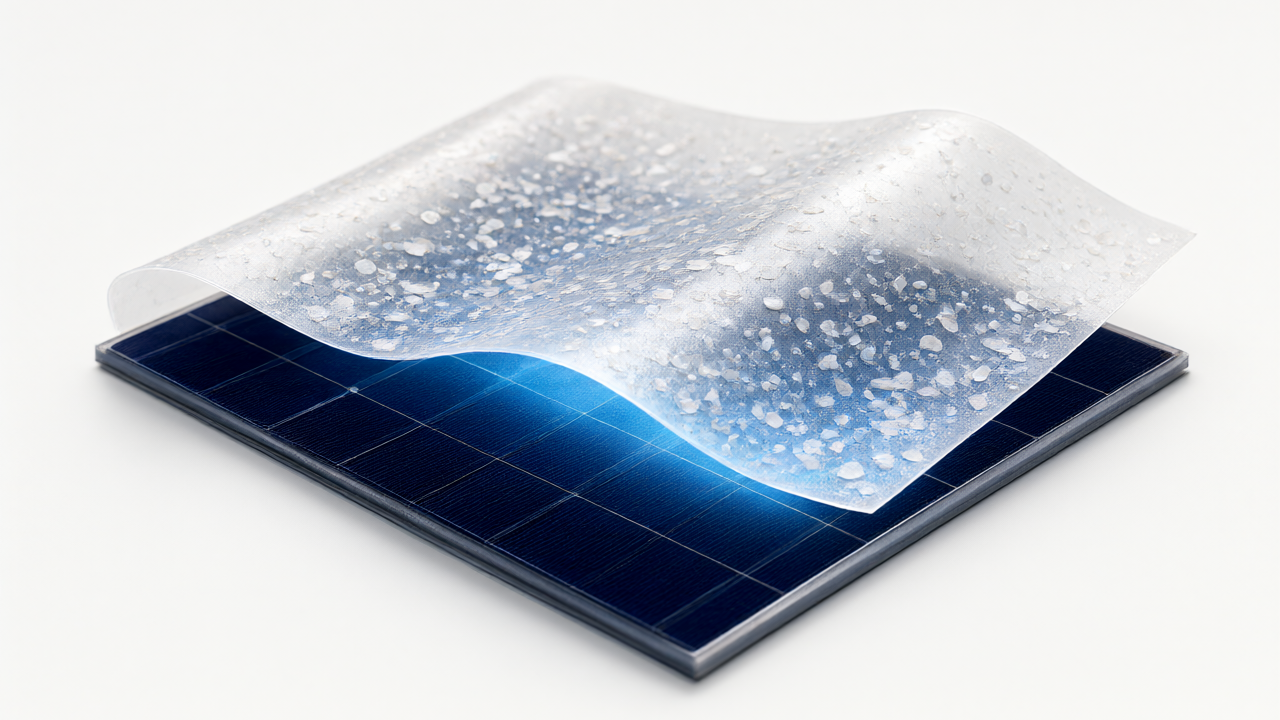
A team of Chinese materials scientists has engineered an ethylene–vinyl acetate (EVA) composite that achieves a through-plane thermal conductivity of 2.96 watts per meter-kelvin, representing a 1245 percent increase over pure EVA. Despite a high filler loading of 110 parts per hundred resin (phr), the film retains a tensile strength of 8.99 megapascals and an elongation at break of 89.75 percent. Additionally, the material maintains electrical isolation with a volume resistivity exceeding 10 to the 14th power ohm-centimeters.
Technical Details
The researchers employed a three-tier design strategy to overcome the trade-off between thermal conductivity and mechanical flexibility:
- Matrix Crosslinking: The EVA matrix is crosslinked (cEVA) to improve structural integrity and prevent the brittleness typically associated with high filler loads.
- Hybrid Filler Architecture: The team utilized a “sheet-sphere hybrid network” (f-BN) combining hexagonal boron nitride microplatelets and spherical boron nitride microspheres. The platelets provide high-conductivity surfaces, while the spheres fill gaps to reduce thermal resistance at junctions.
- Interfacial Engineering: To bridge the organic polymer and inorganic filler, the team used 3-aminopropyltriethoxysilane (KH550). This creates a dual-anchored interface using both covalent bonds and hydrogen bonds, reducing phonon scattering and improving load transfer.
Background & Context
EVA is widely used as a solar encapsulant due to its cost and transparency, but its nature as a thermal insulator causes heat to linger, degrading both the solar cells and the film. While boron nitride is an ideal filler due to its electrical insulation and thermal conductivity, high loadings usually make films too brittle for fabrication.
Significance & Outlook
Beyond conduction, the composite exhibits a solar reflectance of 91.09 percent and an infrared emissivity of 96.17 percent. This allows the film to reflect unused sunlight and radiate absorbed heat. Together, these properties result in a 5.34 degrees Celsius temperature reduction in modules, which is critical for maintaining silicon cell efficiency and extending module lifetimes through passive cooling.
Source: https://bioengineer.org/boron-nitride-hybrid-network-cools-solar-panels-while-keeping-films-tough/
Get our weekly technology intelligence — free
Receive an infographic that lets you judge at a glance whether each field’s analysis report is worth reading.
Subscribe Free — Weekly Tech Intelligence
By subscribing, you’ll receive Troy-Technical’s weekly technology intelligence newsletter.
- Your email and selected fields are used only to deliver the newsletter.
- We never share your information with third parties.
- You can unsubscribe anytime via the link in each email.
See our Privacy Policy for details.
Takes about a minute · Unsubscribe anytime