


Key Findings
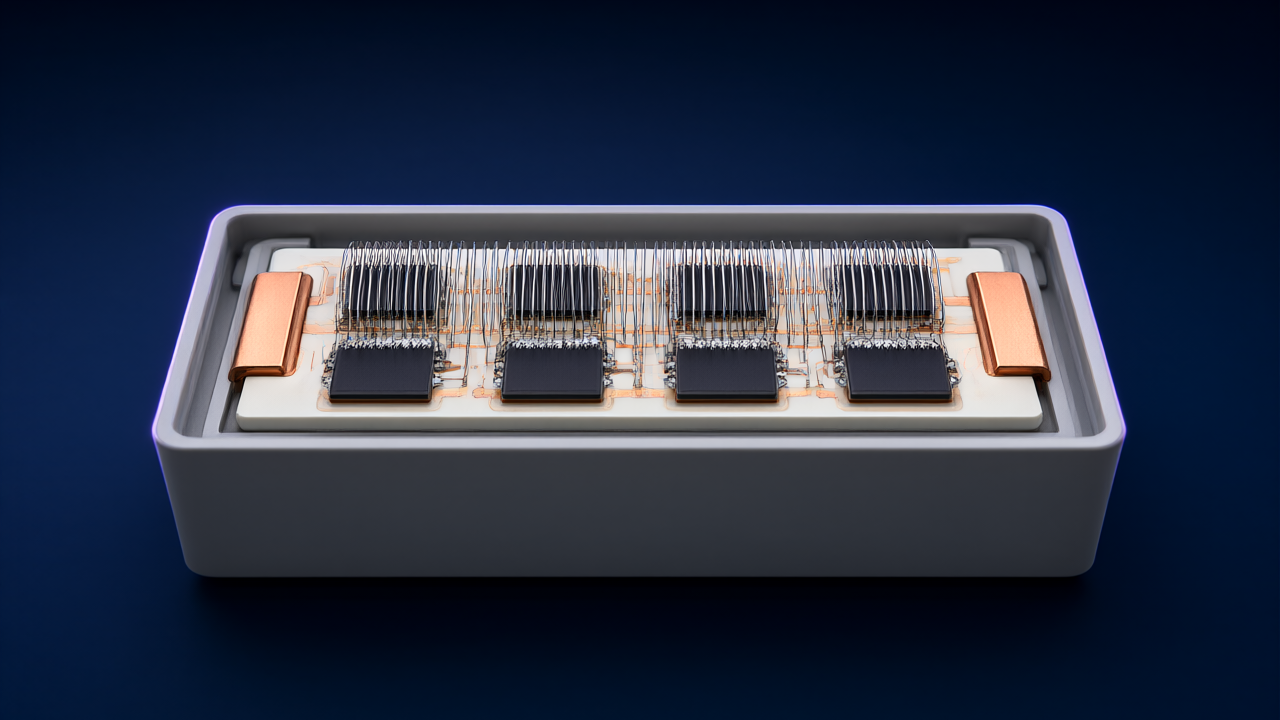
Navitas has launched the G4H08MT23GB4 2300V full-bridge power module family, designed for advanced energy and grid infrastructure. The modules utilize the industry-standard SiCPAK form factor and achieve a class-leading R DSON of 8mΩ. This release expands the company’s UHV SiC portfolio, which includes both 2300V and 3300V options.
Technical Details
The modules are built on Navitas’ fourth-generation GeneSiC Trench-Assisted Planar (TAP) architecture. To ensure high-reliability operation in high-power environments, the construction includes several specific enhancements:
- Substrate: An aluminium nitride (AlN) active-metal-braze (AMB) substrate provides superior heat spreading and isolation capabilities exceeding 5kV.
- Potting: Epoxy-resin potting is used to limit moisture and contaminant ingress and reduce internal stress; this technology offers 10x the thermal conductivity of silicone gel.
- Connectivity: High-current, press-fit pins provide twice the current-carrying capability per pin compared to standard press-fit connections.
- Thermal Management: An optional pre-applied thermal interface material (TIM) is available to standardize heat-sink assembly.
Reliability Testing
The product family is qualified to an internal AEC-Plus reliability benchmark that exceeds AEC-Q101 and JEDEC standards. This testing regime includes dynamic reverse bias (DRB) and dynamic gate switching (DGS) to simulate fast-switching application profiles. Furthermore, the benchmark more than triples the duration of static high-temperature, high-voltage tests (HTRB, HTGB, HTGB-R) and includes HV-H3TRB (HV-THB) qualification for discrete, power modules, and known-good-die (KGD) devices.
Significance and Outlook
These UHV SiC modules serve as medium-voltage building blocks for solid-state transformers. In AI data centers, they enable the direct conversion of grid power into high-voltage DC rails used within server racks. Beyond AI infrastructure, the technology is positioned for use in solar inverters, grid-scale battery energy storage systems, hydrogen fuel cell electrolysis, DC–DC conversion, industrial motor-drives, and EV megawatt charging infrastructure.
Source: https://www.semiconductor-today.com/news_items/2026/oct/navitas-211026.shtml
Get our weekly technology intelligence — free
Receive an infographic that lets you judge at a glance whether each field’s analysis report is worth reading.
Subscribe Free — Weekly Tech Intelligence
By subscribing, you’ll receive Troy-Technical’s weekly technology intelligence newsletter.
- Your email and selected fields are used only to deliver the newsletter.
- We never share your information with third parties.
- You can unsubscribe anytime via the link in each email.
See our Privacy Policy for details.
Takes about a minute · Unsubscribe anytime