


Key Findings
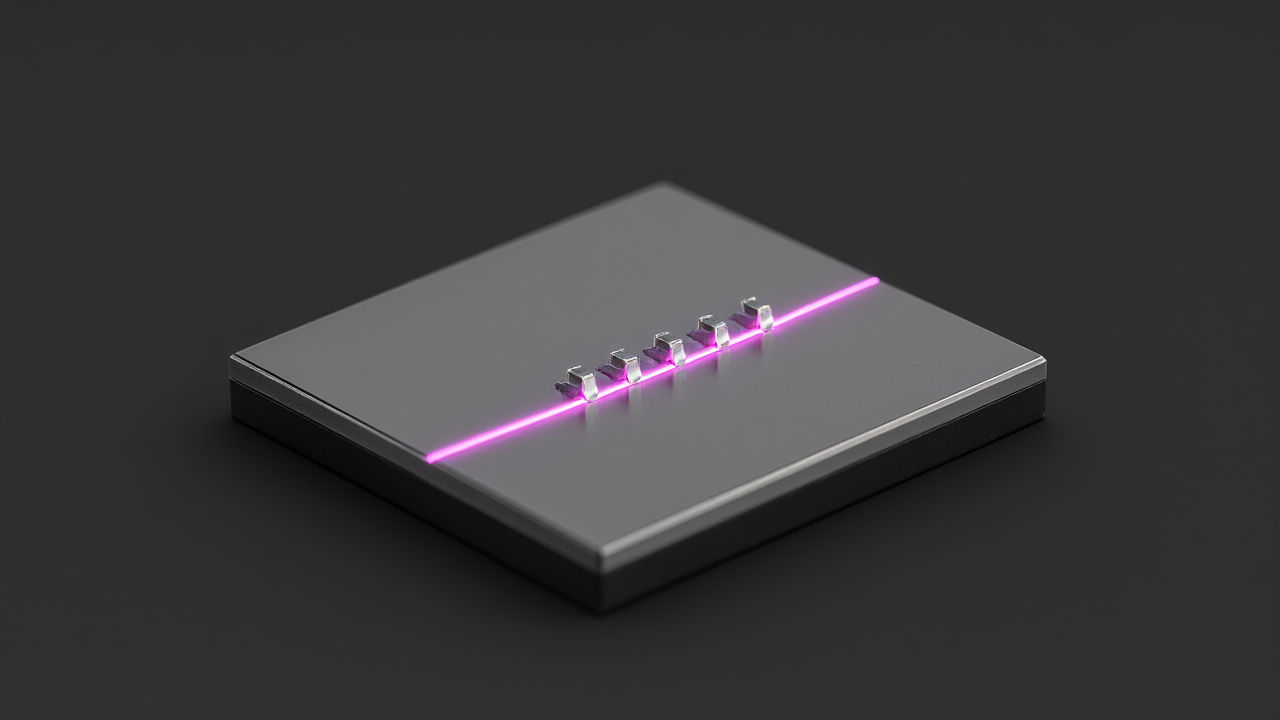
A collaborative team from RIKEN, National Taiwan University, ETH Zurich, and TU Delft has achieved simultaneous single-qubit gate fidelities of ≥99.9% across a five-qubit silicon (28 Si/SiGe) quantum dot array. The researchers successfully utilized a single, shared impedance-matched microwave transmission line to control the qubits, crossing the minimum threshold required for 2D surface code quantum error correction (QEC).
Technical Details
The team identified off-resonant microwave-drive-induced AC-Stark shifts as the primary cause of parallel drive crosstalk, which previously degraded gate fidelities from >99.9% down to 99.5%. To resolve this, they implemented an N(N-1) pairwise calibration protocol. Because the resulting phase shifts (Δφ ij) sum linearly, the crosstalk can be compensated by measuring pairwise phase accumulation between individual qubit pairs.
- Performance: Up to three qubits operated simultaneously at 99.99% accuracy; all five qubits maintained ≥99.9% fidelity.
- Residual Exchange: Decoupled CZ sequence measurements confirmed that residual exchange interactions (J off) between neighboring quantum dots remained below 16.6 kHz during single-qubit driving.
Background and Context
Simultaneous multi-qubit operations are essential for cyclic QEC protocols because idle silicon spin qubits dephase significantly faster (T 2 * ≈ 10 μs) than driven qubits (T 2,R ≈ 100 μs). Previous attempts to drive multiple qubits in parallel suffered from interference that compromised accuracy.
Significance and Outlook
The use of a single shared control line reduces physical wiring density and thermal loads, enabling modular silicon spin-qubit unit cells of approximately 10 qubits per line. The researchers indicate that replacing surface micromagnets with integrated back-end-of-line (BEOL) nanomagnets could double the local field gradient. This modification would allow for faster gate operations (2–3 MHz) at lower microwave power, providing a pathway toward 10-qubit parallel control modules in commercial silicon manufacturing.
Get our weekly technology intelligence — free
Receive an infographic that lets you judge at a glance whether each field’s analysis report is worth reading.
Subscribe Free — Weekly Tech Intelligence
By subscribing, you’ll receive Troy-Technical’s weekly technology intelligence newsletter.
- Your email and selected fields are used only to deliver the newsletter.
- We never share your information with third parties.
- You can unsubscribe anytime via the link in each email.
See our Privacy Policy for details.
Takes about a minute · Unsubscribe anytime