


Key Findings
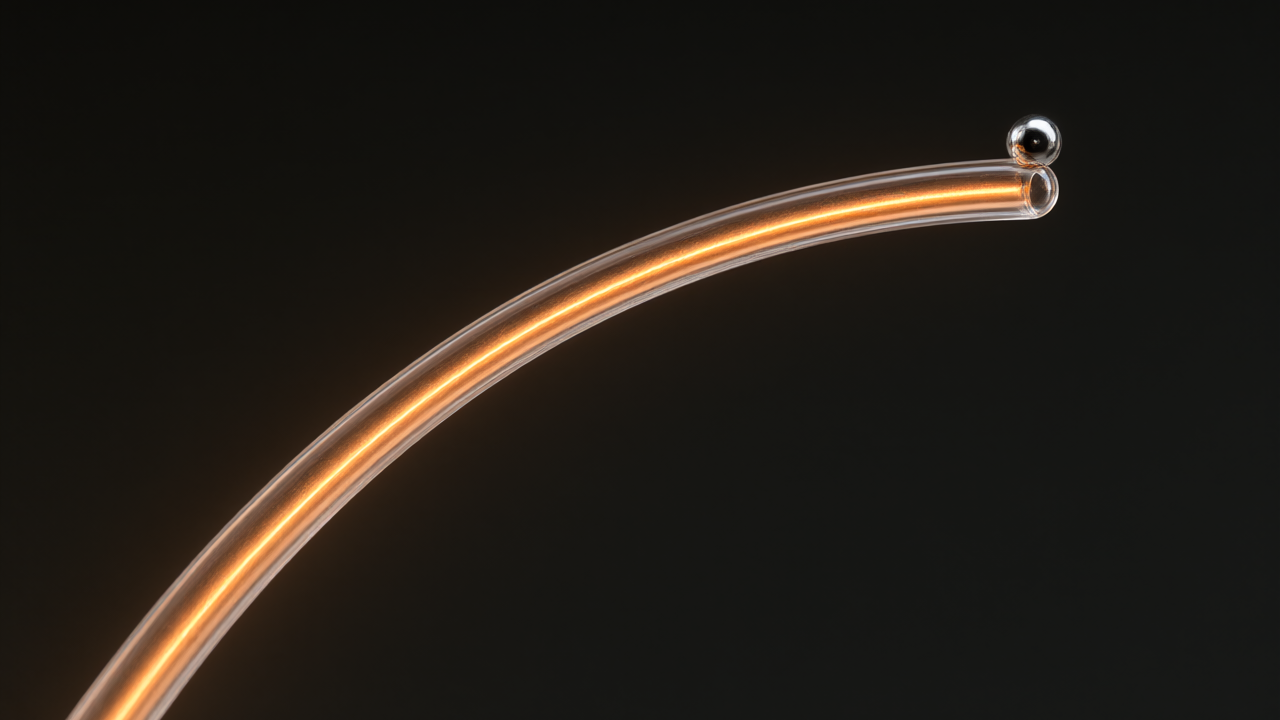
The LCE@CNT/CB fiber actuator enables high-stroke reversible contraction of up to 38% when driven by 808 nm near-infrared (NIR) light. The conductive sheath serves a dual purpose: it converts guided light into heat to drive the LCE core and acts as a strain sensor via piezoresistive response. This integration allows the fiber to lift loads over 320 times its own weight and maintain stable performance over 40 cycles.
Technical Details
The device is manufactured by injecting LCE precursor into a PTFE hollow tube, followed by mechanical pre-stretching and UV polymerization to create a uniaxial nematic structure. A conductive sheath consisting of single-walled CNTs and carbon black (1:1 ratio, 5 wt% each in ethanol) is then coated on the surface, resulting in a layer approximately 18 µm thick.
- Actuation Mechanism: 808 nm NIR light is coupled into the fiber end. The CNT/CB sheath converts this light to heat, triggering a nematic-to-isotropic phase transition in the LCE core.
- Thermal Management: The sheath acts as a thermal conduit, reducing heat localization. Under 1 W laser power, the LCE@CNT/CB fiber reaches a surface temperature of 89°C, significantly exceeding the 72°C transition temperature.
- Self-Sensing: Resistance changes are primarily driven by the reconfiguration of the CNT/CB network during deformation rather than temperature fluctuations. The system can distinguish between different object sizes (M3, M5, and M8 nuts) based on the magnitude of relative resistance change (-ΔR/R0).
Applications and Significance
The fibers were integrated into a biomimetic soft gripper and a cable-driven continuum robotic arm. These systems demonstrated the ability to navigate curved pipes and perform programmable gripping and recovery in constrained environments. By bundling three fibers, the researchers achieved a programmable bending module capable of 360° omnidirectional steering with bending angles exceeding 24° under dual-fiber actuation. This platform provides a compact, scalable solution for soft robotics, minimally invasive devices, and adaptive textiles.
Source: https://news.qq.com/rain/a/20261101A06RXO00
Get our weekly technology intelligence — free
Receive an infographic that lets you judge at a glance whether each field’s analysis report is worth reading.
Subscribe Free — Weekly Tech Intelligence
By subscribing, you’ll receive Troy-Technical’s weekly technology intelligence newsletter.
- Your email and selected fields are used only to deliver the newsletter.
- We never share your information with third parties.
- You can unsubscribe anytime via the link in each email.
See our Privacy Policy for details.
Takes about a minute · Unsubscribe anytime