


Key Findings
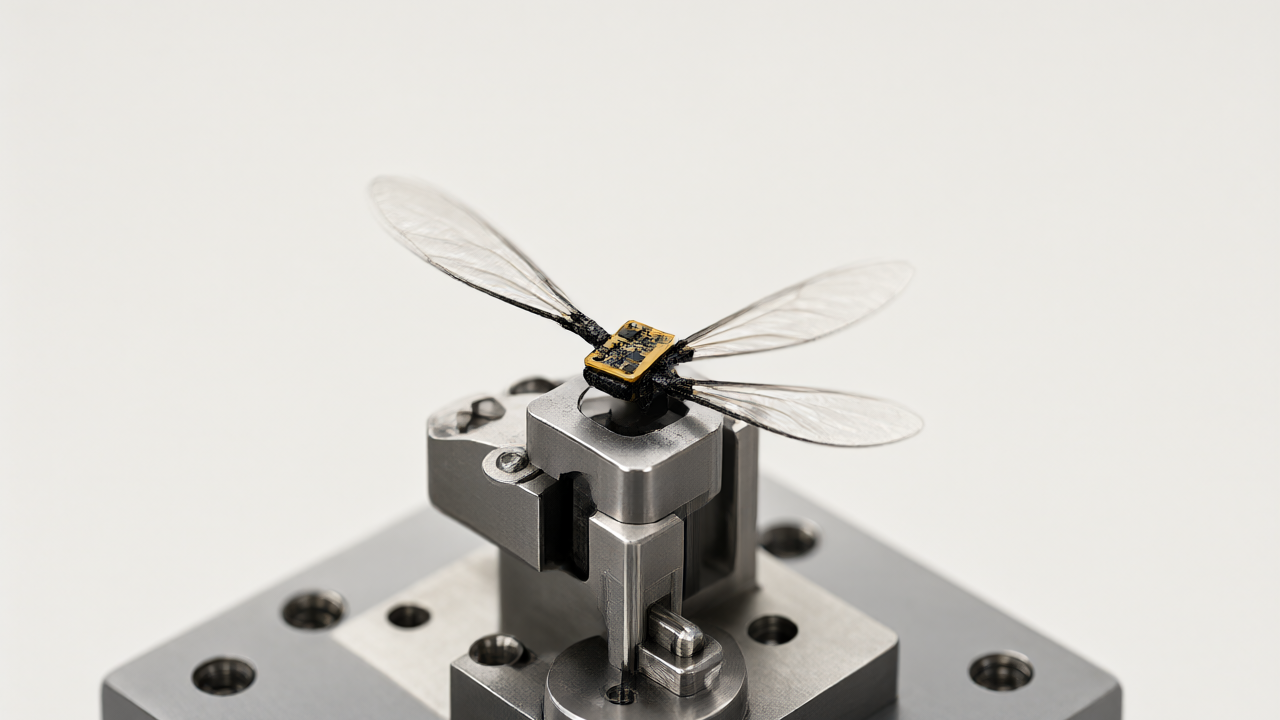
MIT researchers have demonstrated a 1.29-gram aerial microrobot that achieves sensory and compute autonomy, allowing it to hover, follow trajectories, and land without relying on external motion-capture systems. In a 30-second experiment, the robot successfully avoided obstacles and landed on a sunflower. While the robot handles low-level flight control and estimation onboard, it currently requires power from an offboard source and high-level commands from a human operator via joystick.
Technical Details
To accommodate the necessary electronics, the team increased the radius and length of the soft actuators (artificial muscles) by 50%, which boosted net lift force by 46% and resulted in a lift-to-weight ratio of 1.9. This additional lift supports a 244-milligram electronics package mounted on a fiberglass substrate to mitigate vibrations. The sensor suite consists of:
- An inertial measurement unit (IMU) for attitude.
- An optical-flow sensor for lateral speed and position.
- A time-of-flight (ToF) sensor for height.
To manage computational costs and avoid drift caused by the lack of an absolute-position reference, the team implemented a simplified estimator. They determined that continuous estimates at a faster rate were more effective for this flight system than slower, more accurate estimates.
Background & Context
This system evolves from a December 3, 2025, report of a robot capable of performing 10 somersaults in 11 seconds. However, that previous iteration relied on an external computer for its AI-based controller. The current 2026 iteration integrates the navigation sensing and computation directly onto the aircraft.
Significance & Outlook
Potential applications for this technology include precision pollination, pest detection, crop-health monitoring, and industrial surveillance in environments where larger machines are impractical. Future development focuses on adding a camera for autonomous object recognition and obstacle avoidance, as well as integrating batteries and power electronics to enable untethered outdoor flight.
Source: https://www.unite.ai/mit-microrobot-flies-without-motion-capture-using-onboard-sensors/
Get our weekly technology intelligence — free
Receive an infographic that lets you judge at a glance whether each field’s analysis report is worth reading.
Subscribe Free — Weekly Tech Intelligence
By subscribing, you’ll receive Troy-Technical’s weekly technology intelligence newsletter.
- Your email and selected fields are used only to deliver the newsletter.
- We never share your information with third parties.
- You can unsubscribe anytime via the link in each email.
See our Privacy Policy for details.
Takes about a minute · Unsubscribe anytime