Key Findings
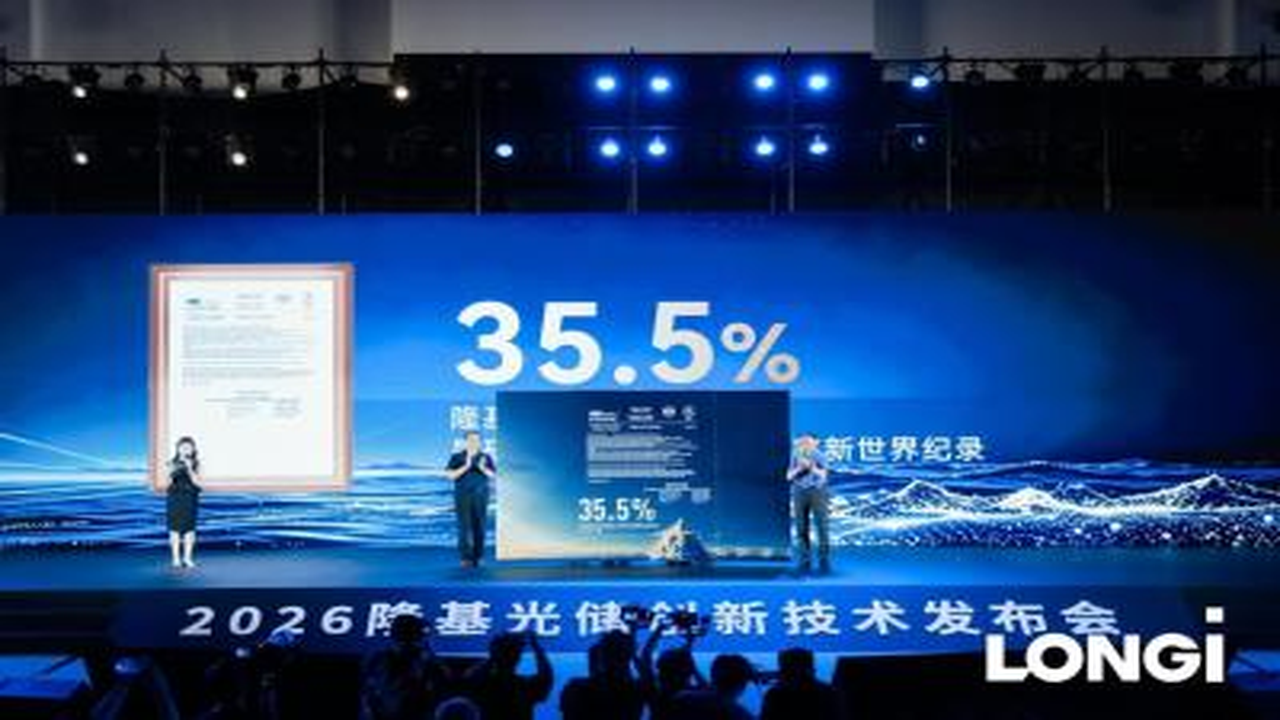
LONGi has achieved a groundbreaking 35.5% power conversion efficiency for its perovskite-crystalline silicon tandem solar cell, a new world record independently certified by the European Solar Test Installation (ESTI). This monumental accomplishment significantly surpasses the established efficiency benchmarks for solar photovoltaics and positions LONGi at the forefront of advanced solar technology development. The achievement is a direct outcome of the company’s ‘Technology Forest’ strategy, which prioritizes cutting-edge research and development in high-efficiency solar solutions.
Technical Details
The record-breaking efficiency stems from a meticulously engineered tandem architecture that integrates a perovskite top cell with a crystalline silicon bottom cell. This design synergistically broadens the spectrum of absorbed sunlight: the perovskite layer efficiently converts high-energy photons (blue and green light), while the underlying silicon layer captures lower-energy photons (red and infrared light) that the perovskite layer cannot. This approach maximizes photon utilization, moving beyond the Shockley-Queisser limit for single-junction cells. Key to this success are innovations in interface engineering between the two layers, optimized charge transport materials, and advanced passivation techniques that minimize energy losses and enhance overall device performance in the research-scale cell.
Background & Context
The solar industry is relentlessly pursuing higher efficiencies and lower levelized cost of electricity (LCOE) to accelerate the global energy transition. Traditional silicon solar cells are approaching their theoretical efficiency limits, making tandem architectures, especially perovskite-silicon, a critical area of innovation. LONGi, a global leader in solar technology, has invested heavily in this domain. Their latest record demonstrates that perovskite technology is rapidly maturing from academic curiosity to a viable commercial pathway. This aggressive development by Chinese manufacturers is intensifying the global race for solar supremacy, pushing the boundaries of what’s possible in renewable energy generation.
Strategic Significance & Outlook
While the 35.5% efficiency record applies to a research-scale cell, not a commercial module, it provides a compelling vision for future solar power. It signals the potential for mass-produced solar modules to exceed 30% efficiency, which would dramatically increase energy yield per unit area and further reduce installation costs. This breakthrough is particularly appealing for applications with space constraints, such as rooftop solar, building-integrated photovoltaics (BIPV), and even electric vehicles. The next challenges for LONGi and the broader industry will involve translating this lab-scale success into stable, durable, and cost-effective manufacturing processes for large-area modules, ultimately aiming for widespread commercial availability in the late 2020s. This progress is pivotal for solar energy’s role in achieving global carbon neutrality targets.
Get our weekly technology intelligence — free
Receive an infographic that lets you judge at a glance whether each field’s analysis report is worth reading.
Subscribe Free — Weekly Tech Intelligence
By subscribing, you’ll receive Troy-Technical’s weekly technology intelligence newsletter.
- Your email and selected fields are used only to deliver the newsletter.
- We never share your information with third parties.
- You can unsubscribe anytime via the link in each email.
See our Privacy Policy for details.
Takes about a minute · Unsubscribe anytime


Comments