Key Findings
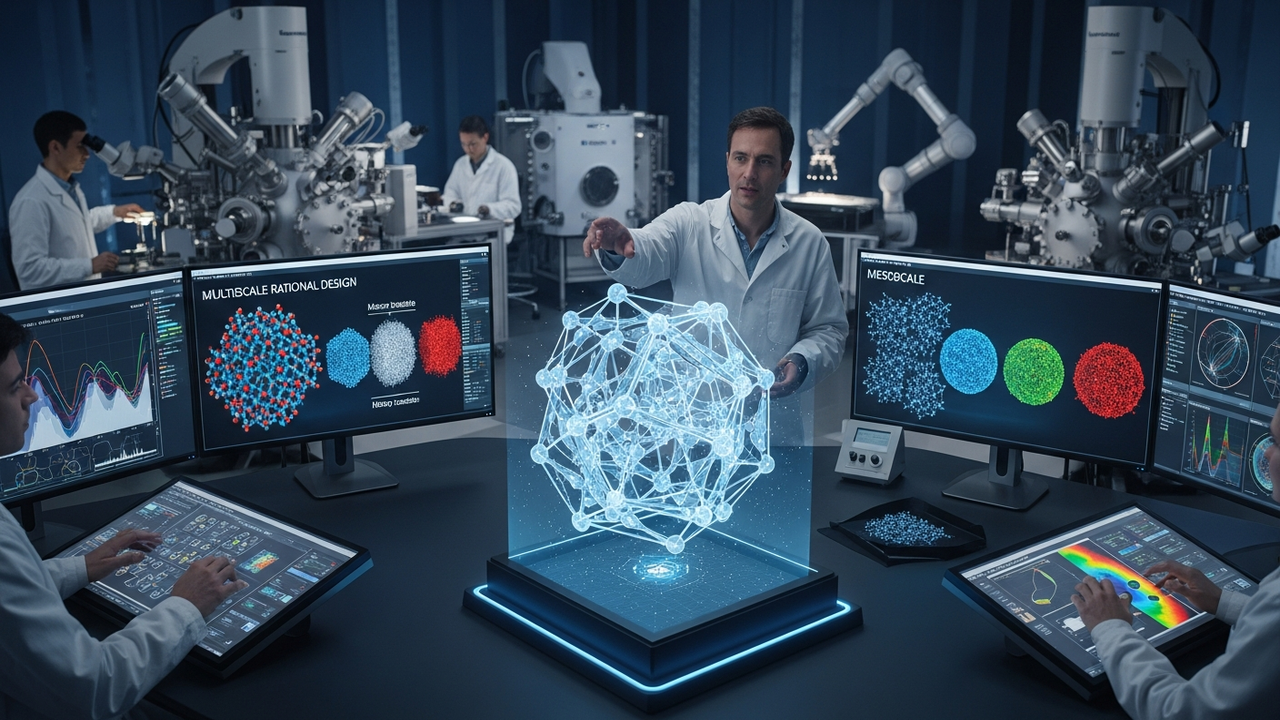
The DeepMeso framework, specifically DeepFerro tailored for ferroelectric materials, has been developed to address long-standing challenges in the rational design of mesoscopic heterogeneous materials. This deep learning-driven model enables both the forward prediction of material properties and inverse design from desired characteristics, opening new possibilities in material development processes.
Technical / Clinical Details
DeepFerro leverages deep learning to model the complex mesoscopic structures of ferroelectrics and their associated properties. While traditional simulation methods struggle to bridge the gap between atomic-scale precision and macroscopic behavior, DeepFerro effectively closes this multi-scale gap. Specifically, it learns how mesoscopic features such as phase transitions, domain structures, and defect influences affect the macroscopic properties of ferroelectrics. The model can accurately predict electrical, mechanical, and thermal properties in a forward manner, taking material composition and microstructure as input. What’s even more groundbreaking is its ability to ‘on-demand’ inverse design optimal material compositions and structural parameters by simply inputting target properties (e.g., specific dielectric constant, Curie temperature). This significantly shortens the design cycle, reducing time and resources spent on trial-and-error. DeepFerro is a powerful tool for unraveling complex structure-property relationships in diverse heterogeneous material systems and enabling their rational design.
Background & Context
Ferroelectrics are crucial functional materials applied in various electronic devices, including capacitors, sensors, actuators, and non-volatile memories. Their performance often heavily depends on mesoscopic structural features such as domain walls, grain boundaries, and defects. The rational design of these heterogeneous materials has been a significant challenge due to the necessity of understanding complex relationships between atomic-scale interactions and macroscopic behavior. AI-driven modeling is opening new avenues to manage this complexity and efficiently explore the material design space.
Strategic Significance & Outlook
The success of frameworks like DeepMeso (DeepFerro) demonstrates the transformative potential that materials informatics brings to the design of functional materials. This technology is expected to be applicable not only to ferroelectrics but also to other mesoscopic heterogeneous materials (e.g., magnetic materials, thermoelectric materials, composites). In the future, AI-driven multi-scale modeling is likely to become a standard method for rapidly developing custom materials for specific industrial applications, dramatically accelerating the pace and efficiency of discovery in materials science.
Source: https://academic.oup.com/nsr/article/13/13/nwag324/8697347
Get our weekly technology intelligence — free
Receive an infographic that lets you judge at a glance whether each field’s analysis report is worth reading.
Subscribe Free — Weekly Tech Intelligence
By subscribing, you’ll receive Troy-Technical’s weekly technology intelligence newsletter.
- Your email and selected fields are used only to deliver the newsletter.
- We never share your information with third parties.
- You can unsubscribe anytime via the link in each email.
See our Privacy Policy for details.
Takes about a minute · Unsubscribe anytime









Comments