Key Findings
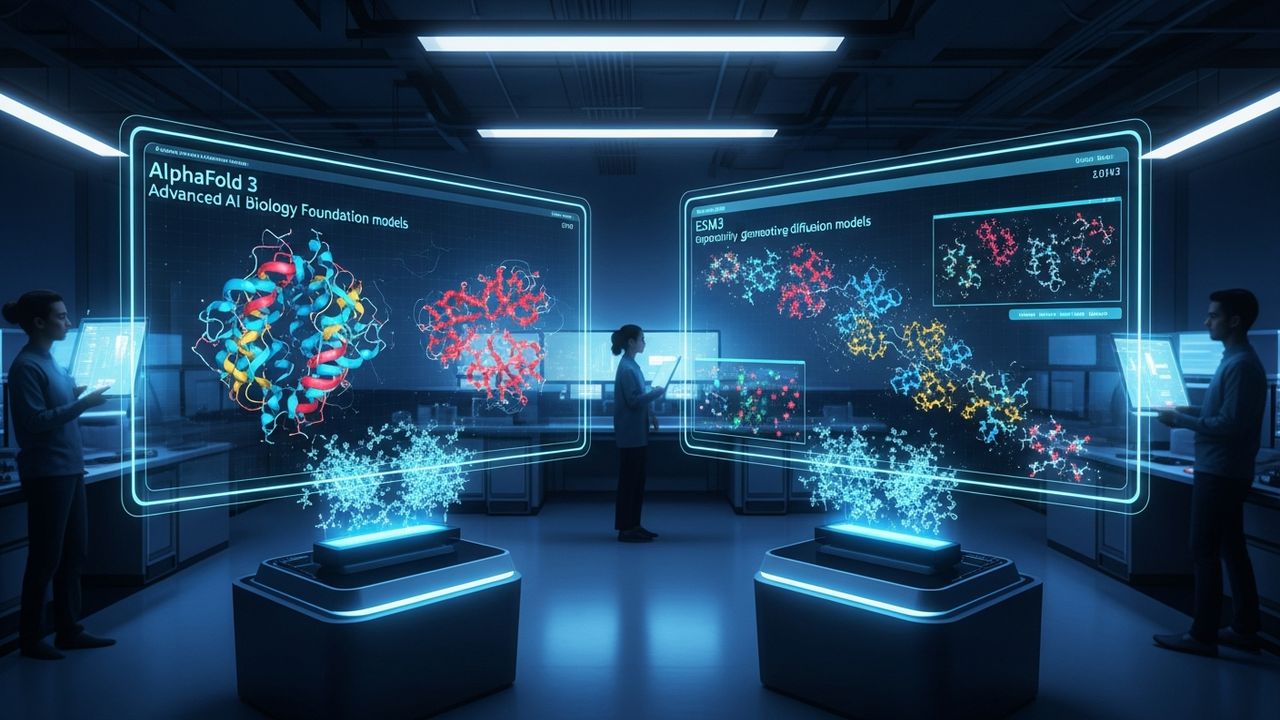
An IntuitionLabs article provides a detailed comparative analysis of leading AI biology foundation models, including AlphaFold 3 and ESM3. It particularly emphasizes that AlphaFold 3’s adoption of a generative diffusion architecture for predicting complex molecular complexes has dramatically enhanced its performance, establishing a new standard for AI-driven structural prediction in biology.
Technical / Clinical Details
The article describes three key AI biology foundation models in detail:
- AlphaFold 3: The latest model developed by Google DeepMind, predicting 3D atomic coordinates for various biomolecular complexes, including proteins, DNA, RNA, and ligands. While previous AlphaFold versions primarily focused on protein structure prediction, AlphaFold 3 has transitioned to a ‘generative diffusion model’ architecture. This change improves its ability to more accurately model interatomic interactions in complex molecular complexes and generate diverse conformations. This is crucial for drug discovery and understanding biological processes.
- ESM-3 (Evolutionary Scale Modeling): The latest generation of protein language models developed by Meta AI. It excels at predicting protein function and properties primarily from protein sequences. By learning from large protein sequence datasets and analyzing amino acid sequence patterns, it contributes to understanding protein evolution, the impact of mutations, and functional prediction.
- Boltz-2: A model that combines structure prediction with binding affinity prediction. While specific details are scarce in the article, this suggests its ability to predict not only molecular structures but also the strength of their binding to other molecules (e.g., drug candidates).
AlphaFold 3’s shift to a generative diffusion architecture indicates the evolution of AI capabilities from mere prediction to ‘generation,’ opening possibilities for more flexible modeling of unknown interactions and complex system behaviors, beyond just improving the accuracy of known structure predictions.
Background & Context
Structural prediction in biology has been a bottleneck in diverse research areas, including drug discovery, enzyme design, and elucidation of disease mechanisms. DeepMind’s AlphaFold series revolutionized this field, dramatically improving the accuracy of protein structure prediction. However, predicting complex interactions of proteins not just with themselves but also with other molecules like DNA, RNA, ligands, and ions, was the next major challenge. The adoption of new generative diffusion models indicates the evolution of AI to address this complexity.
Strategic Significance & Outlook
The advent of generative diffusion models like AlphaFold 3 will significantly transform the future of drug discovery and biotechnology. Researchers will be able to efficiently design novel drug candidate structures that bind to specific disease targets using AI, potentially accelerating development pipelines. Furthermore, a wide range of applications is expected, such as elucidating pathogen infection mechanisms and designing enzymes for new biofuel production. The evolution of AI biology foundation models will be a central driver of life science research in the coming decades.
Source: https://intuitionlabs.ai/articles/biology-foundation-models-comparison
Get our weekly technology intelligence — free
Receive an infographic that lets you judge at a glance whether each field’s analysis report is worth reading.
Subscribe Free — Weekly Tech Intelligence
By subscribing, you’ll receive Troy-Technical’s weekly technology intelligence newsletter.
- Your email and selected fields are used only to deliver the newsletter.
- We never share your information with third parties.
- You can unsubscribe anytime via the link in each email.
See our Privacy Policy for details.
Takes about a minute · Unsubscribe anytime








Comments