Key Findings
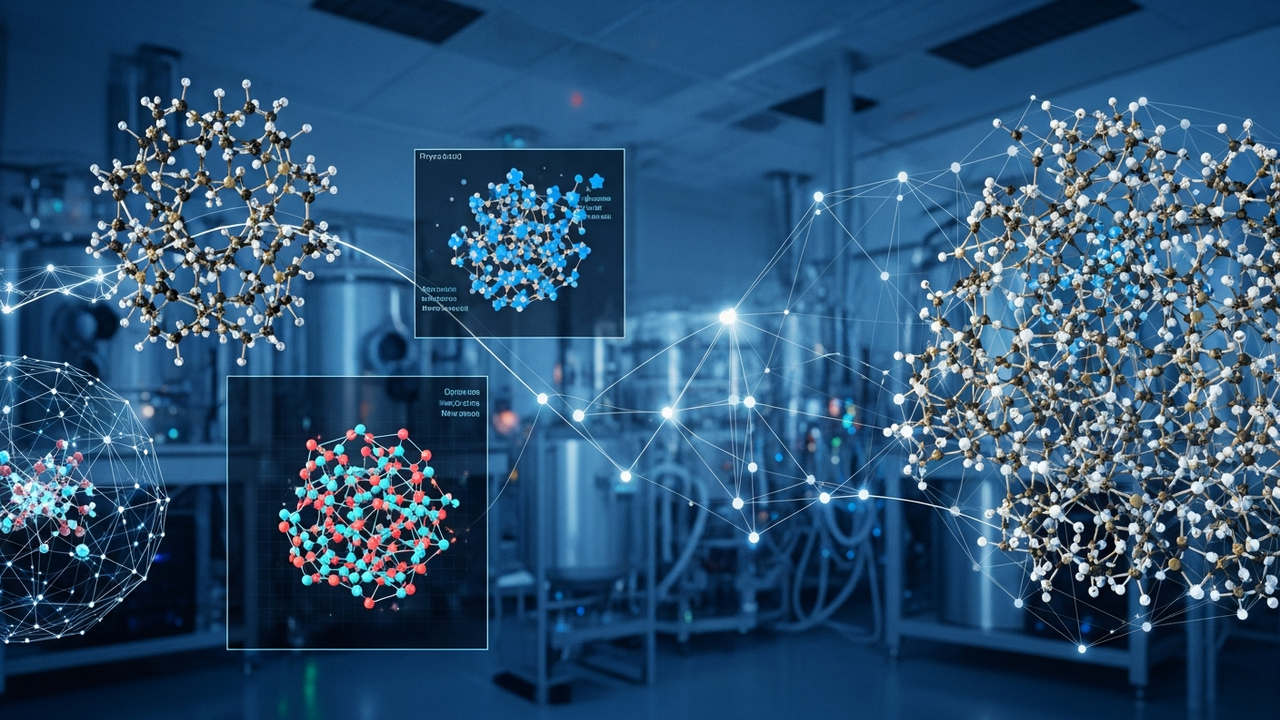
This study proposes a new ‘physics-driven computational paradigm’ for understanding and designing organic crystals that exhibit flexibility at low temperatures. By combining AI-assisted multiscale simulations and machine-learning force fields (MLFFs), it has enabled the reliable generation of mechanically viable and thermodynamically stable structural candidates, particularly in generative models for inverse design, by enforcing physical laws.
Technical / Clinical Details
Low-temperature flexible organic crystals hold promise for various advanced technological applications, including organic electronics and medical materials. However, understanding their complex dynamic behavior and structure-property relationships has been challenging. The paradigm proposed in this study integrates the following key elements:
- AI-Assisted Multiscale Simulation: AI models that simulate material behavior across multiple scales, from atomic to mesoscopic levels. This allows for a more accurate capture of interactions between different scales.
- Machine-Learning Force Fields (MLFFs): Describe interatomic interactions with accuracy comparable to first-principles calculations (DFT) while achieving computational efficiency on par with classical force fields. This enables MD simulations of large organic crystal systems.
- Enforcement of Physical Laws: The most critical aspect is the introduction of mechanisms that explicitly enforce physical laws (e.g., interatomic exclusion volume, bond length/angle constraints, energy minimization principles) within generative models for inverse design. This ensures that the structural candidates generated by AI are not merely statistical patterns learned from data but are also physically plausible and stable.
This physics-driven approach specifically enhances the reliability of generative models in predicting material behavior in ‘Out-of-Distribution’ (OOD) scenarios, particularly in cryogenic regions beyond the training dataset. By ensuring that generative models adhere to physical constraints, it effectively eliminates non-physical (or unstable) structural candidates that conventional black-box AI models tend to produce, enabling more efficient material exploration.
Background & Context
Organic crystals, with their diverse structures and tunable properties, are attracting attention as foundational materials for next-generation flexible electronics, sensors, and biomedical devices. However, predicting and controlling their flexibility and dynamic behavior, especially in low-temperature environments, has been a significant challenge due to their complexity. Traditional computational methods were often too computationally expensive or lacked sufficient accuracy, making rational design of such materials difficult. The introduction of AI offers new opportunities to overcome these challenges and enable faster, more accurate material design.
Strategic Significance & Outlook
The physics-driven computational paradigm holds the potential to revolutionize the design of low-temperature flexible organic crystals. This approach will accelerate the development of new high-performance materials in fields such as organic electronics, flexible displays, and smart wearable devices. In the future, this framework is expected to be further expanded and applied to other types of soft matter (e.g., polymers, liquid crystals) and the design of material responses to more complex external stimuli (e.g., electric fields, magnetic fields, light). This will usher in a more transparent and reliable era where AI leads scientific discovery and innovation.
Source: https://pubs.acs.org/doi/10.1021/jacs.6c00544
Get our weekly technology intelligence — free
Receive an infographic that lets you judge at a glance whether each field’s analysis report is worth reading.
Subscribe Free — Weekly Tech Intelligence
By subscribing, you’ll receive Troy-Technical’s weekly technology intelligence newsletter.
- Your email and selected fields are used only to deliver the newsletter.
- We never share your information with third parties.
- You can unsubscribe anytime via the link in each email.
See our Privacy Policy for details.
Takes about a minute · Unsubscribe anytime







Comments