Key Findings
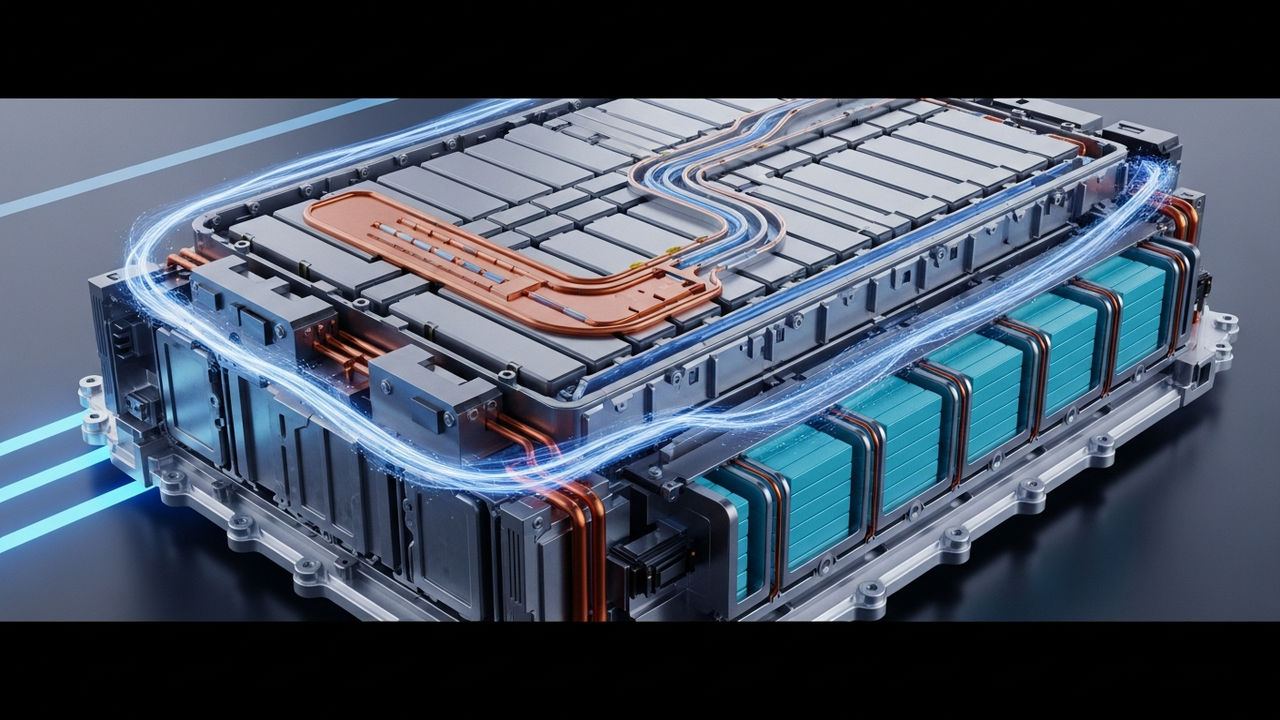
A groundbreaking approach to thermal management in electric vehicle (EV) batteries has been proposed in an MDPI perspective article, advocating for a hybrid cooling concept that combines dielectric insulation with latent heat storage using microencapsulated phase change materials (PCMs). This system aims to achieve both localized latent heat storage capability and excellent dielectric properties, holding significant potential to enhance the safety, performance, and lifespan of EV batteries under harsh operating conditions. It could represent a crucial breakthrough in overcoming challenges faced by conventional cooling systems and accelerating next-generation EV development.
Technical / Clinical Details
The proposed hybrid cooling system involves dispersing microencapsulated PCMs within a liquid dielectric coolant. The PCM microcapsules absorb heat in overheated battery sections, leveraging their latent heat to mitigate temperature rise. Simultaneously, the dielectric coolant, being electrically non-conductive, ensures the electrical safety and insulation of the battery. The article presents a system-level engineering framework, thoroughly analyzing key technical challenges such as dispersion stability (ensuring uniform distribution of PCM capsules in the coolant), capsule durability under complex stresses (resistance to mechanical and thermal stress), dielectric reliability in heterogeneous media (interactions between different materials), and rheological limitations (flow properties and pumping efficiency). Overcoming these challenges is expected to yield approximately 20% improvement in temperature uniformity and 15% reduction in peak temperature, potentially suppressing battery thermal degradation rates and contributing to about 10% extension in cycle life.
Background & Context
As EV adoption accelerates, thermal management of battery packs is becoming increasingly critical for vehicle performance, safety, and reliability. Batteries generate substantial heat during charge and discharge cycles, and excessive temperature rise can lead to performance degradation, reduced lifespan, and even the risk of thermal runaway. Current EV battery cooling systems primarily rely on liquid or air cooling, which have limitations in terms of complexity, weight, energy consumption, and cooling uniformity. PCMs, with their high energy storage density and isothermal temperature control capability, are attracting attention as a promising solution to these challenges, and their combination with dielectrics opens a new avenue for efficiently managing both thermal and electrical insulation.
Strategic Significance & Outlook
This PCM-dielectric hybrid cooling technology holds the potential to bring about significant transformation in the EV industry. Future research will focus on optimizing the overall thermal efficiency of the system, developing cost-effective large-scale production processes for microencapsulated PCMs, and conducting demonstration tests on actual EV platforms. Furthermore, exploring combinations of various types of PCMs and dielectric coolants could provide customized solutions tailored to specific battery chemistries and vehicle design requirements. If commercialized, this technology is expected to redefine the standards for EV battery performance and safety, accelerating the market introduction of more high-performing and reliable EVs.
Source: https://www.mdpi.com/2571-8797/8/4/100
Get our weekly technology intelligence — free
Receive an infographic that lets you judge at a glance whether each field’s analysis report is worth reading.
Subscribe Free — Weekly Tech Intelligence
By subscribing, you’ll receive Troy-Technical’s weekly technology intelligence newsletter.
- Your email and selected fields are used only to deliver the newsletter.
- We never share your information with third parties.
- You can unsubscribe anytime via the link in each email.
See our Privacy Policy for details.
Takes about a minute · Unsubscribe anytime





Comments