Key Findings
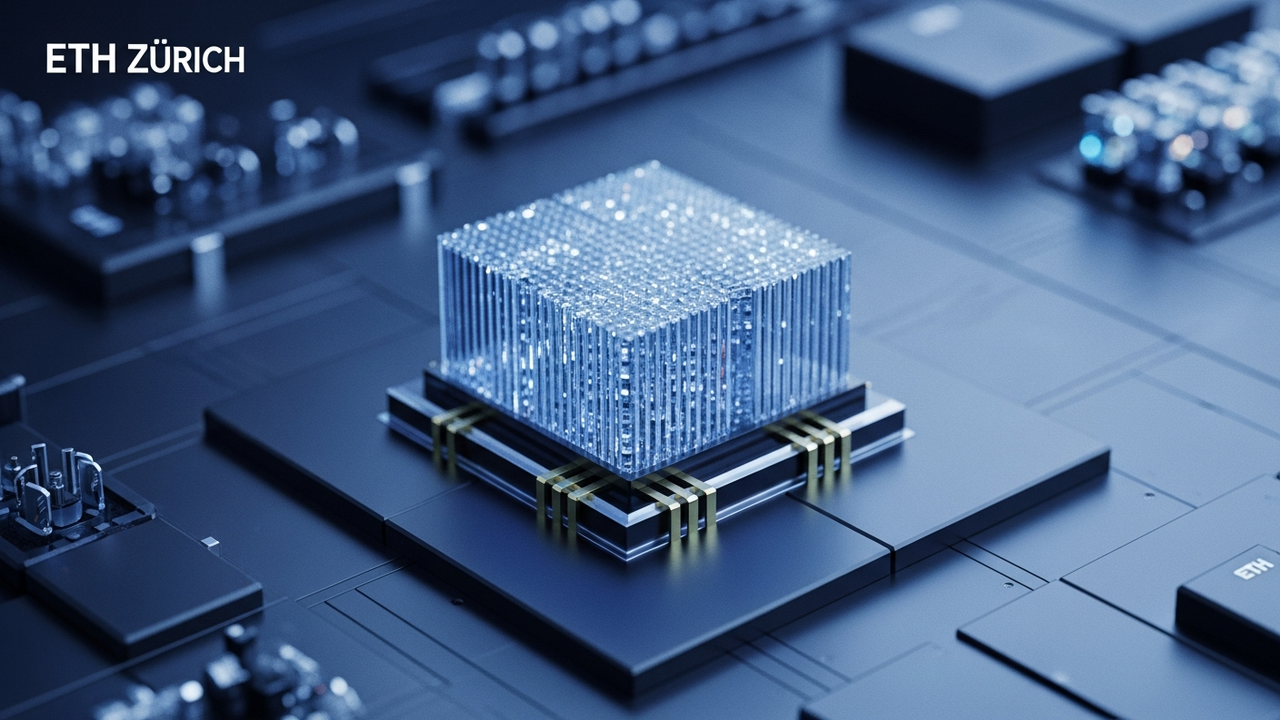
Researchers at ETH Zurich have introduced a novel quantum chip that utilizes mechanical vibrations to store and process information, offering a groundbreaking alternative to electromagnetic storage methods. This innovative approach has demonstrated a significant increase in information density within a substantially smaller volume, positioning it as a potential replacement or complement for the working memory of future quantum computers.
Technical / Clinical Details
The quantum chip integrates a superconducting transmon qubit, functioning as the central processing unit (CPU), with a high-overtone bulk acoustic wave resonator (HBAR) serving as quantum RAM. The HBAR generates microscopic mechanical vibrations, which are then used as carriers for quantum information. The system has successfully passed rigorous stress tests, including complex operations such as the quantum Fourier transform and a period-finding algorithm, demonstrating its capability to perform all fundamental computational steps required for arbitrary quantum computation. This mechanical resonance-based memory potentially offers higher storage capacity and improved coherence times compared to traditional quantum memory solutions.
Background & Context
One of the paramount challenges in scaling quantum computers is the development of efficient and stable quantum memory. Current quantum systems often face bottlenecks due to limited memory capacity and the inherent fragility of qubits. Traditional quantum memories, which typically rely on electromagnetic interactions, are prone to decoherence, where quantum information is lost due to environmental noise. The ETH Zurich team’s approach, by leveraging mechanical vibrations, provides a fresh perspective on overcoming these limitations, paving the way for more robust and high-density memory solutions.
Strategic Significance & Outlook
The successful development of this quantum chip utilizing mechanical vibrations marks a critical step towards the realization of scalable quantum computers. The enhanced information density and improved resistance to decoherence will empower future quantum processors to tackle more complex computational problems. Furthermore, this technology’s compatibility with on-chip phononic networks suggests its potential contribution to distributed quantum computing systems. This innovation is expected to provide more powerful and efficient computational resources, impacting diverse fields such as drug discovery, materials science, and artificial intelligence.
Get our weekly technology intelligence — free
Receive an infographic that lets you judge at a glance whether each field’s analysis report is worth reading.
Subscribe Free — Weekly Tech Intelligence
By subscribing, you’ll receive Troy-Technical’s weekly technology intelligence newsletter.
- Your email and selected fields are used only to deliver the newsletter.
- We never share your information with third parties.
- You can unsubscribe anytime via the link in each email.
See our Privacy Policy for details.
Takes about a minute · Unsubscribe anytime





Comments