Key Findings
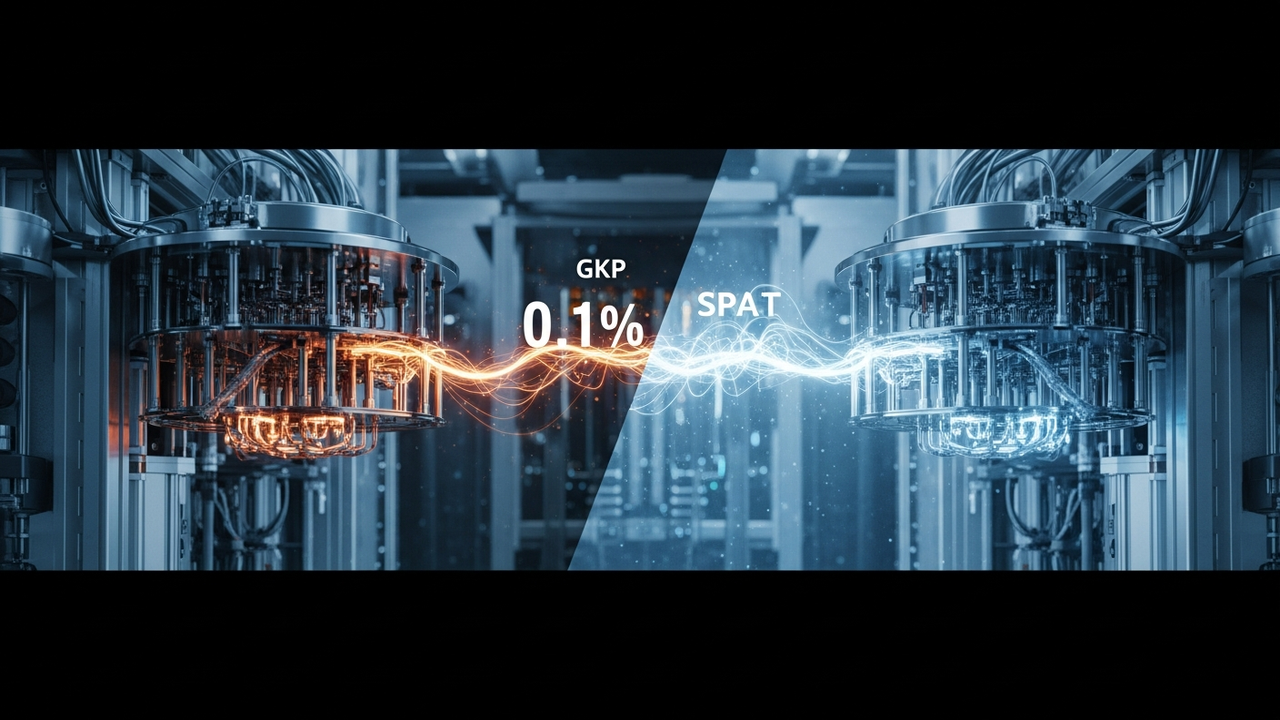
Nord Quantique has published research detailing a significant breakthrough in Quantum Error Correction (QEC), successfully reducing State Preparation and Measurement (SPAM) errors to an impressive level below 0.1%. This achievement represents an approximately 100-fold improvement compared to previous state-of-the-art results in Gottesman-Kitaev-Preskill (GKP) based systems, marking a crucial advancement towards realizing scalable and fault-tolerant quantum computing.
Technical / Clinical Details
SPAM errors are a major contributor to the overall loss of fidelity in quantum computations, occurring during the initialization of qubits and the measurement of their final states. Nord Quantique achieved this dramatic reduction in SPAM errors by employing a superconducting bosonic architecture. GKP qubits, a type of bosonic qubit that encodes quantum information in continuous variables, are considered highly promising candidates for quantum error correction. The company’s technology enables a near one-to-one physical qubit to logical qubit ratio, a stark contrast to traditional methods that often require many physical qubits to form a single logical qubit. This efficiency is paramount for significantly reducing the physical resources needed to build fault-tolerant quantum computers and simplifying system complexity.
Background & Context
One of the foremost challenges in bringing quantum computing to practical use is the extreme sensitivity of qubits to environmental noise, which leads to frequent errors. Quantum Error Correction (QEC) is an indispensable technique for detecting and correcting these errors, thereby enabling the construction of robust logical qubits. Bosonic codes, such as those utilizing GKP qubits, offer a distinct approach by leveraging continuous quantum information, differing from codes based on discrete binary qubits (e.g., spin or charge). Nord Quantique’s breakthrough advances the frontier of QEC research and highlights the competitive advantage of the superconducting bosonic approach in the race among various qubit architectures (superconducting, trapped-ion, neutral-atom) to achieve fault tolerance.
Strategic Significance & Outlook
Achieving SPAM errors below 0.1% and a 100-fold improvement in GKP-based systems opens a significant pathway towards scalable, fault-tolerant quantum computing. This accomplishment makes the construction of logical qubits capable of running complex quantum algorithms with higher fidelity a more tangible reality. Moving forward, Nord Quantique aims to further develop this technology and integrate more logical qubits into its systems, which will accelerate the practical adoption of quantum computing across diverse fields such as drug discovery, materials science, and financial modeling. This breakthrough is expected to have a positive ripple effect throughout the quantum industry, potentially shortening the timeline for the realization of truly fault-tolerant quantum computers.
Get our weekly technology intelligence — free
Receive an infographic that lets you judge at a glance whether each field’s analysis report is worth reading.
Subscribe Free — Weekly Tech Intelligence
By subscribing, you’ll receive Troy-Technical’s weekly technology intelligence newsletter.
- Your email and selected fields are used only to deliver the newsletter.
- We never share your information with third parties.
- You can unsubscribe anytime via the link in each email.
See our Privacy Policy for details.
Takes about a minute · Unsubscribe anytime





Comments