
Key Findings
Qcells has announced that its innovative perovskite-silicon tandem solar cell technology has received certification from the esteemed German testing agency TÜV Rheinland, complying with both the International Electrotechnical Commission’s (IEC) 61215 and Underwriters Laboratories’ (UL) 61215 standards for reliability and safety. This dual certification marks a critical step towards the commercial viability of this advanced photovoltaic technology.
Technical / Clinical Details
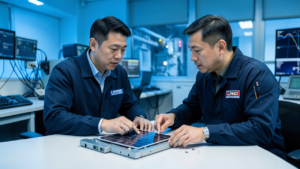
The certified perovskite-silicon tandem solar cell devices were produced at Qcells’ pilot line in Germany. These devices have achieved an impressive record tandem cell efficiency of 28.6%, significantly surpassing the theoretical efficiency limits of standalone silicon solar cells. IEC 61215 is an international standard evaluating the design qualification of crystalline silicon terrestrial and thin-film photovoltaic (PV) modules, while UL 61215 is a US certification standard for electrical product safety. Meeting these rigorous requirements demonstrates that Qcells’ tandem technology possesses the necessary practical durability and safety for real-world applications.
The tandem structure enables the perovskite layer to efficiently absorb blue light, while the underlying silicon layer captures red light, thereby converting a broader spectrum of sunlight into electricity. This allows for higher power generation from the same installation area, making it ideal for space-constrained locations and applications demanding high efficiency.
Background & Context
Qcells is a major player in the global photovoltaic market, with a long history at the forefront of silicon solar cell technology. Its investment in perovskite technology represents a strategic move to lead the next generation of solar energy solutions. TÜV Rheinland’s certification is essential for new technologies like perovskite solar cells, as it demonstrates compliance with established industry standards, thereby increasing confidence among investors, developers, and consumers. Historically, perovskites have garnered attention for high lab efficiencies, but assuring product reliability has been a significant challenge for commercialization.
Strategic Significance & Outlook
This certification is a crucial milestone for Qcells as it transitions its perovskite-silicon tandem technology towards mass manufacturing. It heralds a new era of competition in solar efficiency improvement and positions Qcells to be a leader amid accelerating global commercialization efforts for perovskite technology, such as the 10 GW partnership between Caelux and Indian firms (Article 9) slated for 2028. The market introduction of certified high-efficiency modules is expected to further reduce the Levelized Cost of Energy (LCOE) for solar power, making a substantial contribution to the widespread adoption of clean energy.
Get our weekly technology intelligence — free
Receive an infographic that lets you judge at a glance whether each field’s analysis report is worth reading.
Subscribe Free — Weekly Tech Intelligence
By subscribing, you’ll receive Troy-Technical’s weekly technology intelligence newsletter.
- Your email and selected fields are used only to deliver the newsletter.
- We never share your information with third parties.
- You can unsubscribe anytime via the link in each email.
See our Privacy Policy for details.
Takes about a minute · Unsubscribe anytime


Comments