
Key Findings: LBNL Establishes AI-Accelerated Framework to Optimize Complex Concentrated Alloys for Extreme Environments
Lawrence Berkeley National Laboratory (LBNL), under the U.S. Department of Energy’s (DOE) “Genesis Mission” project, has established an AI-accelerated framework for “Accelerated Alloy Engineering.” This groundbreaking framework is designed to dramatically expedite the design and optimization of Complex Concentrated Alloys (CCAs) capable of withstanding extreme environments in sectors such as aerospace, energy, and nuclear applications.
Technical & Business Details: Integrated Thermodynamic/Kinetic Modeling and Experimental Validation via Closed-Loop System
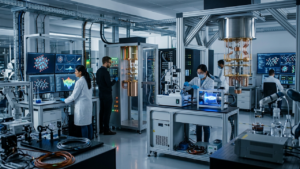
The core of this AI-accelerated framework is a “closed-loop system” that seamlessly integrates thermodynamic and kinetic modeling, rapid experimental synthesis, and atomic-scale structural characterization. AI proposes alloy compositions based on initial computational predictions, and materials are rapidly synthesized through automated processes. Subsequently, advanced tools like electron microscopy and X-ray diffraction are used to evaluate their atomic-level structures and properties, with these results fed back into the AI model to refine its predictions further. This iterative optimization cycle allows for the identification of optimal alloy compositions and process conditions in a much shorter timeframe compared to traditional trial-and-error development. It particularly excels in optimizing properties required in extreme environments, such as high-temperature strength, corrosion resistance, and radiation tolerance.
Background & Industry Context: Growing Demand for Extreme Environment Materials and Development Challenges
Modern high-performance technologies increasingly demand operation in ever-harsher environments. For instance, next-generation nuclear reactors, high-temperature gas turbines, and deep-space probes require materials with heat resistance, strength, corrosion resistance, and radiation tolerance beyond what conventional alloys can offer. However, the design space for these complex alloys is vast, and development based solely on experimentation is extremely time-consuming and costly. AI and materials informatics are gaining attention as powerful tools to overcome these bottlenecks, enabling faster and more efficient material discovery.Strategic Significance & Outlook: Contributions to Aerospace, Energy, and Nuclear Industries
The AI-accelerated framework established by LBNL holds the potential to fundamentally transform materials development in strategically critical industrial sectors like aerospace, energy, and nuclear. The rapid development of superior extreme environment materials will directly lead to enhanced energy efficiency, improved system safety and reliability, and the opening of new technological frontiers. This predictive and high-throughput material design pipeline is expected to bolster U.S. industrial competitiveness and contribute to national security. In the future, this approach is anticipated to be applied to other complex material systems, accelerating the efficiency and innovation across materials science R&D.
Source: https://www.lbl.gov/genesis-mission-projects/
Get our weekly technology intelligence — free
Receive an infographic that lets you judge at a glance whether each field’s analysis report is worth reading.
Subscribe Free — Weekly Tech Intelligence
By subscribing, you’ll receive Troy-Technical’s weekly technology intelligence newsletter.
- Your email and selected fields are used only to deliver the newsletter.
- We never share your information with third parties.
- You can unsubscribe anytime via the link in each email.
See our Privacy Policy for details.
Takes about a minute · Unsubscribe anytime







Comments