
Key Findings
The groundbreaking research ‘DDV-GNet: High-Throughput Defect Detection for Space Manufacturing via Deep Delta Gated Networks,’ presented at the IEEE SPace, Aerospace and defenCE Conference (SPACE 2026), has achieved a significant leap in efficiency and accuracy for defect detection in space manufacturing. This novel approach, leveraging deep delta gated networks, addresses a critical bottleneck in ensuring the reliability of components produced in the harsh orbital environment, which has historically been a significant challenge for in-space production technologies.
Technical Details
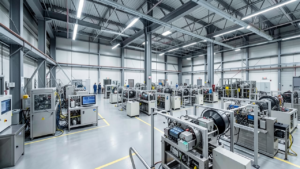
DDV-GNet employs an innovative neural network architecture that combines deep learning principles with advanced gating mechanisms. This design enables high-sensitivity identification of minuscule defects even from low-resolution or incomplete datasets. Unlike traditional image processing techniques, DDV-GNet exhibits superior noise tolerance and adaptability across diverse materials and manufacturing processes. For instance, it can effectively detect internal and surface defects in various structures common in space manufacturing, such as 3D-printed components and composite material joints, providing real-time feedback crucial for process optimization. Its robust framework is designed to operate under conditions distinct from Earth-based manufacturing, accounting for microgravity, radiation, and vacuum.
Background & Context
Quality assurance of components is paramount for in-space manufacturing activities, including orbital construction and lunar base development, aiming to reduce dependency on Earth-launched supplies. As the concept of ‘in-space manufacturing’ gains traction for sustained human presence beyond Earth, guaranteeing the reliability of locally produced parts becomes an urgent imperative. Transplanting conventional terrestrial inspection methods directly to space is often impractical due to the unique environmental factors. This research represents a vital step towards establishing a robust quality management system that functions effectively despite these extraterrestrial constraints.
Strategic Significance & Outlook
The deployment of DDV-GNet promises to significantly enhance autonomous manufacturing capabilities for future long-duration missions, including space stations, lunar habitats, and Mars exploration. Early detection of defects and rapid response not only boost mission safety and success rates but also contribute to substantial operational cost reductions for space assets. Future development will focus on expanding training datasets and optimizing the AI model for lighter weight and lower power consumption, paving the way for integration into small satellites and planetary rovers. Furthermore, the technology holds potential terrestrial applications in demanding industries such as nuclear power plant inspections and deep-sea exploration equipment manufacturing.
Source: https://ieeespace.org/wp-content/uploads/2026/07/IEEE-SPACE-2026_Program_18.07.2026.pdf
Get our weekly technology intelligence — free
Receive an infographic that lets you judge at a glance whether each field’s analysis report is worth reading.
Subscribe Free — Weekly Tech Intelligence
By subscribing, you’ll receive Troy-Technical’s weekly technology intelligence newsletter.
- Your email and selected fields are used only to deliver the newsletter.
- We never share your information with third parties.
- You can unsubscribe anytime via the link in each email.
See our Privacy Policy for details.
Takes about a minute · Unsubscribe anytime






Comments