
Key Findings
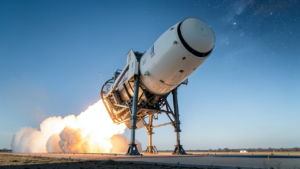
China has made a historic achievement with the Long March-10B rocket, successfully completing the world’s first controlled recovery of a reusable first-stage booster at sea using an innovative net capture system. This milestone unequivocally demonstrates a significant leap forward in China’s reusable rocket technology within its burgeoning space industry.
Technical & Mission Details
The successful recovery method involved deploying a specialized, large net at sea to capture the descending first-stage booster in mid-air. This approach is anticipated to offer several advantages over traditional vertical landing (VTVL) methods, potentially allowing for easier absorption of landing impacts and simpler rocket design or recovery vessel requirements. This Long March-10B mission is part of China’s ongoing efforts to operationalize reusable launch technology, representing a crucial step towards achieving low-cost and high-frequency access to space. The technology also holds the potential to increase launch flexibility and mitigate limitations of inland launch sites by integrating offshore launch and recovery capabilities.
Background & Industry Context
Reusable rocket technology has become a dominant global trend and a ‘game-changer’ in the space industry since its economic and operational efficiencies were demonstrated by SpaceX’s Falcon 9. Beyond its state-led space programs, China has seen active participation from private space companies in developing their own unique reusable technologies. The net capture system represents a distinct alternative to vertical landing methods that utilize landing legs, indicating China’s exploration of diverse technological pathways. This strategy aims to enhance China’s competitiveness in the global space market and solidify its position as a key player in the future space economy.
Strategic Significance & Outlook
The successful sea-based recovery of a reusable rocket using a net capture system introduces new strategic options for China’s space development. As this technology is further refined and put into practical use, China will be able to offer faster and more economical launch services for a wider variety of missions. Offshore launch and recovery, in particular, offer significant benefits for accessing specific orbital inclinations and avoiding impacts on densely populated areas. This will considerably expand the scope and flexibility of China’s space activities, including the deployment of satellite constellations, enhancement of space transport capabilities, and international space cooperation. This achievement is a vital step towards China’s long-term goal of becoming a ‘space superpower’ by 2045.
Source: https://www.alwihdainfo.com/chinas-sea-based-rocket-recovery-a-historic-milestone/
Get our weekly technology intelligence — free
Receive an infographic that lets you judge at a glance whether each field’s analysis report is worth reading.
Subscribe Free — Weekly Tech Intelligence
By subscribing, you’ll receive Troy-Technical’s weekly technology intelligence newsletter.
- Your email and selected fields are used only to deliver the newsletter.
- We never share your information with third parties.
- You can unsubscribe anytime via the link in each email.
See our Privacy Policy for details.
Takes about a minute · Unsubscribe anytime








Comments