Key Findings
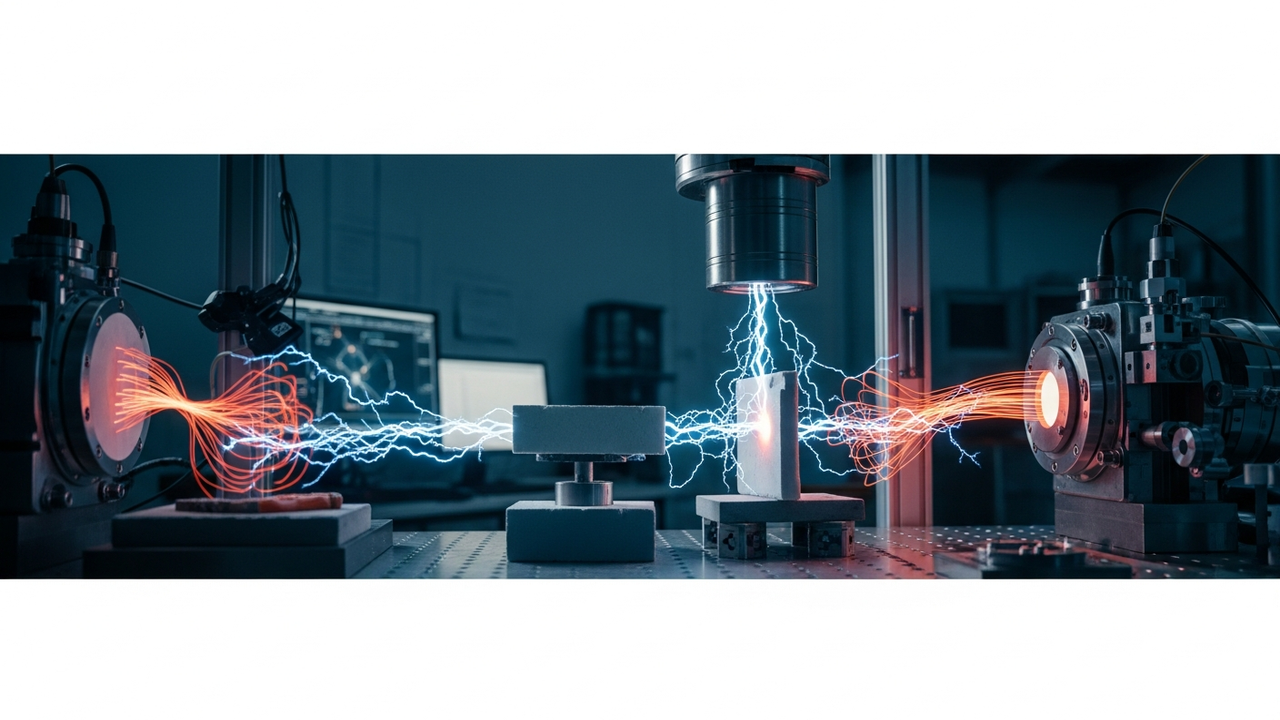
Scientists at Oak Ridge National Laboratory (ORNL) have successfully demonstrated a significant enhancement in the heat conduction of a specific ceramic material, boosting its thermal conductivity by approximately 300% along a particular direction through the application of an electric field. This remarkable discovery holds the potential to resolve long-standing challenges in thermal management and energy conversion fields.
Technical / Clinical Details
The ceramic material used in this study is a type of relaxor ferroelectric, which typically exhibits relatively low thermal conductivity. However, when the research team applied an external electric field to this material, they observed a dramatic change in the behavior of phonons (quantized lattice vibrations that carry thermal energy) within the material. Specifically, it is believed that the electric field slightly rearranges the crystal lattice structure of the material, which in turn reduces the pathways for phonon scattering. By reducing phonon scattering, phonons can move more freely through the material, leading to a significant increase in thermal conductivity. Experimental results confirmed that under specific electric field strengths and temperature conditions, the thermal conductivity reached approximately three times that of the non-electrically stimulated state. This controllable thermal conductivity enables precise heat flux management and dynamic thermal responses previously unachievable with conventional ceramic materials, offering a new paradigm in active thermal regulation.
Background & Context
For high-performance electronic devices, power electronics, and energy storage systems, efficient heat removal (‘cooling’) and effective utilization of waste heat (‘waste heat recovery’) are critically important. Current thermal management materials generally possess fixed thermal conductivity, making it challenging to adapt to dynamic thermal loads in systems. For example, while high thermal conductivity materials are needed for cooling high-heat-generating components, insulating materials are also required for energy efficiency—a significant trade-off. ORNL’s discovery introduces a new class of materials whose thermal conductivity can be precisely controlled by an electric field, offering an innovative solution to these challenges and enabling a shift from passive to active thermal management. This breakthrough aligns with national and global efforts to improve energy efficiency and sustainability in technological applications.
Strategic Significance & Outlook
The discovery of this electric field-controllable thermal conductive ceramic is poised to have a broad impact across various industrial sectors. For instance, in data center server cooling systems, the ability to adjust cooling capacity as needed can significantly improve energy efficiency. In electric vehicle battery management systems, dynamic control of thermal conductivity will enable optimal operating temperatures while preventing overheating. Furthermore, in waste heat recovery devices, thermal conductivity can be optimized according to temperature gradients to maximize recovery efficiency, leading to dramatic improvements in energy utilization. ORNL is further researching the stability, durability, and manufacturing scalability of this technology for practical implementation, positioning it as a potential pioneer in next-generation thermal management technologies globally, addressing critical challenges in energy and electronics.
Source: https://www.ornl.gov/news/electric-field-raises-heat-conduction-ceramic-nearly-300-ornl-study-finds
Get our weekly technology intelligence — free
Receive an infographic that lets you judge at a glance whether each field’s analysis report is worth reading.
Subscribe Free — Weekly Tech Intelligence
By subscribing, you’ll receive Troy-Technical’s weekly technology intelligence newsletter.
- Your email and selected fields are used only to deliver the newsletter.
- We never share your information with third parties.
- You can unsubscribe anytime via the link in each email.
See our Privacy Policy for details.
Takes about a minute · Unsubscribe anytime









Comments