Key Findings
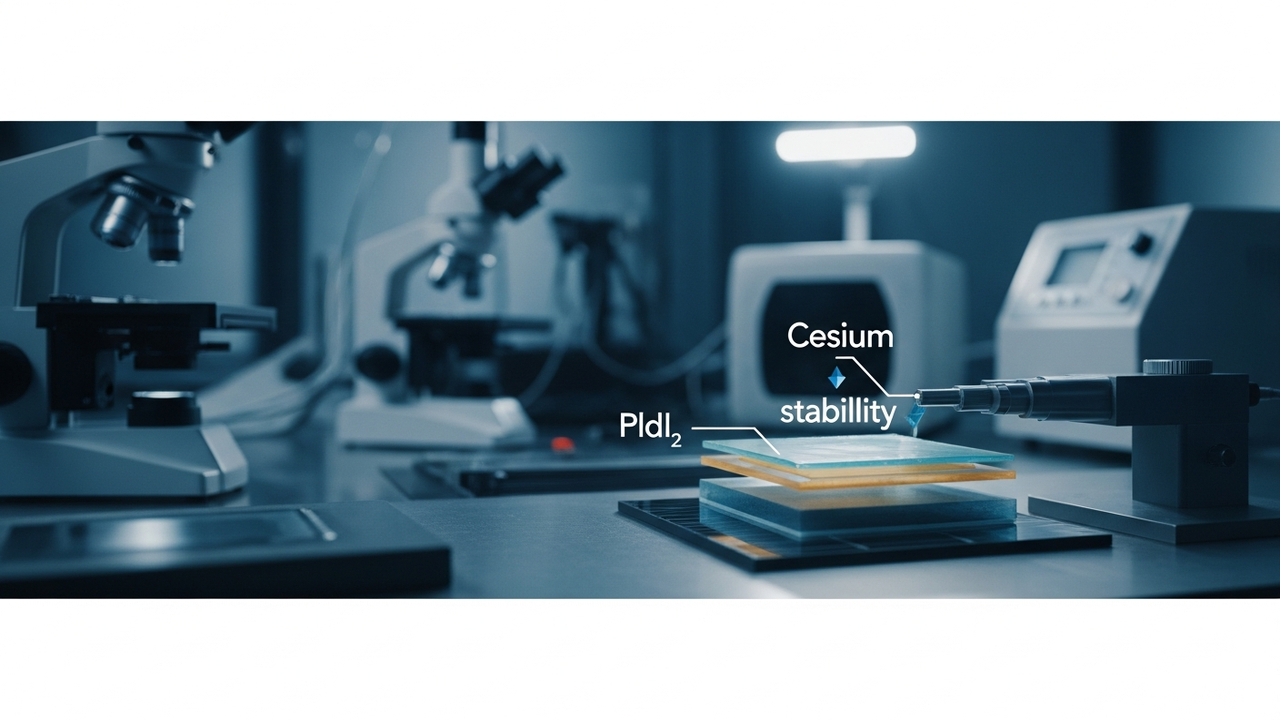
A novel two-step intercalation strategy has been developed, revolutionizing the performance and stability of air-processed MAPbI3 (methylammonium lead iodide) perovskite solar cells. This strategy employs a simple method of directly premixing cesium iodide (CsI) into the PbI2 precursor layer, which effectively regulates perovskite crystal growth and charge carrier dynamics. As a result, the devices achieved a high power conversion efficiency of 23.17% and demonstrated excellent operational stability, with unencapsulated devices retaining 97.7% of their initial efficiency under continuous operational illumination. Furthermore, durability was confirmed, maintaining 82% efficiency after 30 days of environmental storage, indicating a promising pathway to overcome the stability challenges critical for perovskite solar cell commercialization.
Technical / Clinical Details
MAPbI3 perovskite, while possessing high light absorption capabilities, has been plagued by instability issues, particularly its sensitivity to moisture and heat. This research fundamentally improves the perovskite crystalline film formation process by adding CsI to the PbI2 precursor layer. The Cs cations influence the nucleation and growth rate of the perovskite crystals, leading to the formation of denser, less defective crystalline structures. This reduction in charge carrier recombination losses enhances both open-circuit voltage and fill factor, culminating in a final power conversion efficiency of 23.17%. Crucially, these devices were fabricated under ambient air conditions. Achieving high performance and excellent stability (97.7% under continuous illumination, 82% after 30 days of environmental storage) in such a relatively simple environment directly translates to reduced manufacturing costs and improved scalability. Traditionally, perovskite solar cells required strict atmospheric control during fabrication, but this technology significantly contributes to simplifying the manufacturing process.
Background & Context
Perovskite solar cells are garnering significant attention as a next-generation photovoltaic technology due to their potential to achieve efficiencies comparable to or even surpassing silicon solar cells. However, challenges related to humidity sensitivity during manufacturing and long-term stability have hindered their widespread commercialization. Air-processing, in particular, is highly attractive for cost reduction and scalability but often comes with the risk of performance degradation. The control of crystal growth and carrier dynamics through CsI addition demonstrated in this study offers a groundbreaking approach to resolve this stability issue under air-processing conditions. This technology has the potential to drastically reduce manufacturing costs by eliminating the need for expensive equipment like gloveboxes, thereby significantly boosting the market competitiveness of perovskite solar cells.
Strategic Significance & Outlook
This CsI intercalation strategy, combining 23.17% high efficiency with excellent air-processed stability, is poised to be a crucial technology accelerating the commercialization of perovskite solar cells. Future work will focus on scaling up this technology for larger areas, conducting further long-term durability tests under various environmental conditions, and assessing its applicability to mass production processes. The ability to manufacture in ambient air is particularly important, as it can facilitate solar power adoption in a wider range of regions, including developing countries, significantly contributing to the spread of sustainable energy sources. This breakthrough represents a decisive step for perovskite solar cells to fully enter the mainstream market.
Source: https://pubs.rsc.org/en/content/articlelanding/2026/ra/d6ra00000a
Get our weekly technology intelligence — free
Receive an infographic that lets you judge at a glance whether each field’s analysis report is worth reading.
Subscribe Free — Weekly Tech Intelligence
By subscribing, you’ll receive Troy-Technical’s weekly technology intelligence newsletter.
- Your email and selected fields are used only to deliver the newsletter.
- We never share your information with third parties.
- You can unsubscribe anytime via the link in each email.
See our Privacy Policy for details.
Takes about a minute · Unsubscribe anytime