Key Findings
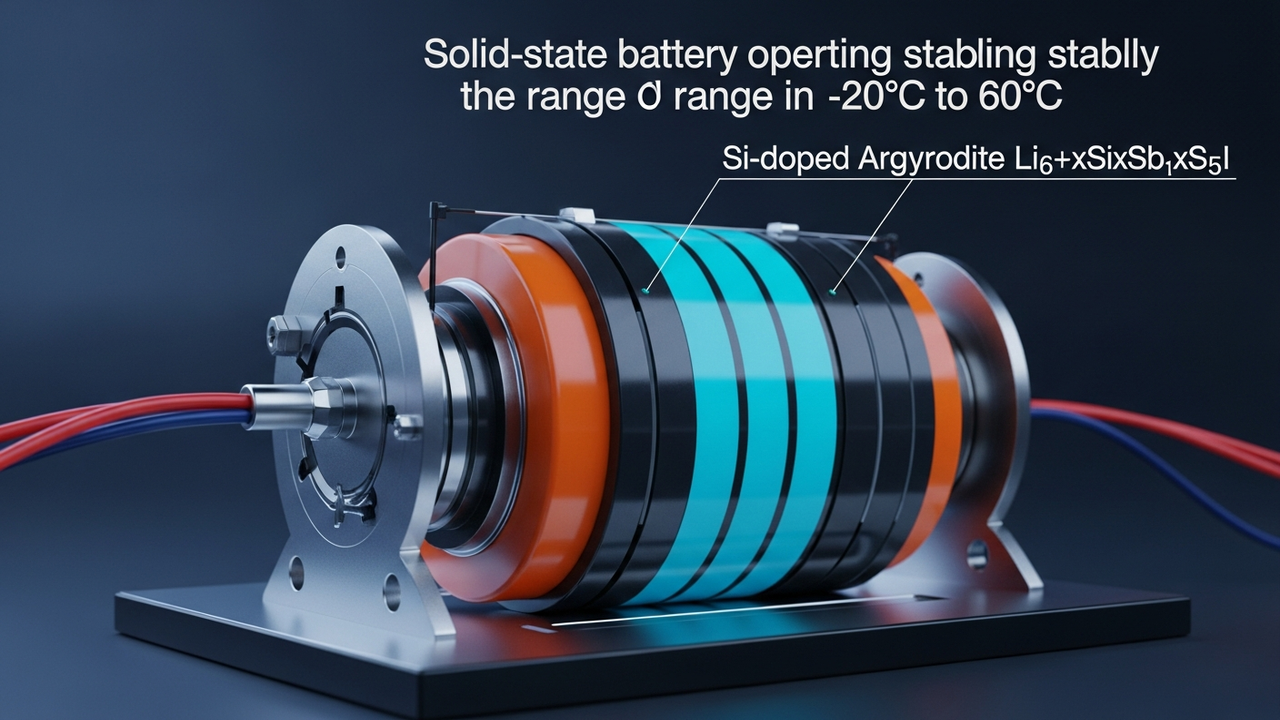
Stable operation of all-solid-state batteries across a broad temperature range is a critical factor for their practical implementation. This research demonstrates that an all-solid-state battery, fabricated by combining a Si-doped antimony argyrodite Li6+xSixSb1-xS5I electrolyte with an LiNbO3-coated LiNi0.7Co0.1Mn0.2O2 (NCM) cathode, maintains stable cycling performance within a remarkably wide temperature range, specifically from -20°C to 60°C. Achieving an initial discharge capacity of 171.2 mAh g-1 and an impressive 84.2% capacity retention after 200 cycles, this breakthrough paves the way for reliable, high-performance next-generation all-solid-state batteries capable of operating under harsh thermal conditions.
Technical / Clinical Details
This innovative all-solid-state battery utilizes the sulfide-based solid electrolyte Li6+xSixSb1-xS5I to achieve both high ionic conductivity and superior interfacial stability. This argyrodite-type electrolyte is characterized by its ability to facilitate rapid lithium ion transport, particularly exhibiting high ionic conductivity at room temperature. Furthermore, the cathode material, LiNi0.7Co0.1Mn0.2O2, is coated with LiNbO3 (lithium niobate) to reduce interfacial resistance and suppress detrimental side reactions between the electrolyte and electrode. This strategic modification significantly enhances stability during charge-discharge cycles across the extended temperature range. Specifically, the battery delivered an initial discharge capacity of 171.2 mAh g-1 and maintained a high capacity retention of 84.2% after 200 cycles. Its ability to sustain stable performance even at low temperatures (-20°C) is a crucial advancement for electric vehicles (EVs) and other applications operating in extreme climates.
Background & Context
All-solid-state batteries are garnering significant attention as a next-generation battery technology due to their potential for higher energy density and improved safety compared to existing lithium-ion batteries. However, sulfide-based solid electrolytes, in particular, have long struggled with challenges such as air stability and performance degradation due to interfacial side reactions with lithium metal anodes. Poor performance in low-temperature environments has also been a major barrier. The stable operation across a wide temperature range demonstrated in this study presents a concrete material design and interfacial engineering strategy to overcome these issues, marking a significant step towards the practical application of all-solid-state batteries. This expands the potential regions and applications where all-solid-state batteries can be utilized.
Strategic Significance & Outlook
The all-solid-state battery developed in this research, utilizing the Li6+xSixSb1-xS5I electrolyte, exhibits a clear advantage over existing technologies in terms of wide-temperature stability. Future challenges will include further extending cycle life, adapting to higher voltages, and simplifying manufacturing processes while reducing costs. This achievement is expected to find applications in sectors demanding highly reliable batteries under various thermal conditions, such as electric vehicles (EVs), aerospace, and stationary energy storage systems. Notably, it could be a pivotal technology for accelerating EV adoption in regions with extremely cold or hot climates.
Source: https://arxiv.org/html/2607.19664v1
Get our weekly technology intelligence — free
Receive an infographic that lets you judge at a glance whether each field’s analysis report is worth reading.
Subscribe Free — Weekly Tech Intelligence
By subscribing, you’ll receive Troy-Technical’s weekly technology intelligence newsletter.
- Your email and selected fields are used only to deliver the newsletter.
- We never share your information with third parties.
- You can unsubscribe anytime via the link in each email.
See our Privacy Policy for details.
Takes about a minute · Unsubscribe anytime