Key Findings
This research, published in ACS Energy Letters, meticulously elucidates the decomposition mechanism of quinone-based electrodes within sulfide all-solid-state batteries. This groundbreaking discovery resolves a long-standing paradox where sulfide solid electrolytes, while suppressing benzoquinone decomposition, simultaneously induce severe degradation at the electrode-electrolyte interface. The study clearly demonstrates that both nucleophilic attack and proton-driven self-discharge contribute synergistically to the overall degradation process, emphasizing the critical importance of resistance to initial nucleophilic attack in future organic electrode material designs.
Technical / Clinical Details
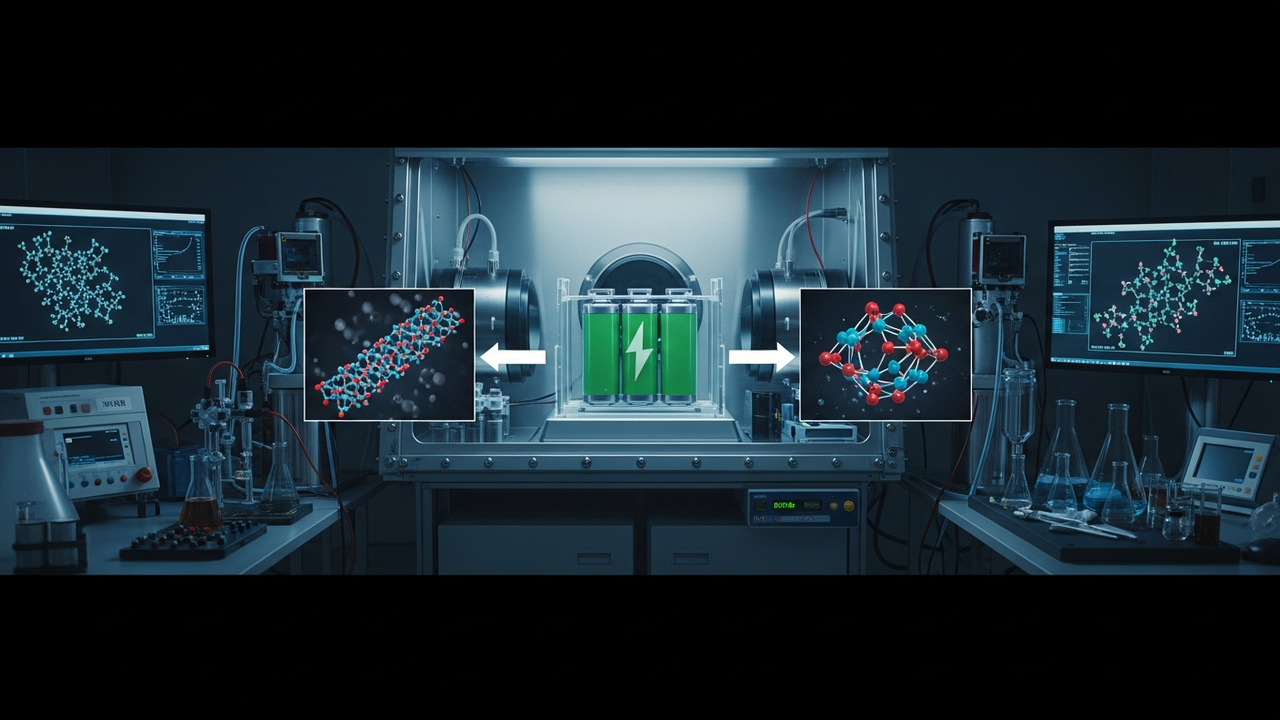
Quinone-based organic electrode materials are drawing significant attention as promising candidates for next-generation batteries due to their high theoretical capacity and abundant resources. However, interfacial stability has been a major challenge, particularly in all-solid-state batteries employing sulfide solid electrolytes. This study utilized advanced analytical techniques, including operando DEMS (Differential Electrochemical Mass Spectrometry) and XPS (X-ray Photoelectron Spectroscopy), to meticulously track electrode degradation behavior during charge-discharge cycles. The results revealed that ‘nucleophilic attack’ by nucleophilic sulfide ions from the electrolyte on the carbonyl groups of the electrode, combined with ‘proton-driven self-discharge’ caused by trace amounts of water or protic impurities within the electrolyte, simultaneously accelerate the decomposition of the electrode material. Understanding this complex, combined degradation mechanism provides more effective guidelines for designing electrode materials and interfacial protection layers to enhance the performance and stability of sulfide all-solid-state batteries.
Background & Context
All-solid-state batteries are anticipated as the ‘holy grail’ for improving safety and energy density in electric vehicles (EVs) and stationary energy storage systems. Sulfide solid electrolytes are among the most promising candidates due to their high ionic conductivity, yet challenges concerning their chemical and electrochemical stability at the electrode interface persist. Organic electrode materials are actively researched for their low cost and environmental friendliness, but the unclear decomposition mechanisms have hindered their practical application. The findings of this study provide crucial scientific insights to resolve this fundamental problem, thereby accelerating the development of high-performance all-solid-state batteries.
Strategic Significance & Outlook
The insights gained from this research on decomposition mechanisms will directly inform the design of new organic electrode materials that are resistant to initial nucleophilic attack, or the development of innovative interfacial layers to protect the interface between the electrolyte and electrode. For example, forming barrier layers against nucleophilic sulfide ions or improving techniques for removing protic impurities could be explored. This is expected to significantly enhance the cycle life and energy efficiency of sulfide all-solid-state batteries, accelerating their commercialization in various applications, including electric vehicles. Ultimately, this will contribute to the realization of more sustainable and high-performance energy storage systems.
Source: https://pubs.acs.org/doi/10.1021/acsenergylett.6c01251
Get our weekly technology intelligence — free
Receive an infographic that lets you judge at a glance whether each field’s analysis report is worth reading.
Subscribe Free — Weekly Tech Intelligence
By subscribing, you’ll receive Troy-Technical’s weekly technology intelligence newsletter.
- Your email and selected fields are used only to deliver the newsletter.
- We never share your information with third parties.
- You can unsubscribe anytime via the link in each email.
See our Privacy Policy for details.
Takes about a minute · Unsubscribe anytime