Key Findings
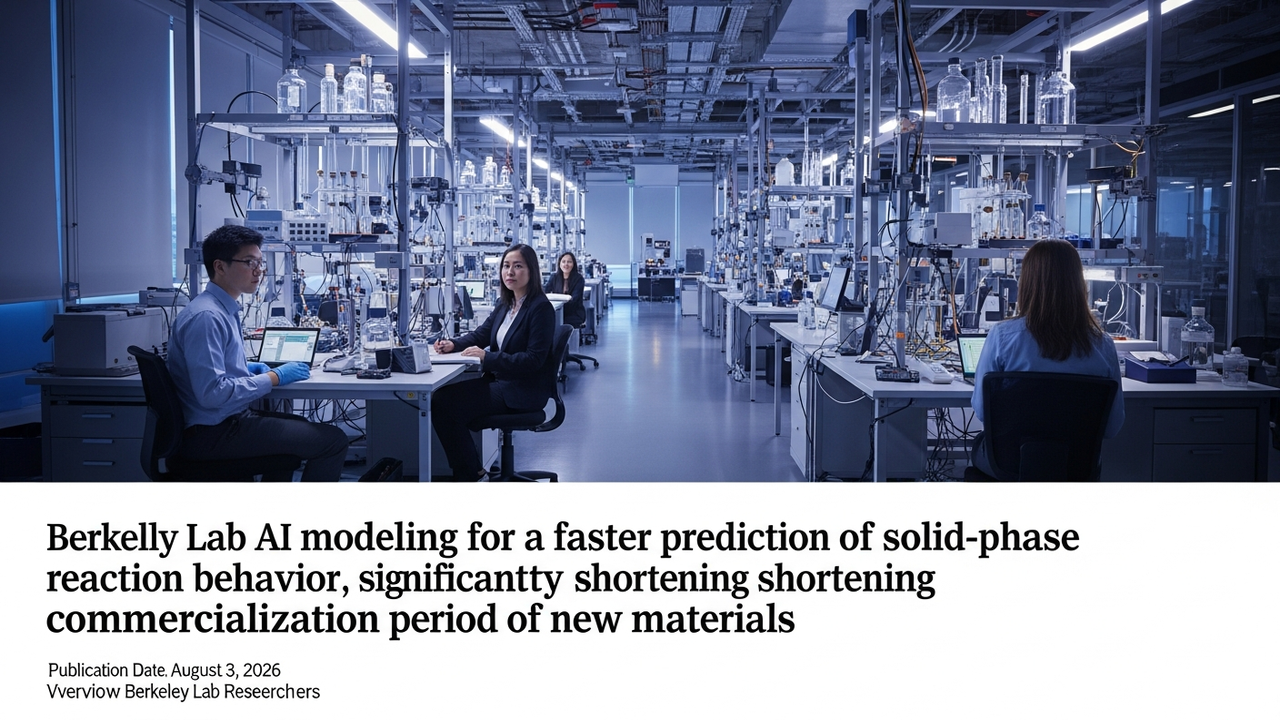
Scientists at Lawrence Berkeley National Laboratory (Berkeley Lab) have pioneered a novel AI modeling approach capable of accurately and rapidly predicting the progression of solid-state reactions over time. This represents the first predictive model to account for atomic travel during these complex reactions, providing invaluable insights into optimal synthesis recipes for advanced materials. This breakthrough has the potential to dramatically accelerate the commercialization process for new solid materials, marking a significant advancement in materials science.
Technical / Clinical Details
Solid-state reactions are fundamental to numerous industrial processes, including powder metallurgy, ceramic manufacturing, and battery material synthesis. However, the diffusion and rearrangement of atoms within solids are intricate phenomena, and previous modeling techniques struggled to accurately predict these dynamic changes. The newly developed AI modeling approach overcomes this challenge by combining machine learning algorithms with fundamental principles of physics. Specifically, the model learns the detailed pathways of atomic movement during reactions and predicts microstructural changes at an atomic level. This allows researchers to optimize synthesis parameters such such as temperature, pressure, and duration, required to form specific materials, without extensive trial-and-error experimentation. The research was published in the prestigious journal ‘Nature Materials,’ underscoring its scientific rigor. This predictive capability is applicable not only to the design of new functional materials but also to the improvement of existing materials and failure analysis, substantially boosting efficiency in materials engineering.
Background & Context
The development and market introduction of new materials are crucial for the advancement of modern technology, yet these processes typically demand vast amounts of time and considerable resources. The optimization of synthesis conditions in laboratories, particularly, has traditionally been centered on iterative, trial-and-error experimentation, creating a significant bottleneck. Next-generation materials, demanded across various sectors like batteries, catalysts, and high-performance alloys, often possess complex compositions and microstructures, making their design difficult with conventional empirical rules or simple models. Berkeley Lab’s AI-driven approach is designed to alleviate this materials development bottleneck, enabling faster and more efficient innovation. This positions it as a critical strategic tool for the United States to gain an advantage in the advanced materials development race.
Strategic Significance & Outlook
The implementation of this AI modeling approach is expected to significantly accelerate the commercialization of new functional solid materials. Developers will be able to find optimal synthesis recipes in shorter periods with fewer resources, driving dramatic progress in the development of next-generation energy storage devices, semiconductors, and structural materials. In the future, this technology represents a crucial step toward realizing ‘autonomous materials laboratories,’ where experimental work and AI simulations are integrated, potentially leading to a future where materials are designed and optimized without human intervention. This is a groundbreaking advancement with the potential to fundamentally transform the efficiency and speed of innovation in materials science research worldwide.
Get our weekly technology intelligence — free
Receive an infographic that lets you judge at a glance whether each field’s analysis report is worth reading.
Subscribe Free — Weekly Tech Intelligence
By subscribing, you’ll receive Troy-Technical’s weekly technology intelligence newsletter.
- Your email and selected fields are used only to deliver the newsletter.
- We never share your information with third parties.
- You can unsubscribe anytime via the link in each email.
See our Privacy Policy for details.
Takes about a minute · Unsubscribe anytime