Key Findings
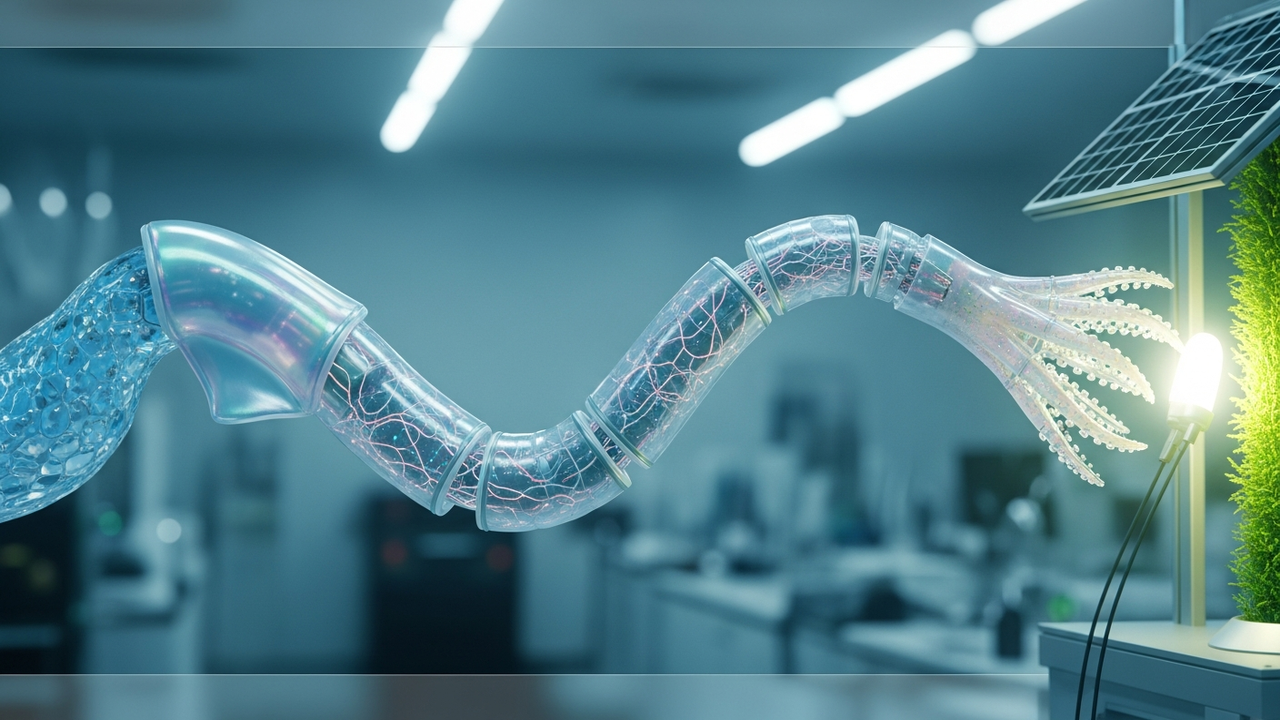
This review article provides a detailed analysis of recent advancements and future prospects for thermo-responsive materials, aiming to enable soft robots powered by sustainable energy sources. It specifically focuses on key smart materials such as shape-memory materials, liquid crystalline elastomers (LCEs), and hydrogels, elucidating their unique characteristics and the challenges associated with integrating them into autonomous soft robotic systems. This comprehensive analysis offers crucial guidelines for developing environmentally friendly and energy-efficient robots.
Technical / Clinical Details
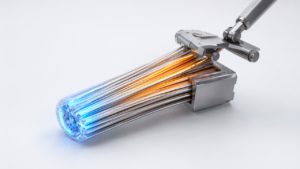
The review delves into the mechanisms and application potentials of each thermo-responsive material. Liquid Crystal Elastomers (LCEs) are highlighted for their ability to undergo large reversible strains (typically over tens of percent) and precise anisotropic shape changes (contraction/elongation only in specific directions) when their molecular alignment shifts in response to external stimuli like heat or light. These properties are considered ideal for soft robots requiring delicate actuation and complex movements. However, challenges related to LCEs’ response speed, durability, and thermal stability currently limit their widespread use in practical autonomous robots. In contrast, Shape Memory Alloys (SMAs) are lauded for their faster response speeds to temperature changes and their capacity to exert higher forces and stiffness compared to Shape Memory Polymers (SMPs). SMAs, such as nickel-titanium alloys (NiTi), possess the property of reverting to their original shape above a specific phase transition temperature, offering the advantage of direct alignment with ambient temperature fluctuations. Hydrogels are noted for their significant volume change in response to water content, making them promising for biomimetic robots and biocompatible devices, particularly in medical applications.
Background & Context
Soft robotics has rapidly advanced in recent years as a technology capable of overcoming safety issues and limited adaptability to complex, unstructured environments inherent in conventional rigid robots. Their flexibility and adaptability are highly valued, especially for safe human-robot collaboration, medical applications (e.g., endoscopes, surgical assistance), and exploration activities. However, driving these soft robots often requires external tethers such as pumps or compressed air sources, which limits their autonomy. The realization of soft robots powered by sustainable energy sources (e.g., solar, waste heat, biochemical reactions) is critical to solving this tethering problem and developing truly autonomous, environmentally friendly robotic systems. This review provides material selection and design guidelines to accelerate progress in this vital field.
Strategic Significance & Outlook
Further research into thermo-responsive materials, particularly LCEs and shape-memory alloys, is key to realizing high-performance soft robots powered by sustainable energy. If challenges related to LCEs’ response speed and durability can be overcome, they will bring innovation to diverse fields such as medicine, wearable devices, and industrial grippers as more precise and efficient artificial muscles. Furthermore, the hybridization of different materials like SMAs, LCEs, and hydrogels is expected to lead to the development of more complex and functional soft robotic systems with multiple actuation modes. Ultimately, a future is envisioned where soft robots, capable of harvesting energy from the environment and functioning autonomously for extended periods, will excel in missions previously deemed difficult, such as surveillance, environmental monitoring, and disaster response, thereby significantly contributing to a more sustainable and resilient society.
Source: https://pmc.ncbi.nlm.nih.gov/articles/PMC13178080/
Get our weekly technology intelligence — free
Receive an infographic that lets you judge at a glance whether each field’s analysis report is worth reading.
Subscribe Free — Weekly Tech Intelligence
By subscribing, you’ll receive Troy-Technical’s weekly technology intelligence newsletter.
- Your email and selected fields are used only to deliver the newsletter.
- We never share your information with third parties.
- You can unsubscribe anytime via the link in each email.
See our Privacy Policy for details.
Takes about a minute · Unsubscribe anytime