Background
Perovskite solar cells (PSCs) continue to excite the renewable energy sector with their remarkable potential for high power conversion efficiencies. However, translating these laboratory-scale triumphs into large-area, industrially viable production has remained a formidable hurdle. A critical missing piece has been the development of scalable coating techniques that can maintain high performance. This latest research effectively bridges this gap by combining a cost-effective, large-area deposition method—blade coating—with advanced interfacial engineering to maximize device performance, significantly clarifying the commercialization pathway for perovskite solar cells.
Key Findings
In a significant advancement for perovskite solar cell (PSC) technology, a research team has developed an innovative co-deposition strategy leveraging multidentate thiol anchoring molecules that is fully compatible with blade coating, a highly scalable manufacturing technique. This novel approach has enabled the fabrication of small-area PSCs with an astonishing champion power conversion efficiency (PCE) of 26.60% (independently certified at 26.23%). This efficiency stands among the highest reported for PSCs fabricated using scalable coating methods. Furthermore, the team successfully demonstrated the scalability of their technique by achieving 23.31% PCE on a practical 20.9 cm² mini-module, a crucial step towards industrial application.
Technical Details and Manufacturing Innovation
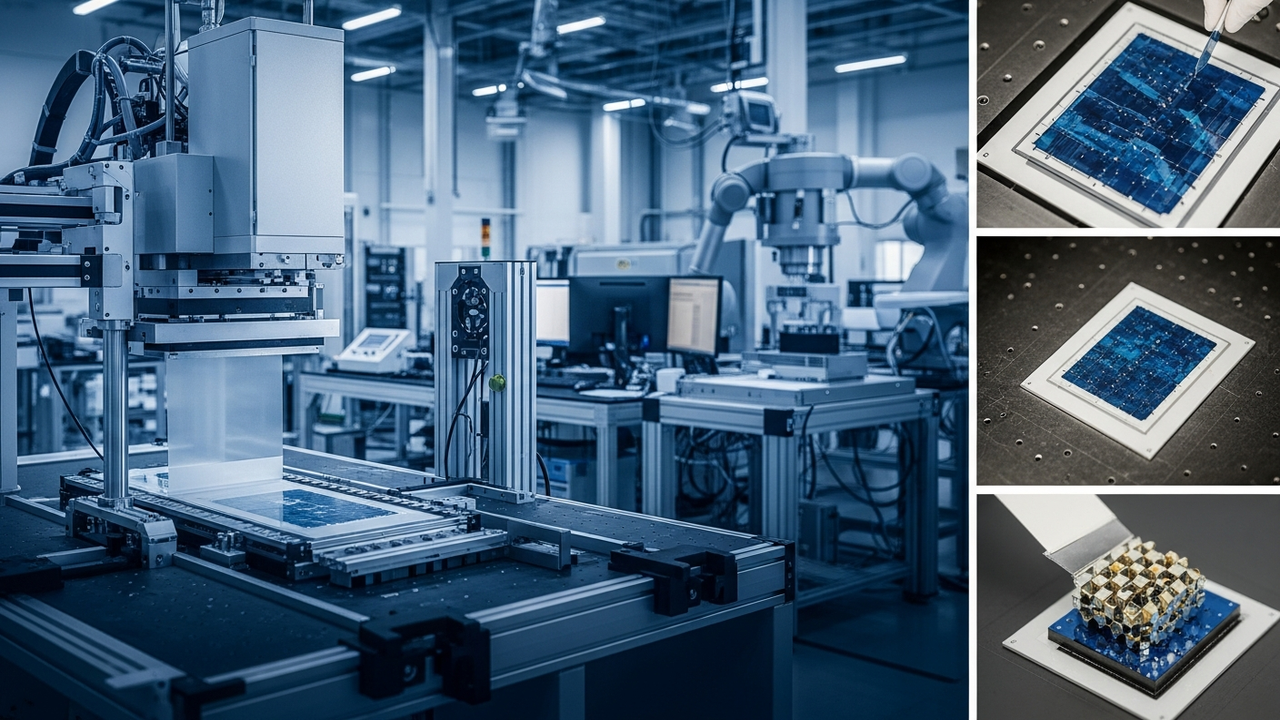
- Blade Coating for Scalability: Unlike laboratory-scale spin coating, blade coating is a high-throughput, cost-effective technique inherently suitable for large-area deposition. Its successful integration with advanced interfacial engineering represents a major breakthrough, making industrial production of perovskite solar cells more viable.
- Multidentate Thiol Anchoring Molecules in SAMs: The core innovation lies in the use of multidentate (multiple-binding-site) thiol molecules within self-assembled monolayers (SAMs). These molecules form strong, stable chemical bonds at the critical interface between the perovskite layer and the charge transport layer (typically the hole transport layer). This robust anchoring and improved interfacial contact are vital for effectively passivating defects, such as undercoordinated lead ions, which are primary sources of non-radiative recombination and efficiency loss.
- Reduced Interfacial Stress: The SAM modification also plays a crucial role in alleviating interfacial stress. This stress often arises from mismatches in thermal expansion coefficients between different layers of the solar cell. Reducing this stress contributes to enhanced mechanical stability and can significantly improve the long-term durability of the device.
Strategic Significance and Outlook
This blade-coating compatible co-deposition strategy represents a crucial breakthrough for the mass production of perovskite solar cells. The combination of world-class high efficiency in small devices and demonstrated scalability to a practical mini-module size significantly enhances the prospects for manufacturing high-performance perovskite solar modules at low cost and on a gigawatt scale. Future work will likely focus on comprehensive long-term stability assessments of modules fabricated with this technique and further performance verification on even larger module sizes. This advancement is expected to play a vital role in improving the cost-performance ratio of solar power, accelerating the global adoption of next-generation renewable energy technologies, and helping to meet ambitious clean energy targets worldwide.
Get our weekly technology intelligence — free
Receive an infographic that lets you judge at a glance whether each field’s analysis report is worth reading.
Subscribe Free — Weekly Tech Intelligence
By subscribing, you’ll receive Troy-Technical’s weekly technology intelligence newsletter.
- Your email and selected fields are used only to deliver the newsletter.
- We never share your information with third parties.
- You can unsubscribe anytime via the link in each email.
See our Privacy Policy for details.
Takes about a minute · Unsubscribe anytime