Background
Lead-free perovskite solar cells are critically important from environmental, regulatory, and sustainability perspectives, offering a promising alternative to their lead-based counterparts. However, they often exhibit lower performance and inherent stability challenges compared to traditional lead-halide perovskites. This study specifically investigates CH3NH3SnBr3, a lead-free perovskite material that replaces toxic lead with tin (Sn). While environmentally friendlier, tin-based perovskites are prone to oxidation, which can compromise their long-term stability and efficiency under ambient conditions.
Understanding the impact of temperature fluctuations, a common occurrence in real-world operating environments, is therefore crucial for the practical application and successful commercialization of these devices. This research employs SCAPS-1D simulation to quantitatively analyze how temperature affects the performance of lead-free tin-perovskite solar cells, aiming to provide essential insights for optimized material design and device architecture to overcome these limitations.
Key Findings
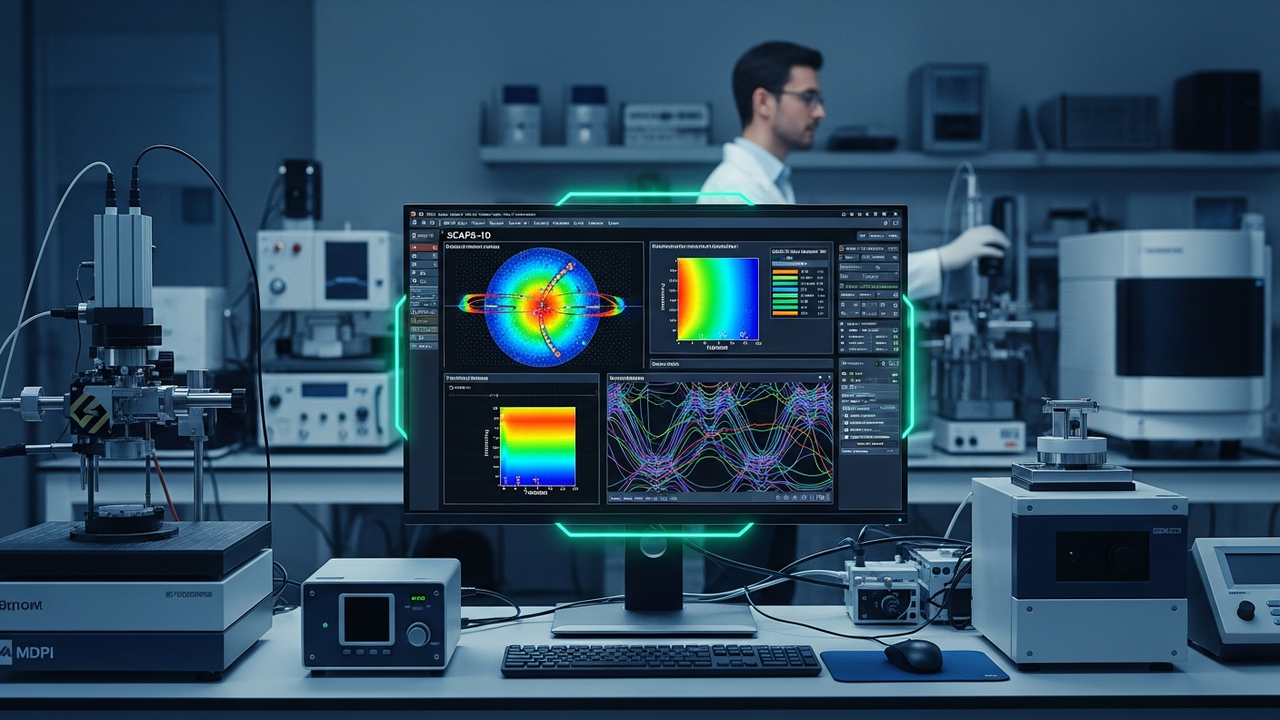
This research utilized SCAPS-1D (Solar Cell Capacitance Simulator in One Dimension) simulations to perform a comprehensive analysis of thermal effects on lead-free CH3NH3SnBr3 perovskite solar cells. The simulations, which covered a temperature range of 270 K to 400 K (-3.15 °C to 126.85 °C), meticulously examined the electrical characteristics and impedance response of the devices. SCAPS-1D’s capability to incorporate temperature-dependent material properties, such as bandgap shrinkage and changes in carrier mobility, was instrumental in this detailed analysis.
The study revealed several critical insights into the temperature dependence of device performance:
- Significant Reduction in Open-Circuit Voltage (Voc): Higher operating temperatures led to a notable decrease in Voc. This reduction is attributed to a combination of factors: increased bandgap shrinkage and intrinsic carrier concentration at elevated temperatures, which diminishes the built-in potential of the p-n junction, and enhanced thermal excitation leading to greater charge carrier recombination.
- Stability of Short-Circuit Current Density (Jsc): In contrast to Voc, the Jsc remained relatively stable across the studied temperature range. Jsc primarily depends on light absorption and charge generation, and while subtle bandgap changes do occur, their impact on the overall light absorption spectrum and subsequent current generation was found to be minimal.
- Complex Behavior of Fill Factor (FF) and Net Decrease in Power Conversion Efficiency (PCE): The fill factor initially showed a slight increase before significantly decreasing at higher temperatures. This ultimately resulted in a substantial net decrease in the power conversion efficiency (PCE). The simulations strongly indicated that the primary driver for this PCE reduction is an increase in charge carrier recombination rates, exacerbated by higher temperatures, alongside an increase in series resistance.
These findings provide clear guidelines for advancing lead-free CH3NH3SnBr3 perovskite solar cells. The study underscores the critical importance of precise thermal control and judicious interface optimization to mitigate recombination losses and enhance device performance and long-term stability. For researchers and engineers, this insight is vital for designing devices that are more thermally robust, capable of operating stably even under challenging environmental conditions. Future research directions will likely focus on developing perovskite compositions with improved intrinsic thermal stability, engineering optimized interfacial layers to suppress recombination pathways, and implementing advanced device architectures for efficient heat dissipation. Such advancements are crucial for accelerating the commercialization of lead-free perovskite solar cells and their widespread adoption in sustainable energy initiatives.
Source: https://www.mdpi.com/2673-4117/7/8/412
Get our weekly technology intelligence — free
Receive an infographic that lets you judge at a glance whether each field’s analysis report is worth reading.
Subscribe Free — Weekly Tech Intelligence
By subscribing, you’ll receive Troy-Technical’s weekly technology intelligence newsletter.
- Your email and selected fields are used only to deliver the newsletter.
- We never share your information with third parties.
- You can unsubscribe anytime via the link in each email.
See our Privacy Policy for details.
Takes about a minute · Unsubscribe anytime