Key Findings
A team of Chinese researchers has successfully engineered a lightweight receiver for drones that efficiently converts laser light into usable electrical power. This innovative tandem device, which combines perovskite and thermoelectric materials, is poised to significantly extend drone flight durations and unlock new possibilities in aerial power supply.
Technical / Clinical Details
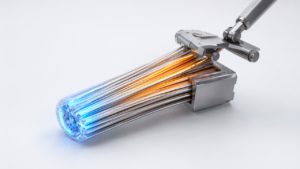
The receiver is primarily composed of two functional layers. The top layer features a perovskite material, which is responsible for absorbing the majority of the incoming laser light to generate electrical current. Perovskites are renowned for their high photoelectric conversion efficiency. Any remaining light energy that is not absorbed, or heat generated within the perovskite layer, is subsequently converted into additional electricity by a thermoelectric material positioned in the bottom layer. This synergistic approach maximizes the energy harvested from the laser light, enhancing the overall efficiency of the device. To further mitigate the risk of overheating, nanorods of antimony selenide are embedded within the perovskite layer. These nanorods not only boost the photovoltaic performance but also function as an internal heat shield, increasing the temperature gradient across the thermoelectric layer and thereby efficiently enhancing its power generation capability.
Background & Context
Drones are seeing expanded use across diverse fields such as logistics, surveillance, agriculture, and disaster response. However, their short battery life and limited flight duration have presented significant challenges, making them unsuitable for long-range missions or extended surveillance tasks. Wireless power transmission, particularly using lasers, has emerged as a promising approach to address drone power supply issues. Nevertheless, critical challenges for practical implementation included the efficiency of laser light conversion and effective management of the heat generated during this conversion. This research offers a high-efficiency and thermally stable solution to these problems.
Strategic Significance & Outlook
The success of this lightweight laser receiver will dramatically enhance drone operational capabilities. Significantly extended flight times will enable drones to undertake broader tasks and longer surveillance missions, creating new value in sectors like logistics, infrastructure inspection, agricultural management, and border security. Future research will focus on further optimizing laser output and receiver efficiency, ensuring safety (particularly the impact of lasers on humans and animals), and developing large-scale power transmission systems. This technology holds the potential to revolutionize future aerial transport and remote operational systems by expanding drone autonomy and application scope.
Get our weekly technology intelligence — free
Receive an infographic that lets you judge at a glance whether each field’s analysis report is worth reading.
Subscribe Free — Weekly Tech Intelligence
By subscribing, you’ll receive Troy-Technical’s weekly technology intelligence newsletter.
- Your email and selected fields are used only to deliver the newsletter.
- We never share your information with third parties.
- You can unsubscribe anytime via the link in each email.
See our Privacy Policy for details.
Takes about a minute · Unsubscribe anytime