Key Findings
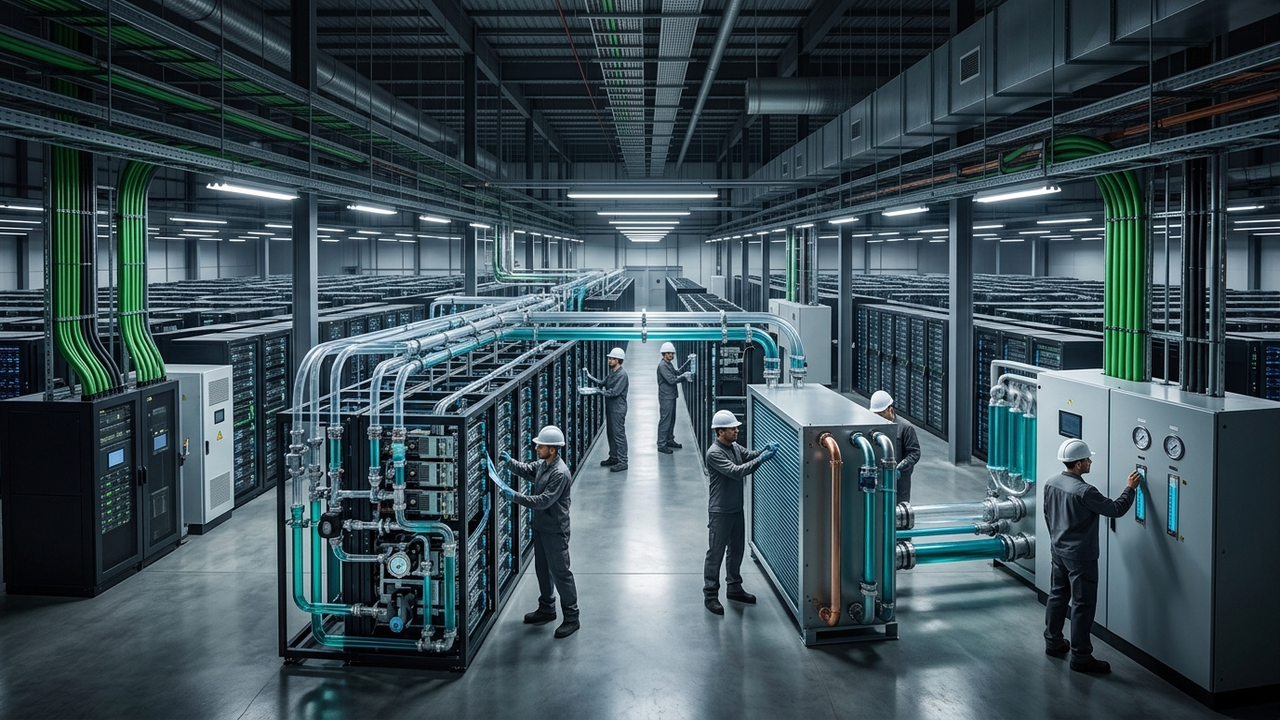
The explosive growth in AI demand is fundamentally restructuring the industrial equipment supply chain and dramatically accelerating investment in data center power and cooling infrastructure. To meet the needs of hyperscalers and cloud providers deploying high-density AI computing facilities, manufacturers of generators, electrical systems, energy storage solutions, and cooling technologies are significantly expanding their production capacities. Crucially, liquid cooling technology is emerging as an indispensable solution for managing the immense heat generated by AI accelerators, with the global AI Data Center Liquid Cooling Market projected to reach a substantial $23.23 billion by 2035.
Technical / Clinical Details
AI workloads are characterized by significantly higher power densities and heat generation compared to traditional servers. It is not uncommon for modern AI GPU clusters, such as those from NVIDIA, to consume over 100kW per rack. To manage these extreme thermal loads, advanced cooling technologies are being deployed:
- Cold Plate Liquid Cooling: This technology directly circulates coolant to heat sources like GPUs, efficiently absorbing heat. It is currently the dominant liquid cooling technique in the AI data center market.
- Immersion Cooling: Involves submerging entire servers in a non-conductive dielectric fluid. While offering the highest thermal density capacity and superior power efficiency, its adoption faces challenges related to initial cost and complexity.
On the power infrastructure front, AI data centers require massive power supply and distribution systems. This includes high-voltage substations to ensure stable supply from the grid, Uninterruptible Power Supplies (UPS) with large-capacity batteries for outages, and robust backup power sources like diesel generators. Energy storage solutions play a vital role in leveling out power supply during peak loads and facilitating integration with renewable energy sources.
Background & Context
Since the advent of generative AI models like ChatGPT, global investment in AI technology has surged. Concurrently, the computational resources required for AI model training and inference have grown exponentially, exceeding the capacities of existing data center infrastructures. The International Energy Agency (IEA) projects that data center electricity consumption will more than double by 2030. Meeting this demand necessitates not only the retrofitting of existing facilities but also the construction of new, higher-performance data centers. This situation fosters collaboration and innovation across the entire ecosystem of semiconductor manufacturers, data center operators, and power/cooling equipment providers.
Strategic Significance & Outlook
The AI data center boom is expected to sustain its growth trajectory for several more years. Liquid cooling technology, in particular, is forecast to become a standard feature in AI infrastructure, with its adoption rate continuing to climb. This will drive further technological innovation aimed at improving the efficiency, cost-effectiveness, and ease of deployment of liquid cooling systems. Stabilizing and ensuring the sustainability of power supply will also be a critical challenge, potentially leading data centers to explore integration with smart grids and adopt novel power generation technologies like Small Modular Reactors (SMRs). The growth in this market presents immense business opportunities across the data center-related industries, forming the foundational bedrock for the next generation of the AI-driven economy.
Get our weekly technology intelligence — free
Receive an infographic that lets you judge at a glance whether each field’s analysis report is worth reading.
Subscribe Free — Weekly Tech Intelligence
By subscribing, you’ll receive Troy-Technical’s weekly technology intelligence newsletter.
- Your email and selected fields are used only to deliver the newsletter.
- We never share your information with third parties.
- You can unsubscribe anytime via the link in each email.
See our Privacy Policy for details.
Takes about a minute · Unsubscribe anytime