Key Findings
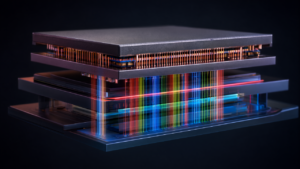
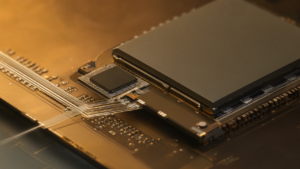
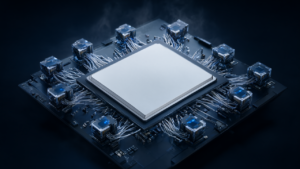
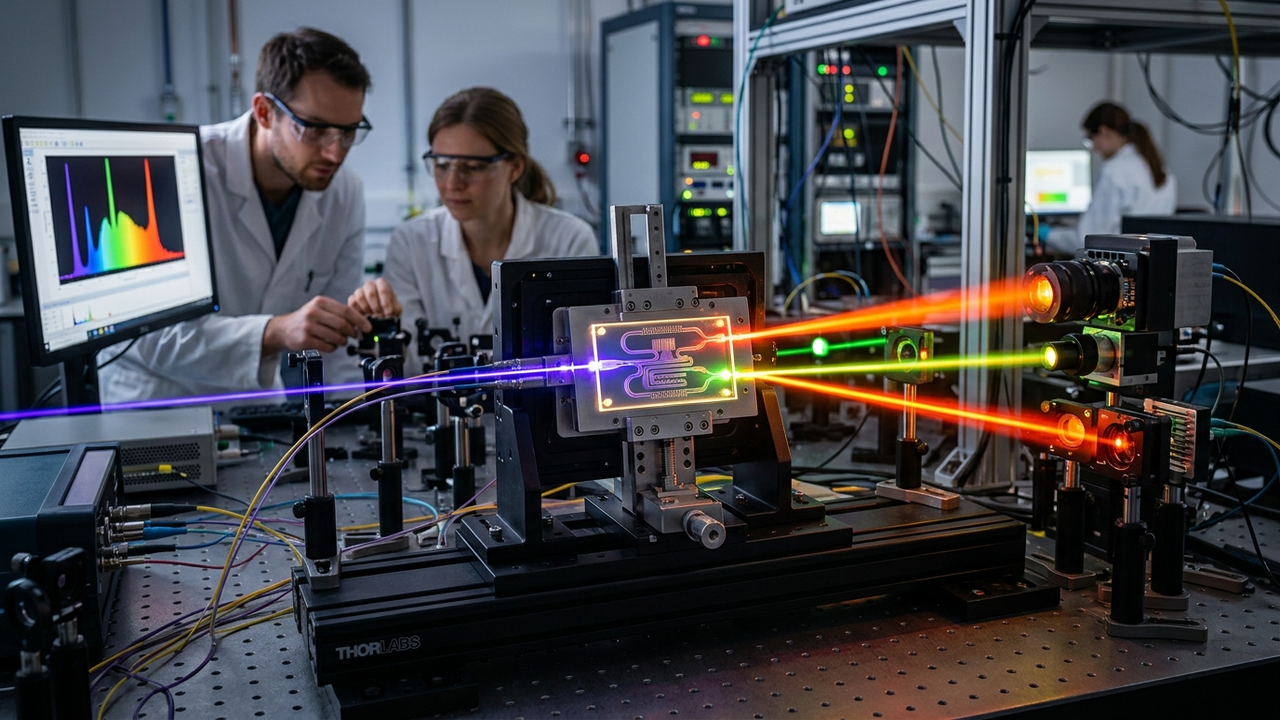
Scientists at the Max Planck Institute have achieved a significant advancement in integrated photonics by developing hybrid photonic chips that combine silicon nitride and quartz (silicon dioxide). The unique architecture features a silicon nitride ring resonator embedded within a quartz cladding, allowing light to efficiently interact with both the high-index core and the surrounding lower-index material. This design enables the generation of novel light colors and frequencies through enhanced nonlinear processes, including Raman scattering and four-wave mixing, paving the way for highly versatile optical devices.
Technical / Clinical Details
The core innovation of these hybrid chips lies in their ability to leverage the complementary optical properties of two distinct materials. Silicon nitride offers excellent nonlinear optical properties and low-loss waveguiding, while quartz provides superior transparency and stability over a broad spectral range. By ensuring intimate light interaction with both materials, a wider array of nonlinear effects can be efficiently induced, leading to superior frequency conversion capabilities. This technology is particularly adept at generating ‘broadband supercontinuum sources,’ which produce a continuous spectrum of wavelengths from a single laser input, finding applications in sensing, metrology, and spectroscopy. It also contributes to the realization of ‘self-referenced frequency combs,’ crucial for high-precision optical frequency measurements and atomic clocks.
Background & Context
In various fields such as optical communications, sensing, metrology, and quantum technologies, there is a constant demand for precise control over light properties and efficient generation of specific wavelengths and frequencies. Traditional photonic chips, based on a single material, often face inherent physical limitations in efficiently inducing certain nonlinear optical phenomena. The Max Planck Institute’s hybrid approach overcomes these limitations by synergistically merging the advantages of different materials. This represents a new paradigm for achieving higher performance and multifunctionality in optical devices, showcasing significant progress in material science and device design within integrated photonics.
Strategic Significance & Outlook
The development of these hybrid photonic chips holds immense potential for expanding the applications of nonlinear photonics. Devices like broadband supercontinuum sources and self-referenced frequency combs are indispensable tools for scientific research, industrial process control, medical diagnostics, and precise time and frequency synchronization in telecommunications infrastructure. The work by the Max Planck scientists is expected to contribute to the realization of more compact, robust, and high-performance light generation and control devices, significantly impacting the evolution of next-generation optical technologies. In the future, these chips could also play a role in increasing the capacity of optical communication networks and building new quantum information processing platforms.
Get our weekly technology intelligence — free
Receive an infographic that lets you judge at a glance whether each field’s analysis report is worth reading.
Subscribe Free — Weekly Tech Intelligence
By subscribing, you’ll receive Troy-Technical’s weekly technology intelligence newsletter.
- Your email and selected fields are used only to deliver the newsletter.
- We never share your information with third parties.
- You can unsubscribe anytime via the link in each email.
See our Privacy Policy for details.
Takes about a minute · Unsubscribe anytime