Key Findings
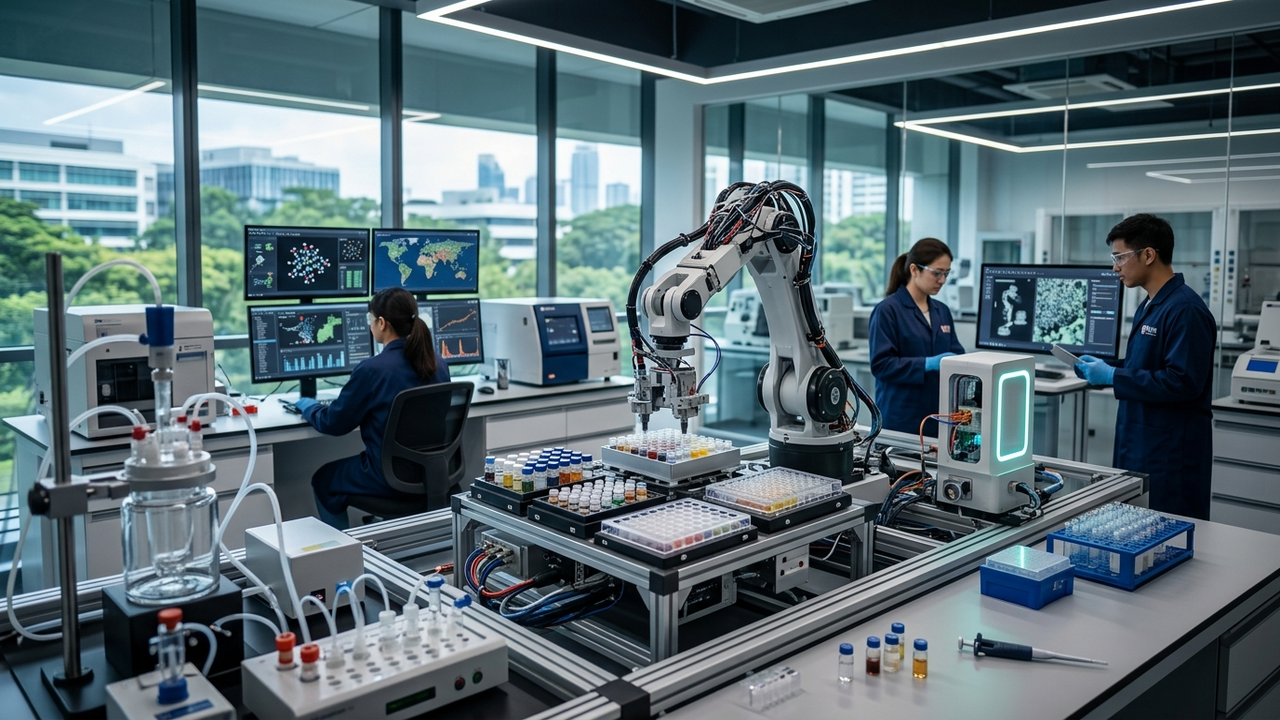
The National University of Singapore (NUS) has announced the establishment of an ‘AI Foundry,’ spearheaded by Professor Shyue Ping Ong, which combines artificial intelligence, vast scientific datasets, and advanced automated experimental systems. This groundbreaking platform aims to drastically shorten the new material discovery cycle from traditional timelines measured in months to just weeks, ushering in a new era for materials science research.
Technical / Clinical Details
The AI Foundry initiates its process with AI models that learn from extensive materials science data to autonomously propose promising material candidates with specific desired functionalities. Subsequently, these proposed materials are rapidly synthesized and characterized by automated robotic systems, minimizing human intervention. The experimental results are immediately fed back into the AI models, enabling them to learn and propose optimal experimental conditions or material compositions for the next iteration. This closed-loop, iterative optimization cycle significantly boosts the efficiency of material exploration, making it possible to discover complex material systems that were previously challenging to identify using conventional methods.
Background & Context
The discovery and development of new materials are fundamental to innovation across diverse industrial sectors, including energy, electronics, and medicine. However, traditional materials science research has historically relied on time-consuming and costly trial-and-error processes, acting as a bottleneck for discovery. The convergence of AI, robotics, and high-performance computing, often referred to as ‘materials informatics,’ is emerging as a solution to this challenge, enabling faster and more efficient material development. NUS’s AI Foundry is positioned to establish global leadership in this transformative field.
Strategic Significance & Outlook
The NUS AI Foundry is not only poised to significantly accelerate the pace of new material development but also to provide researchers with novel tools to tackle more complex and challenging material problems. In the future, this platform is expected to serve as a hub for international collaboration, accelerating the creation of breakthrough materials that address global challenges such as sustainable energy solutions, advanced medical devices, and high-performance computing components. Through this initiative, Singapore is further solidifying its position at the forefront of scientific and technological innovation.
Source: https://cde.nus.edu.sg/news/building-an-ai-foundry-to-transform-materials-discovery/
Get our weekly technology intelligence — free
Receive an infographic that lets you judge at a glance whether each field’s analysis report is worth reading.
Subscribe Free — Weekly Tech Intelligence
By subscribing, you’ll receive Troy-Technical’s weekly technology intelligence newsletter.
- Your email and selected fields are used only to deliver the newsletter.
- We never share your information with third parties.
- You can unsubscribe anytime via the link in each email.
See our Privacy Policy for details.
Takes about a minute · Unsubscribe anytime





Comments