Key Findings
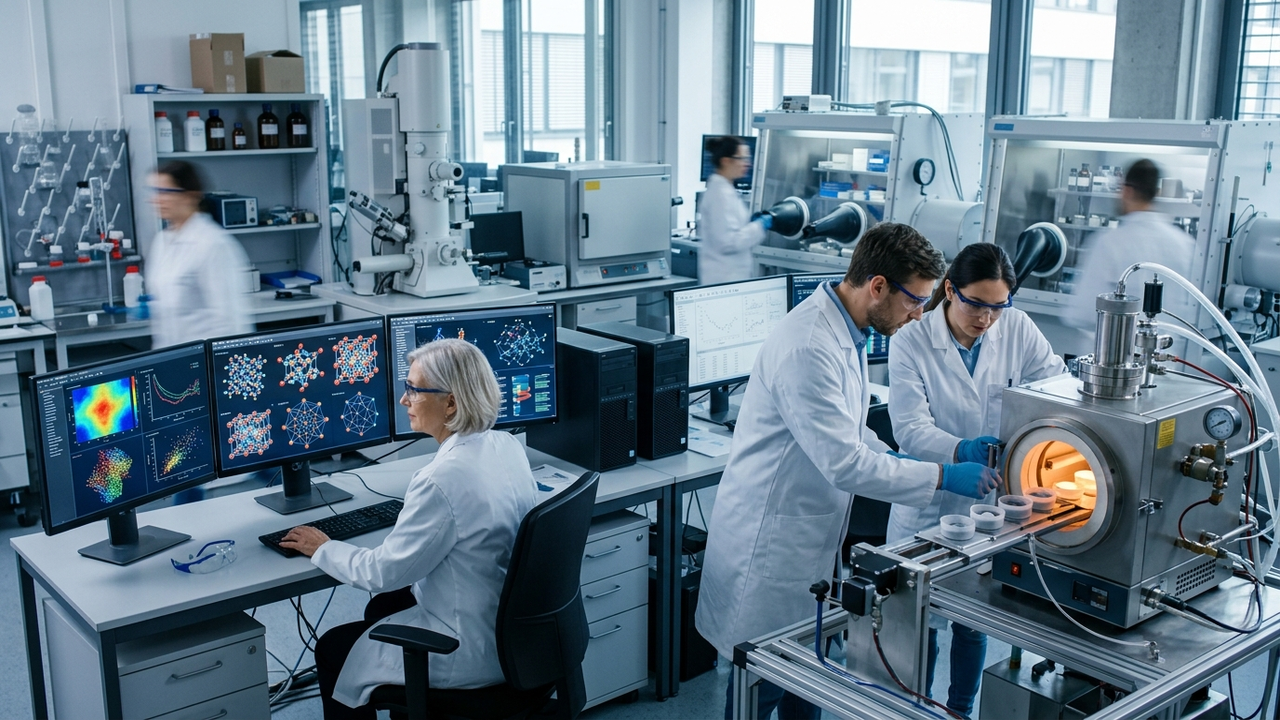
Researchers have successfully discovered groundbreaking lead-free dielectric materials with high-temperature stability by employing an artificial intelligence (AI)-driven reverse design approach. This method integrates multimodal literature mining with physics-based machine learning, efficiently pinpointing just 37 promising candidate materials from an initial virtual compositional space of 150 million possibilities.
Technical / Clinical Details
At the core of this research is AI’s ability to extract relevant information from vast scientific literature and learn complex relationships among material composition, structure, and properties. Multimodal literature mining analyzes diverse information formats—text, figures, and data tables—to construct a comprehensive knowledge graph in materials science. Based on this knowledge graph, physics-based machine learning models predict key properties of dielectric materials, such as dielectric constant, loss tangent, and Curie temperature. In the reverse design approach, the AI autonomously ‘designs’ materials that satisfy target properties like high-temperature stability and lead-free composition. From an initial pool of 150 million virtual material candidates, the AI evaluated physical feasibility, stability, and suitability for the target properties, ultimately downselecting to the 37 most promising candidates. This highly curated set of materials will proceed to experimental synthesis and validation, significantly de-risking the R&D process.
Background & Context
Modern electronic devices demand miniaturization, higher integration, and operation in high-temperature environments, making high-performance dielectric materials indispensable. Simultaneously, increasing environmental regulations, such as the RoHS directive, necessitate a rapid transition away from hazardous lead-containing materials. Traditional lead-free dielectrics have often suffered from inferior high-temperature stability or dielectric performance compared to their lead-based counterparts, posing a critical challenge for the electronics industry. AI-driven materials discovery emerges as a powerful solution, capable of identifying new materials that meet such complex requirements far more efficiently than conventional trial-and-error approaches. This research stands as a concrete example of AI expanding the frontiers of materials design and contributing to sustainable technological development.
Strategic Significance & Outlook
The 37 lead-free dielectric candidates identified by AI hold significant potential to impact next-generation electronic components, including power electronics, sensors, and capacitors, where high-temperature operation is crucial. The success of this reverse design approach suggests its applicability to the exploration of other functional materials (e.g., piezoelectrics, ferromagnetics), highlighting the versatility of AI in materials science. In the future, this AI-driven platform is expected to be integrated into a ‘closed-loop’ materials discovery ecosystem, autonomously managing everything from material design to synthesis and characterization. This will further reduce development times and costs, accelerating the introduction of more innovative, eco-friendly materials to the market globally. This represents a vital step towards reconciling environmental protection with sustainable industrial growth.
Source: #
Get our weekly technology intelligence — free
Receive an infographic that lets you judge at a glance whether each field’s analysis report is worth reading.
Subscribe Free — Weekly Tech Intelligence
By subscribing, you’ll receive Troy-Technical’s weekly technology intelligence newsletter.
- Your email and selected fields are used only to deliver the newsletter.
- We never share your information with third parties.
- You can unsubscribe anytime via the link in each email.
See our Privacy Policy for details.
Takes about a minute · Unsubscribe anytime







Comments