Key Findings
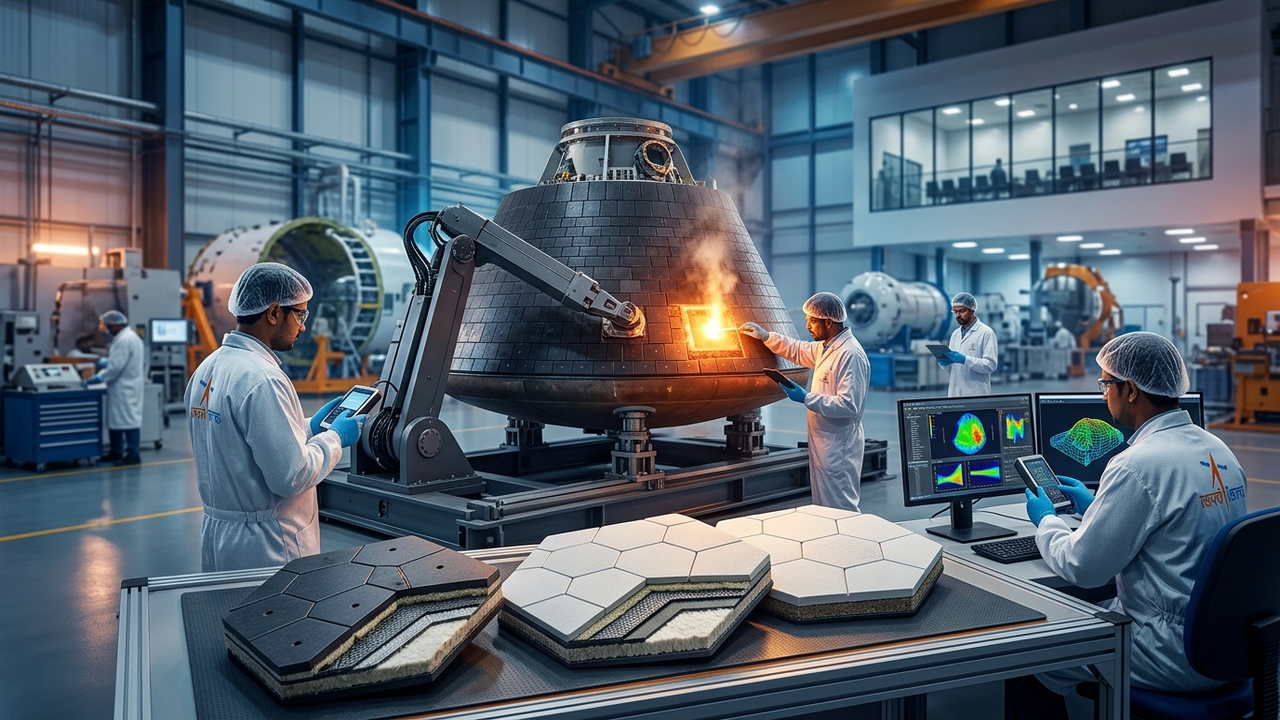
The Indian Space Research Organisation (ISRO) has released comprehensive details regarding the Thermal Protection System (TPS) for its Gaganyaan crew module, a critical component for India’s inaugural human spaceflight mission. This sophisticated TPS is engineered to safeguard the spacecraft and its occupants from the intense aerodynamic heating and thermal fluxes experienced during atmospheric re-entry, capable of enduring external temperatures reaching 1800°C while maintaining the internal cabin environment at a safe 150°C or below.
Technical / Clinical Details
The Gaganyaan TPS employs an ablative design, leveraging specialized composite materials such as carbon phenolic and silica phenolic tiles. Upon exposure to the extreme heat of re-entry, the outer layers of these materials undergo a controlled sacrificial decomposition (ablation), absorbing and dissipating thermal energy. The byproducts of this ablation form a boundary layer that further insulates the spacecraft, effectively preventing heat transfer to the primary structure. This method ensures maximum thermal protection with minimal structural weight, a crucial factor for mission efficiency and crew survival. The robust performance parameters, including resistance to 1800°C re-entry temperatures and strict internal temperature control, underscore the advanced material science and engineering applied in its development.
Background & Context
The Gaganyaan mission represents India’s ambitious endeavor to achieve independent human spaceflight capability, with a target of sending three astronauts into low Earth orbit (LEO) by 2025. The development of a reliable TPS is paramount to the mission’s success, directly impacting the safety of the crew during the most hazardous phase of space travel. This public disclosure of TPS specifics comes as ISRO progresses with unmanned test flights, including the TV-D1 mission, demonstrating the maturity and readiness of India’s space technology. Globally, only a handful of nations possess human spaceflight capabilities, and India’s advancements in this domain are pivotal for solidifying its position as a major space power.
Strategic Significance & Outlook
The successful development and validation of this TPS technology significantly enhance the safety and reliability of the Gaganyaan mission, bolstering India’s confidence in its human spaceflight program. Looking ahead, this foundational technology has broad applicability for future deep-space missions, including lunar and Martian exploration, where re-entry into planetary atmospheres is a key challenge. Furthermore, the expertise gained in ablative materials and thermal management is invaluable for the development of reusable launch vehicles (RLVs), contributing to reduced costs and increased frequency of space access. This achievement not only propels India’s indigenous space capabilities but also positions it for greater collaboration within the international space community, potentially offering advanced re-entry solutions for global missions.
Source: https://www.insightsonindia.com/2026/08/21/the-thermal-protection-system-tps/
Get our weekly technology intelligence — free
Receive an infographic that lets you judge at a glance whether each field’s analysis report is worth reading.
Subscribe Free — Weekly Tech Intelligence
By subscribing, you’ll receive Troy-Technical’s weekly technology intelligence newsletter.
- Your email and selected fields are used only to deliver the newsletter.
- We never share your information with third parties.
- You can unsubscribe anytime via the link in each email.
See our Privacy Policy for details.
Takes about a minute · Unsubscribe anytime






Comments