Key Findings
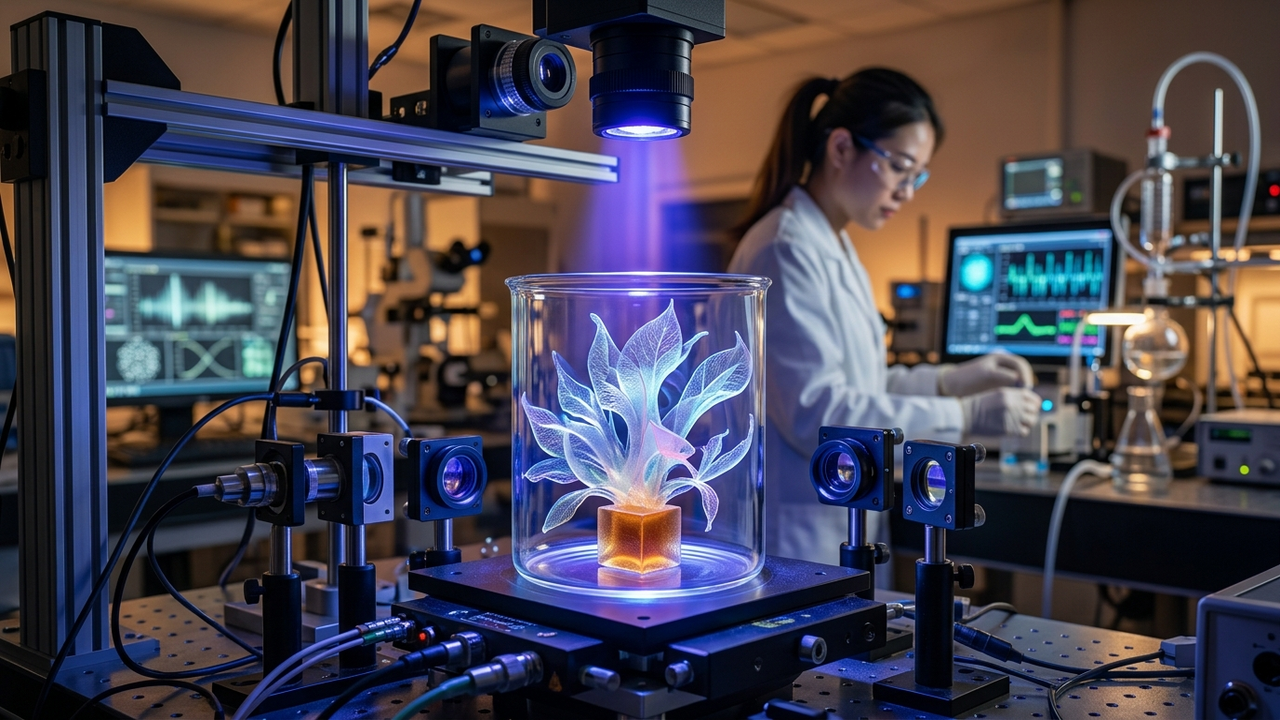
Researchers at the University of Science and Technology of China have developed an innovative photoresponsive hydrogel that can expand by over 80,000% within just 40 seconds using only light as its energy source, enabling complex and extreme shape transformations. This novel material can be repeatedly programmed into various 3D shapes, such as helices and twists, even after fabrication, opening unprecedented possibilities for spatiotemporal control in smart materials and soft robotics.
Technical / Clinical Details
This hydrogel is composed of a polymer network specifically designed to change its internal structure in response to particular wavelengths of light. Upon light irradiation, molecular-level changes, such as the swelling of hydrophilic segments and contraction of hydrophobic segments within the hydrogel, are induced. These microscopic changes lead to dramatic macroscopic volume changes and shape deformations. The research team demonstrated that this material can precisely and reversibly alter its shape based on specific light patterns, intensity, and duration. For example, by simply changing how light is applied, a flat sheet can transform into a complex helical structure or mimic the grasping motion of a robotic arm. This controlled, extreme expansion and contraction capability significantly outperforms existing responsive materials.
Background & Context
In the fields of smart materials and soft robotics, the development of materials that can change their shape and function in response to external stimuli has been a long-standing goal. There is a growing demand for more flexible and adaptable devices in various application areas, including medical (drug delivery, minimally invasive surgery), exploration (working in hazardous environments), and consumer products. However, previous responsive materials have been limited by their response speed, deformation magnitude, reproducibility, and ability to achieve complex shape control. This new hydrogel has the potential to overcome these challenges simultaneously.
Strategic Significance & Outlook
The development of this photoresponsive hydrogel is poised to revolutionize diverse fields such such as soft robotics, biomimetic devices, smart actuators, and self-assembling structures. Light-based, non-contact, high-precision shape control enables cleaner, faster, and more localized manipulation compared to conventional methods using electromagnetic, thermal, or chemical stimuli. In the future, this technology could form the basis for self-deploying space structures, micro-robots that release drugs within the body, or smart camouflage that changes color and shape in response to environmental conditions. For investors and researchers, this material with unprecedented performance will attract significant attention for its potential to create new product categories and markets.
Get our weekly technology intelligence — free
Receive an infographic that lets you judge at a glance whether each field’s analysis report is worth reading.
Subscribe Free — Weekly Tech Intelligence
By subscribing, you’ll receive Troy-Technical’s weekly technology intelligence newsletter.
- Your email and selected fields are used only to deliver the newsletter.
- We never share your information with third parties.
- You can unsubscribe anytime via the link in each email.
See our Privacy Policy for details.
Takes about a minute · Unsubscribe anytime








Comments