Key Findings
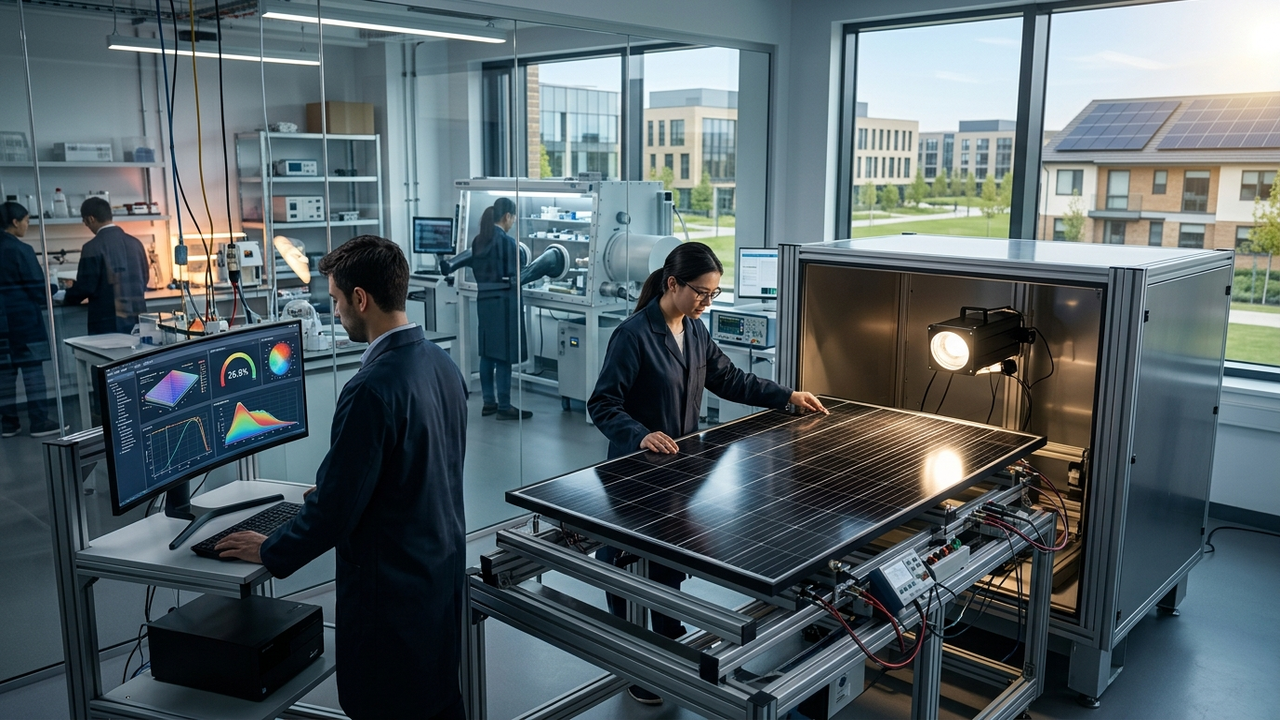
Oxford PV, a pioneering spin-off from Oxford University, has achieved a record-breaking 26.9% conversion efficiency for residential-sized solar panels, demonstrating the practical superiority of perovskite technology. Simultaneously, a research team at the University of Queensland in Australia successfully developed a tin-based, lead-free perovskite solar cell that maintained 16.65% efficiency and stable performance for over 1,000 hours, secured through the addition of an antioxidant. These dual achievements signify that perovskite solar cells are advancing not only in efficiency but also in addressing environmental concerns and long-term reliability.
Technical / Clinical Details
Oxford PV’s 26.9% efficient panel utilizes a tandem structure where a perovskite layer is stacked on top of existing silicon solar cell technology. This ‘miracle material’ perovskite efficiently absorbs shorter-wavelength light that silicon struggles with, dramatically boosting the overall photoelectric conversion efficiency. This approach enables the utilization of a broader portion of the solar spectrum, maximizing power generation per unit area. In parallel, the University of Queensland’s research focused on lead-free perovskites, primarily using tin (Sn), which are crucial for addressing environmental toxicity concerns. The main challenge with tin-based perovskites has been their susceptibility to oxidation, leading to stability degradation. The research team successfully mitigated this by incorporating antioxidants (e.g., specific organic molecules or inorganic salts), which inhibited tin oxidation and significantly improved cell stability. This resulted in a breakthrough for lead-free perovskites, demonstrating 16.65% efficiency while maintaining nearly initial performance for over 1,000 hours.
Background & Context
Perovskite solar cells are considered a next-generation technology with the potential for higher efficiency and lower manufacturing costs than silicon PV. Oxford PV’s achievement proves that this technology can deliver high performance not just at a laboratory scale but also in practical residential applications. Research into lead-free perovskites is essential to alleviate concerns about the toxicity of lead traditionally used in perovskite materials. The University of Queensland’s breakthrough represents a crucial step towards developing environmentally friendly yet commercially viable perovskite solar cells. These advancements collectively underscore the evolution of solar PV technology in both efficiency and sustainability, influencing the overall direction of the industry.
Strategic Significance & Outlook
Oxford PV’s 26.9% efficient residential panels will contribute to reducing the installation footprint of solar power systems and increasing energy yield, thereby improving the cost-effectiveness of home energy solutions. This could accelerate the adoption of residential solar PV. The enhanced stability of the University of Queensland’s lead-free technology addresses environmental concerns surrounding perovskite solar cells, fostering broader market acceptance. As these technologies scale up for mass production and become cost-competitive, perovskite solar cells are expected to play a significant role as an alternative or complement to conventional silicon solar cells in the renewable energy market. Particularly, the dual achievement of lead-free composition and high efficiency will be a powerful driver toward realizing a sustainable energy future.
Get our weekly technology intelligence — free
Receive an infographic that lets you judge at a glance whether each field’s analysis report is worth reading.
Subscribe Free — Weekly Tech Intelligence
By subscribing, you’ll receive Troy-Technical’s weekly technology intelligence newsletter.
- Your email and selected fields are used only to deliver the newsletter.
- We never share your information with third parties.
- You can unsubscribe anytime via the link in each email.
See our Privacy Policy for details.
Takes about a minute · Unsubscribe anytime




Comments